Two letters published recently by the Roanoke Times serve to illustrate the wide gap remaining between opponents of and advocates for industrial wind. On the one side is a letter written by Ms. Annie Krochalis, a private citizen local to the area, expressing concern at the intrusion of industrial wind into her life and the dismal contribution it would provide to the energy needs of the community. On the other, in what would seem a horrible mismatch, Michael Goggin, the Manager of Transmission Policy for the wind industry’s powerful and well funded trade association, the American Wind Energy Association, attempts to counter her statements.
One of the difficulties with hard print is that the last letter published seems to always have the advantage. It is difficult in the print news format to have a timely exchange of ideas, so the last word becomes, by default, simply that – the last word.
In an attempt to remedy that issue, at least for this instance, this post will expand on the points raised by Ms. Krochalis, and Mr. Goggin’s response. One thing you may note is, having been dismissed as “another victim of the fossil fuel propaganda campaign,” Ms. Krochalis is in excellent company.
Let us first take a look at each letter as it arrived and then discuss a bit.
First this, from Ms. Krochalis:
Thursday, July 08, 2010
Annie Krochalis
Krochalis is a freelance writer living in Bent Mountain and director of the Paw and Whisker.
The vision of harnessing the wind to replace fossil fuel sources is seductive, but like Odysseus sailing past the Sirens, it is a seduction that takes us away from the true journey. It is not a choice between wind and mountaintop removal. It is a choice between corporate subsidies and community. Industrial wind turbines are a gift like the Trojan Horse; once in the gates, there is hidden danger.
Industrial wind turbines such as those proposed for Poor Mountain do not significantly offset coal-powered electricity or CO2 emissions. J. Boone’s “Less for More: The Rube Goldberg Nature of Industrial Wind Development” explains that industrial wind energy does not reduce greenhouse gas emissions. In “Wind Power or Hot Air?” Dave Erb discusses the situation in western North Carolina.
Industrial turbines rely on the grid to operate and intermittently send electricity to the grid. Thus, the power plant may need to vary the degree of operation, slowing a bit and speeding up now and then. This actually increases emissions as the plant moves from standby to full operation. Low output speeds use more power. Wind power is not a steady supply, varying with wind presence and strength. The coal-fired power plant will remain as the first feeder to the grid. The input of wind power is negligible and measurement of output must include subtracting the actual use of electricity by the turbines.
Electricity is used from the grid to keep blades perpendicular to the assembly and prevent bowing of the structure. Electricity is also required to keep a desirable blade temperature, to provide a dehumidifier and heat/cooling to the gearbox and nacelle, for magnetizing the stator (coil system) and operating the generator.
Turbines use a generator as a motor to keep blades turning even if there is no wind available. The amount of coal-powered electricity may be supplemented by wind, but it is not true in reverse — coal power operates wind turbines for a questionable amount of return. The market is supported by energy credits to corporate suppliers who charge higher prices for wind energy that cannot be distinguished from coal-powered energy in the grid — an important fact considering that turbines generally produce only 25 percent of their rated capacity.
If we look to longer term wind-power locations, such as Great Britain and Denmark, we find real disillusionment with the experience. Details of this are discussed by Glenn Schleede in “The Naked Truth About Wind Power.“
Denmark struggles with meeting demand using a dual source system of wind and existing grid source power. Niels Sandøe, writing in the Danish newspaper, Jyllands Posten, says, “if this balance is not achieved, there will be an automatic disconnection of either supply (to prevent physical damage to generating plant) or of loads (blackouts). Conventional plants have to be run in conjunction with the unpredictable wind generators and their output varied in order to provide a cushioning effect.”
In the UK, the reliance on windfarms for the renewables sector prevents meeting the government’s targets for CO2 reduction from power generation.
The Invenergy proposal does not provide a way to store wind power not accepted by the grid. That power will be sent into the land. This is a dangerous practice, as the current then seeks a ground — be it metal, human or someone’s cattle. The turbines are locked down by an electric/hydraulic brake when wind reaches 55 mph. The site is labeled Class 3 for wind, the lowest possible score for any siting. It is located between the Nature Conservancy’s Bottom Creek Gorge and the Poor Mountain Preserve.
Invenergy has asked to buy land to widen the road for their construction. Existing roads are 600-level rural roads, ending in dirt and gravel roads to the top of the mountain.
Industrial wind power does not reduce the horrors of mountaintop removal mining because it does not reduce our reliance on a coal-fired grid. Sadly, it gives corporations a way to qualify for renewable portfolio standards credits and subsidies at the expense of mountain eco-systems and communities.
This is a project dealing in tax credits and not in energy. Once again, the Appalachians are being exploited by big coal and its new partner, the Chicago Energy Exchange where RPS credits are traded.
Letter ends!
(Allegheny Treasures Note: We’ve taken the liberty to provide links to articles referenced in Ms. Krochalis’ letter.)
Mr. Goggin’s reply:
Thursday, July 15, 2010
Michael Goggin
Goggin is the manager of transmission policy for the American Wind Energy Association in Washington, D.C.
As wind energy use has grown — it accounted for nearly 40 percent of the newly installed power generating capacity in each of the last three years — the increasingly desperate, well-funded fossil fuel lobby has resorted to misinformation to delegitimize it.
Annie Krochalis’ July 8 commentary, “Wind energy is a sham,” suggests she is yet another victim of the fossil fuel propaganda campaign. The truth is that wind energy is creating tens of thousands of American jobs, cleaning our air, reducing our dependence on fossil fuels and lowering consumers’ electric bills. To respond directly to errors and misleading statements in Krochalis’ piece:
n Wind and fossil fuel use and emissions: Dozens of government studies validate the unsurprising conclusion that, as wind energy is added to the power grid, fossil fuel use and emissions at fossil fuel plants go down. U.S. Department of Energy data for Colorado show that as wind energy grew from providing 2.5 percent of Colorado’s electricity in 2007 to 6.1 percent in 2008, carbon dioxide emissions fell by 4.4 percent, nitrogen oxide and sulfur dioxide emissions fell by 6 percent, coal use fell by 3 percent (571,000 tons), and electric-sector natural gas use fell by 14 percent.
Comparable data exist for Texas and each of the other five major grid-operating areas in the U.S. To ignore this data and claim that adding wind energy to the power grid will not reduce the output from other types of power plants ignores the laws of physics that say that energy cannot be destroyed.
n Electric demand for power plant components: Krochalis seems confused on this point, because fossil fuel power plants, not wind turbines, use a significant share of their electric output to run auxiliary power plant equipment. Today’s coal-powered plants use between 5 and 10 percent of their electric output to run auxiliary equipment, and that percentage is several times higher for proposed clean-coal power plants. In contrast, wind turbines typically use less than 1 percent of their output for auxiliary loads.
Similarly, Krochalis’ odd claim that electric motors are used to turn wind turbines when the wind speed is low is simply fictional. Her later claim that a wind turbine will send excess electrical power into the ground when output is too high is also false. In fact, just a sentence later she contradicts herself by noting that a hydraulic mechanism is used to limit wind turbine output if needed.
n European experience with wind energy: It’s fitting that Krochalis cites Denmark, since that country’s experience is a great success story. Denmark now derives more than 20 percent of its electricity from wind energy, which has allowed the country to cut its electric-sector carbon dioxide emissions in half over the last 20 years while still increasing electricity use.
Almost as impressive, Germany, Spain, Portugal and Ireland all obtain around 10 percent of their electricity from wind energy.
Given that America’s wind resources are much higher quality (50 percent better) than Europe’s and much more plentiful (enough to meet U.S. electric demand at least 10 times over), our achievements should far surpass Europe’s, should we choose to use those resources.
Mr. Goggin’s letter ends!
As we said earlier, Mr. Goggin’s letter seems, by its sequence, to conclude the discussion. But again, we think allowing that to stand would be a disservice to the discussion and a missed opportunity to expand on Ms. Krochalis’ effort. We recognize that the AWEA has a distinct advantage in any argument, not based in facts certainly, but in the amount of money it can throw at marketing and lobbying efforts in its attempt to dismiss any counter argument, especially those brought by private citizens.
But thankfully, there is a great reserve of well informed individuals speaking out against the wind lobby’s efforts to place these poor performing, unreliable tax shelters across our landscape. A few of the individuals Ms. Krochalis refers to in her letter are, in fact, folks we at Allegheny Treasures quote widely. What we find remarkable is that the great majority of learned individuals who oppose industrial wind on its merit have no financial interest in the outcome, as opposed to organizations such as the AWEA and its employees. As Mr. Jon Boone of Stop Ill Wind points out, the “AWEA is a trade operation seeking to sell a particular brand of soap–and is in the game solely because it is financially beholden to the perception of wind technology as a successful enterprise. So much for dispassionate analysis, or the scientific premise that requires the elimination of bias.”
So what do we make of Mr. Goggin’s challenge to Ms. Krochalis’ letter? Not to worry, it appears she is in good company. Seems Mr. Goggin, who joined the AWEA in 2008, also saw fit recently to challenge Robert Bryce’s new book, Power Hungry. Mr. Bryce, having written articles on energy for major publications since 1989 offers an excellent assessment of “The myths of green energy and the real fuels for the future,” but, as you might suspect, Mr. Goggin is obviously not appreciative of Mr. Bryce statements regarding the failures of industrial wind. If you read Mr. Goggin’s review, you’ll find Jon Boone’s review of the book an excellent counterpoint. We’ll have another post shortly about Mr. Boone’s thoughts of Mr. Goggin’s review.
Understanding that it’s always helpful to allow a person’s own words to speak for them and, rather than simply jump in to support Ms. Krochalis as I’m tempted to do, I refer readers to an article written by Mr. Goggin just a year ago. His writing contains much of the same argument raised in response to Ms. Krochalis as well as some additional commentary. I choose not to fill this page with Mr. Goggin’s commentary, since it differs little from the AWEA boilerplate so near and dear to you, but link it here for you, and highly recommend you go to the link and read it.
What is extremely educational and wonderfully supportive of Ms. Krochalis’ statements is the comment section which follows Mr. Goggin’s “Wind, Backup Power and Emissions.” I am privileged to have personally corresponded with and posted the work of several of the readers who commented on this piece and found the interchange extremely informative. I’ve included the comments here for your convenience. Again, go to the Energy Pulse site to see it in its full context, but, for now you may want to just follow the discussion as it evolves:
What struck me was how Mr. Goggin drifted away from the conversation centered on his own article, never really seeming to take control. It appeared to me that he might have been playing out of his league and found that simply tossing a few links at the discussion of reality wasn’t enough to persuade these experienced and seasoned individuals, armed with facts and logic to support their position. I was quite surprised that his comment effort actually ceased and, unlike his letter to the Roanoke Times, his word was not the last in a venue which actually permitted it to be so.
In fact, in a similar interactive comment discussion in which Mr. Goggin inserted himself, resulting from this article just weeks later, we note this invitation from Tom Stacy to Michael Goggin, “Any time AWEA, Michael Goggin et al would like to have a live, televised debate, I’ll grab my buds from PJM, DOE, ASME, California Energy Commission, NRECA and the rest, and see how far AWEA gets arguing on promises of a wind powered America. I offer this idea up every so often, but AWEA never responds. I wonder why? Michael? As you might suspect, no reply.
So, as you can see in the striking exchange resulting, again, from his own article, no longer was it enough to simply draw three or four sentences selectively chosen from the Department of Energy web site to construct a fairy tale conclusion. These folks were not going to accept woulda, shoulda, coulda, might and maybe as factual performance measures. They keep asking for data, facts, performance records … yes transparency! Where is the actual data to support Mr. Goggin’s claims?
While Mr. Goggin continues to call out selective percentages and phrases from the IEA web site to build a performance case from nothing, I suspect he will not present this comment from the US Energy Information Agency’s own Electric Power Industry 2008: Year in Review: “The increases in installed wind capacity are reflected in the reduced performance of renewable resources in aggregate, as measured by a composite capacity factor. The variable, intermittent nature of wind as an energy source leads to a low capacity factor relative to biomass, as wind is only available for generation subject to prevailing wind conditions. Renewable generation other than hydroelectric had a 37.3-percent capacity factor in 2008. This is a significant decrease from the 59.1 percent achieved in 2000, at which time the category was dominated by wood, wood-derived fuels, and other biomass, all of which are dispatchable energy sources. The continuous decline in the average capacity factor for all non-hydroelectric renewable resources is consistent with the significant growth of wind capacity relative to other forms of renewable electricity generation.”
Ranking perhaps only second to Disney, the AWEA will find a creative way to turn the descriptive “reduced performance,” “intermittent nature,” “low capacity factor,” “only available,” “significant decrease,” and “continuous decline” into positives. Heck, they might even convince some folks that “dispatchable energy sources” are just so over-rated! We wouldn’t be at all surprised if the AWEA somehow used this assessment as an argument for additional government funding and increased tax incentives.
Oh, by the way … would you like to see the “bang for your wind subsidy buck?”
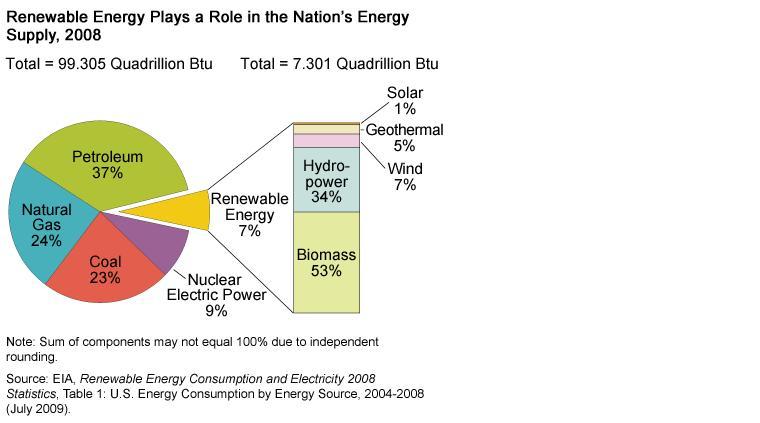
Think of it! With thousands of 747 size tinker toys covering our landscape today and billions invested in wind, we’re still only talking 7% of 7%? How many hundreds of thousands of the massive turbines will be required to meet “20% in 2030” or whatever the latest political pipe dream happens to be? And, if the 20% is based on installed capacity, that’s bad enough! If you have to meet a 20% goal based on actual power generation from these clunkers, you will have to quadruple even that massive number of turbines.
As we’ve suggested many times, ignorance is the wind industry’s best friend. Ms. Krochalis’ letter and letters from other private citizens are so very important in raising issues that demand attention. They serve not only to educate the public, but to inform the political debate. Politicians need to be informed about the negatives of industrial wind. As we’ve suggested, once informed, should politicians continue to support industrial wind with your tax dollars – vote them out!
And finally, take heart Ms. Krochalis! You are not alone in this battle against the wind juggernaut. As citizens become informed of the facts, they see beyond the boilerplate hype and green movement slogans hijacked by this high cost / low benefit industry and begin to ask questions the wind industry lobby dare not answer. The network of rapidly expanding citizen groups forming to counter the unsubstantiated claims of the wind industry will support you.
As we said, without question the wind industry has a large pile of cash to market against opponents. But in reality, as you have witnessed first hand, lacking facts to support their claims, all that money simply buys more smoke and larger mirrors.
As we stated here before, “the greatest threat to the wind industry’s growth is, in fact, the wind industry’s growth.” For when our government finally realizes the hefty tax subsidies yield so little in return, subsidies will cease. Without subsidies, the industry simply cannot exist.
(Allegheny Treasures wishes to take this opportunity to thank the many individuals who have been so generous with their talent and time, and in particular to Jon Boone, who continues to serve as a major resource to our continuing education.)


 Allegheny Treasures