Dear State and Local Official representing Mineral County, West Virginia,
Subject: Pinnacle Wind project – focus on jobs, economic development and tax revenue.
After a grand skirmish on both sides, the rising towers make it clear the Pinnacle wind project you supported is well underway. It would seem a perfect time to move on to other topics.
Sadly, experience from across this country shows that folks initially opposed to a wind project often continue to feel so even after completion. As example, many of our citizens still think the community has been duped and, unless evidence to the contrary is provided, will continue to rail against the project. Happily, you folks are in an excellent position to defuse this mistrust by confirming that the project benefits you touted are, in fact, real.
You must agree that providing measurable results to confirm your promotional rhetoric could serve to calm fears. Gathering information to confirm your claims should be relatively simple since the developer has to be chomping at the bit to confirm the claims as well.
Of the three issues mentioned in the subject line above, Mineral County labor participation would seem to deserve immediate and ongoing assessment so remedial action can, if necessary, take place now. We fully expect that you are asking, and will report, how many Mineral County workers and businesses have been and can yet be hired during the construction phase. Certainly, at projects end, you will summarize local labor content in terms of labor hours (not the phony “jobs” number) to determine the true impact on our community not only to measure success, but to better decide on future projects in our area. We must assume you are monitoring this critical issue and only ask that you release your findings to the public immediately, and do so regularly.
Also at projects end, but accumulating data now, what increase in economic activity has/will be seen as a direct result of Pinnacle construction? I recognize this is a bit difficult to quantify as the even the wind company’s experts stated in testimony before the Public Service Commission that there is no way to determine if their very positive estimates of community ecomomic benefit are accurate in real life. I’m sure you state level folks, with support of our local representatives, insisted the PSC request that the wind company’s experts study, in detail, the Pinnacle project’s impact on our community so their future testimony in similar cases before the PSC might be a bit more factually based. The added benefit, of course, is that you can confirm that the project did, in fact, improve the community’s economic position in real terms, not simply based on theoretical computer models.
Regarding the issue of tax revenue … do you have assurance that the new and future owners will not appeal the current tax rate assessment seeking to reduce their obligation? Experience shows that many communities across the country have been blindsided by this phenomenon, so it is not unlikely this topic will reach your desk in the future. We citizens will feel much better if you can confirm this will not to happen to us. Besides, the owners must surely be on board with this issue, considering how many times the dollar figures appeared in the local news.
Finally, this additional item is intended specifically for the Mineral County Commissioners. During your PSC mandated consideration of project decommission, I wrote you expressing my concern that the transportation estimate offered by GL Garrad Hassan was wildly understated. I stated my concern that this will potentially place the county in severe financial jeopardy and suggested how my concerns could be easily and quickly dismissed before you finalized the agreement. Having received no reply to my concerns and the fact that you ultimately chose ZERO dollars as adequate funding for the escrow account suggests my concerns were perhaps ignored. But now that complete units have been delivered, the developer is certainly in a position to confirm to you, based on actual cost, that the Hassan estimate is accurate and my fears are unfounded. I implore you not to pass the ball to someone else down the road by giving the “reassess in five years” answer to this issue. Deal with today’s issues today!
Time and again in the run up to actual Pinnacle construction, these positive claims of jobs, economic development and tax revenue, which you echoed, were published as fact. Now comes the time to prove the naysayers wrong and each of you has an opportunity, actually an obligation, to do so.
Michael Morgan
Keyser, WV
AT Note: I have purposely avoided the peripheral issues of industrial wind’s notorious poor performance, dependence on tax subsidies, bat/bird kills, noise and view-shed in order to remain focused on the specific community benefits promised by our local leaders. As regular readers will note, we take these issues very seriously as well and hold industrial wind accountable for all its failings.
3-“Wind turbines violate the principle of fairness by transferring vast amounts of money from the poor to the rich. They despoil our unique landscape and environment and, through noise, the flicker-effect and vibration, they abuse the health and welfare and animals which have to live near them.” – MEP Struan Stevenson (Scotland)
4-“All the social engineering and industrial policy in the EU and the US of picking energy winners and losers has failed.” – Master Resource
5-Finally, a display of some real energy to get you over hump day:
Politicians! Only in the fantasy world of industrial wind would they be used as a beacon of credibility.
Where else would folks so desperate to promote an expensive, poor performing relic of the wooden shoe era look for support if not the Barnum and Bailey knock-off otherwise known as the US Congress?
You only need to think post office, mercury filled curly light bulbs and “cash for clunkers” to see that the three ring circus comprised of the White House, Senate and House of Representatives is not the first stop on the creative solution tour.
But that’s exactly the gang the wind folks turned to during the Iowa State gathering of presidential hopefuls, according to an article in Renewable Energy World, “In Iowa, Most GOP Nominees Back Wind.” I mean, c’mon folks … they’re the same people who, moments earlier, were flipping pork chops and downing foot long sausages in an effort to convince voters they’re capable of running the country.
But you’ve got to hand it to the wind folks, they got almost every politician to sign their turbine blade. Even Herman Cain, the no-nonsense business candidate and former company CEO signed the blade. Before doing so Mr. Cain replied to a bystander concerned about subsidies with, “It’s free enterprise.”
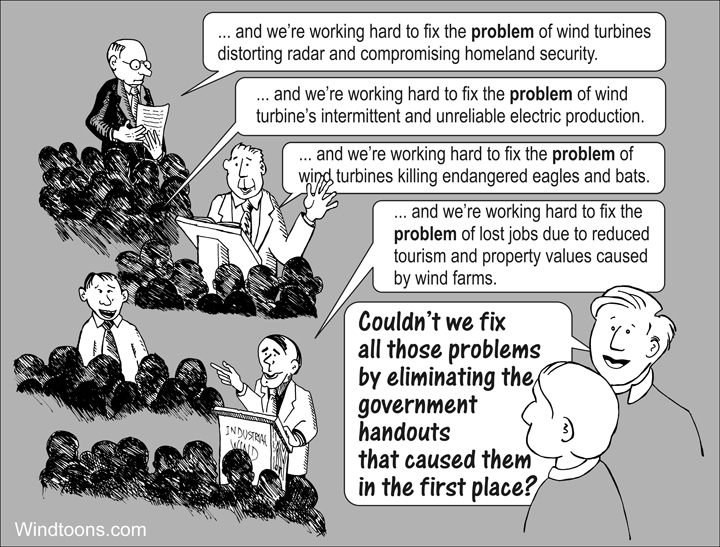
Well, Mr. Cain … if were “free” they wouldn’t be asking politicians to mandate it’s use and hand out our precious tax dollars support it, would they? Of all people, I thought you would stand away from federal subsidies which effectively chooses business winners and losers. I’m very disappointed!
I wonder how Mr. Cain and the other candidates would have fared had they been asked to specifically address industrial wind’s dismal contribution to the energy sector. How educated do you think these candidates are on the topic of wind power, beyond the information sheet the wind lobby attaches to the campaign checks?
The only thing the support of Republican candidates proves is, stupidity is not limited solely to one political party.
And if ever there was validation of the Will Rogers statement, support for industrial wind is it … “The more you read and observe about this Politics thing, you got to admit that each party is worse than the other…”
And if you aren’t stopping at Wind Concerns Ontario every day, you’re missing out. We can learn a great deal from our great northern friends.
3-And I thought we were a little short on cash!
Energy Secretary Chu hands $102 million we don’t have to a Maine wind developer so they can install Siemens (aka-German) turbines – Department of Energy
4-Ignoring the content, you gotta admit the interview is entertaining.
5-Relative to the interview in Item 4 – remember this from Speigel Online a month ago? (bold emphasis mine)
“The government of Chancellor Angela Merkel established an atomic “moratorium” immediately following the March 11 disaster in Japan and took Germany’s seven oldest reactors offline. Not long after , Berlin decided to keep them shut down permanently. But with concern rising that solar and wind power might not be sufficient on cold winter days, one of those older reactors will likely have to be switched back on. A final decision will be made in August. Merkel and her government have celebrated the phase out of nuclear energy in Germany as an “energy revolution” and vowed to make up for the capacity lost through the reactor shutdowns through billions in investments in renewable energies and energy savings measures. But according to a report in the daily Berliner Zeitung on Wednesday, some of that money has now been earmarked to subsidize the construction of new coal-fired power plants.“
Yep! That pesky thing called reality keeps spoiling the ending of the renewable fairy tale!
2-“Wind farm accidents in Gansu caused major disruptions to China’s power grid, while Beijing just announced the State Electricity Regulatory Commission (SERC) will conduct nationwide inspections this month of wind power facilities after a series of large-scale disconnections that threatened the stability of the power grid, as reported by the China Daily on August 5.” – CRI English
3-In case you missed it – “The great green wind scam“ – JONATHAN CARTER – Director, Forest Ecology Network
4-Thanks to Jon Boone for alerting us to the third ATI video of the series:
ATI Environmental Law Center v. State of Colorado Renewables Mandate – Pt. 3, Possible Outcomes:
For your convenience, here is the first and second video, which we posted earlier:
American Tradition Institute Colorado Lawsuit, Part 1 – Pollution Issues:
American Tradition Institute Colorado Lawsuit, Part 2 – Constitutionality:
Please be sure to visit the American Tradition Institute website for a comprehensive study of the ongoing lawsuit and other issues concerning environmental policies.
2-“Texas has seen large growth in wind generation because of DOE subsidies for wind generation. The subsidies are what makes wind generation feasible economically.” – Energy Blogs
Our friend Fran Kunz notes: “Here’s another great insight to what is happening with wind. If, (more like when) the subsidies get pulled from wind power, the companies go bankrupt. (That’s not the punch line though.) The punch line is; the land owner is stuck with a useless reminant of poor technology, reduced land value, and removal costs while the power company gets to hide all the money they got from the tax payers. LOL! well, maybe its not really that funny after all?”
6-Another happy customer? “As I write this letter (Aug. 4), the entire output for Ontario’s 800 IWTs is a pathetic 17MW” – The Beacon Herald
2-The wind lobby claims industrial wind reduces emissions. Wind Farm Realities has a very nice assessment of the ongoing debate.
“It is pretty obvious that AWEA has no interest is doing some actual science and using actual measurements to see if wind energy is effective in reducing emissions. Instead they write papers using whatever scattered numbers they can come across, choosing to look authoritative in contrast to being authoritative.”
6-So the author says: “Before I get any mail, I’m NOT advocating huge government subsidies for wind power. The technology can clearly stand on its own, and is getting cheaper (read: more cost-effective) all the time.
So when will Denise Bode of the American Wind Energy Association be puting her tin cup back in the closet?
7-And speaking of Ms. Bode – “We call wind and solar alternative energy, but wind companies are much like any other energy companies and are run by some of the same people.” – dagblog
3-Texas beyond ecstatic … wind momentarily produced at 25% of capacity during recent peak demand! As our Veep might say, Hey, when you only count on 8.4%, that’s a big effin deal.
To compare the cost of wind and coal energy, “the Michigan Public Service Commission study tacked a “carbon tax” onto the price of coal. Yet no such tax exists — either at the state or national level.”
Yep, you read it right! The recent Laurence Hammack article at Roanoke.com notes that “PJM Interconnection LLC, the suburban Philadelphia-based company that manages the grid for a 12-state area that includes Virginia … which likens itself to the grid’s air traffic controller, adjusts for the variations (in industrial wind supply) by forecasting that wind farms will produce 13 percent of their generating capacity.”
Imagine if you bought a $1,000,000 Enzo Ferrari and, after getting passed by nearly everything on the road home, you find it’s been equipped with a VW Beetle engine. Would you simply find a way to “manage” it? I doubt it! My suspicion is that you would demand the full value of your purchase. But our public servants, who are so generous with your money in the form of subsidies to the wind folks, don’t seem to mind that these clunkers consistently under-perform. And, rather than discounting the full value of the project to 13% before calculating the hand-out as they might do if it were their money, they happily award the full sum to the wind developer. Why, even the wind lobby (AWEA) admits one should assume around 30% production against nameplate capacity.
A couple of days ago we posted how the Canadian developers of the Windstar I project in California expect US Taxpayer to kick in 30% of the full project cost upon completion of the installation … before the blades even turn. That alone amounts to a $99,000,000.00 hand out to the developer for one project! I wonder how much has been paid out for the total 850 wind farms the AWEA claims exist in the US. Be nice to know, wouldn’t it. Ask your Congressional Representative … I’ll bet they know!
Similarly, I’m sure the developers of projects planning to supply the PJM grid, such as perhaps Edison’s Pinnacle project in Mineral County WV, will likely expect to receive 30% of the full cost of the project when completed. To paraphrase Sonny and Cher, “and the debt goes on.”
In truth, this is where the debate over wind energy’s viability as an energy source needs to be centered. Sure, the problems with noise, bat and bird kills, flicker and all the other issues industrial wind brings to the table do matter. But I think wind opponents would make a much stronger argument if they focused on what industrial wind doesn’t bring to the table – reliable and reasonably priced electricity delivered to the consumer whenever it is demanded.
Simply put … industrial wind is a failure. The output from these monstrous consumers of land and air space is beyond dismal and often the relatively small amount of electricity produced arrives at off-peak hours. If Taxpayers and consumers really understood how little they receive in return for their hard earned money, they would surely revolt against this ridiculous business.
The wind business seems to prefer a debate centered on issues other than performance, and of course, “true” cost. The “softer” issues of birds and noise are easily turned into emotional harangues lead by experts on either side flipping their competing charts and flapping their gums about nebulous theories and assumptions.
Performance is the wind industry’s Achilles heel. Unfortunately, wind opponents fall into the trap of arguing “emotional” issues instead of simply noting that the damned things don’t work. Power generation and supply, relative to investment is measurable. If only the wind business were required to pull back the “proprietary” curtain and allow the Taxpayers and consumers to see the performance results relative to the true and complete costs of industrial wind, the wind business would fall under its own weight. But try to get your hands on that information. The facts typically only slip out now and then as the 13% PJM forecast did in this article.
Another section in the Roanoke.com article quotes the American Wind Energy Association lobby saying “there are about 850 utility-scale wind farms in 38 states. The facilities can produce more than 41,000 megawatts, enough to power 10 million homes and provide 2 percent of the nation’s electricity.” The key word here is “can!”
What if we factor the PJM forecasted 13% of nameplate capacity into the AWEA statement? How many homes would the 850 utility scale wind farms power then power?
Is the 13% PJM forecast against nameplate capacity unfair? I don’t really know. But in February of 2010, Dennis Avery provided this analysis:
“Out in Oregon, General Electric has just announced a big wind project: 338 turbines, rated at 845 MW. GE claims it will power for 235,000 homes, and is applying for the appropriate federal subsidies.
Will the wind turbines power 235,000 homes? Don’t bet on it. My friend Donald Hertzmark—an energy economist—warns the power deliveries from this wind project are likely to average only 25 percent of its rated capacity. That would serve only 58,000 homes, not 235,000.
But Hertzmark says even this is too high because the wind is highly variable. The Texas power grid’s experience is to rely on no more than 9 percent of the wind farm’s rated capacity. That would reduce GE’s real subsidy claim to about 21,000 households.”
Again … “The Texas power grid’s experience is to rely on no more than 9 percent of the wind farm’s rated capacity.”
But, in reality, whether it’s 9%, 11% or 30% actual production v nameplate capacity, the information we should be seeking is how much these poster children of corporate welfare actually produce and when … and at what cost?
If the very politicians protecting these business entities were forced to provide a fully transparent assessment of the wind business to the citizens they are sworn to protect, a very different picture would emerge. My suspicion is that the wind business would cease to exist. And what impact would that have on this Country’s future energy supply? Absolutely none!
And, while we’re on the topic of hand-outs … with a vast majority of the Senate recognizing (and even Al Gore admitting) that ethanol is a failure, the same “trustees” you elected to guard your money just voted to continue spending billions for ethanol subsidies by shooting down an amendment that would have repealed a 45-cent-per-gallon tax credit to blend ethanol in gasoline. Opponents claim their negative vote was a result of a “procedural problem.” But when you get into the weeds, you find that Senators like Diane Feinstein simply needed more time “to try to work out a deal with ethanol backers on possibly continuing some type of federal assistance for the corn-based additive.” They want you to think they’re against handouts all the while continuing to hand out your money.
Another dance, anyone?
AT NOTE: Important commentary regarding my post was received from Mr. Jon Boone, of Stop Ill Wind. It is included within the post for your convenience.
Mr. Boone begins:
Nice try! But you overstate the case for wind. Here’s why.
1. The PJM “forecast” for wind is misstated. What Hammack should have reported is that the PJM will only guarantee transmission of no more than 13% of wind’s rated capacity at any key peak demand period. This is to protect transmission access primarily, since unscheduled wind can clog transmission arteries and stop up firm capacity generation.
2. This 13% is different from the PJM forecast of 13% capacity credit. See my essay, Why Wind Won’t Work, for an explanation. Capacity credit is a statistical average, usually taken over a three year period, of what wind performance has done at peak times. This in no way is a predictor for what it will do at any future time. Here’s a quote from an email I recently sent Robert Bryce that discusses some of this re his post in the NYT a few days ago:
“I wish you would point out, particularly for wind projects, that the 70 Manhattans of land mass required to support wind technology at a scale sufficient to provide one-sixth of California’s electricity is a MATHEMATICAL construction, not a functional one. The 8500MW of installed wind capacity would likely produce an annual average output of 2000MW and at peak times in summer about 400MW. This is the first point I made some years ago to Jesse Ausubel.
You do no favor to your argument when you allow people to believe that 8500MW of wind spread over an area the size of 70 Manhattans would actually provide a large chunk of the state’s electricity. There are too many out there who think having all that wind is a fine idea, all the while repressing the reality of how such a scheme would do violence to Schumacher’s vision (ie, “small is beautiful”)–viz, The Sierra Club.
As you know, the stark reality is that California would need an armada of fossil fueled plants to support 8500MW of wind, plus new transmission and voltage regulation systems. The physical plants of each would have to be factored in to account for all the land–all the material–necessary for wind installations.”
3. As for the homes “served by wind” nonsense, perhaps you and others might consider how “serviceable” a windmobile would be if you never knew when it would start or stop, how fast or slowly it would move, or what direction it would take. How serviceable would a vacuum cleaner be if it worked as desired 13%, or 30%, or 50% of the time–but you never knew when that would be? Or a chain saw? How functional, in terms of modern expectations, would a commercial glider flight be if you had to be in San Francisco tomorrow at 3:00 PM?
In reality, NO homes can be served–that is, powered–by archaic, tail-wagging-the-dog wind energy, given today’s expectations of reliability and performance. Recall that wind is continuously bouncing around between zero production and about 90% of its rated capacity. This output, averaged over a year, will typically generate around 20-30% of any wind project’s rated capacity. But no one can predict a specific increment of wind production for any time ahead period, which is the firm capacity (capacity value) delivered by all conventional generators. Wind cannot provide firm capacity.
The homes “served” bromide is simply PR hash used 50 years ago by nuclear advocates in an attempt to make nuclear appear “homey” to just plain folks. It has been resuscitated by AWEA to make people believe pigs can fly.
This is not a difficult concept to understand. It’s why we have lemon laws…. And why sailboats are used almost exclusively for recreation, where time and distance don’t matter.
American Battlefield Trust
The American Battlefield Trust preserves America’s hallowed battlegrounds and educates the public about what happened there and why it matters

 Allegheny Treasures