PJM grid: “wind farms will produce 13 percent of their generating capacity.”

Yep, you read it right!  The recent Laurence Hammack article at Roanoke.com notes that “PJM Interconnection LLC, the suburban Philadelphia-based company that manages the grid for a 12-state area that includes Virginia … which likens itself to the grid’s air traffic controller, adjusts for the variations (in industrial wind supply) by forecasting that wind farms will produce 13 percent of their generating capacity.”

Imagine if you bought a $1,000,000 Enzo Ferrari and, after getting passed by nearly everything on the road home, you find it’s been equipped with a VW Beetle engine.  Would you simply find a way to “manage” it?  I doubt it!  My suspicion is that you would demand the full value of your purchase.  But our public servants, who are so generous with your money in the form of subsidies to the wind folks, don’t seem to mind that these clunkers consistently under-perform.  And, rather than discounting the full value of the project to 13% before calculating the hand-out as they might do if it were their money, they happily award the full sum to the wind developer.  Why, even the wind lobby (AWEA) admits one should assume around 30% production against nameplate capacity.

A couple of days ago we posted how the Canadian developers of the Windstar I project in California expect US Taxpayer to kick in 30% of the full project cost upon completion of the installation … before the blades even turn.  That alone amounts to a $99,000,000.00 hand out to the developer for one project!  I wonder how much has been paid out for the total 850 wind farms the AWEA claims exist in the US.  Be nice to know, wouldn’t it.  Ask your Congressional Representative … I’ll bet they know!

Similarly, I’m sure the developers of projects planning to supply the PJM grid, such as perhaps Edison’s Pinnacle project in Mineral County WV, will likely expect to receive 30% of the full cost of the project when completed.  To paraphrase Sonny and Cher, “and the debt goes on.”

In truth, this is where the debate over wind energy’s viability as an energy source needs to be centered.  Sure, the problems with noise, bat and bird kills, flicker and all the other issues industrial wind brings to the table do matter.  But I think wind opponents would make a much stronger argument if they focused on what industrial wind doesn’t bring to the table – reliable and reasonably priced electricity delivered to the consumer whenever it is demanded.

Simply put … industrial wind is a failure.  The output from these monstrous consumers of land and air space is beyond dismal and often the relatively small amount of electricity produced arrives at off-peak hours.  If Taxpayers and consumers really understood how little they receive in return for their hard earned money, they would surely revolt against this ridiculous business.

The wind business seems to prefer a debate centered on issues other than performance, and of course, “true” cost.  The “softer” issues of birds and noise are easily turned into emotional harangues lead by experts on either side flipping their competing charts and flapping their gums about nebulous theories and assumptions.

Performance is the wind industry’s Achilles heel.  Unfortunately, wind opponents fall into the trap of arguing “emotional” issues instead of simply noting that the damned things don’t work.  Power generation and supply, relative to investment is measurable.  If only the wind business were required to pull back the “proprietary” curtain and allow the Taxpayers and consumers to see the performance results relative to the true and complete costs of industrial wind, the wind business would fall under its own weight.  But try to get your hands on that information.  The facts typically only slip out now and then as the 13% PJM forecast did in this article.

Another section in the Roanoke.com article quotes the American Wind Energy Association lobby saying “there are about 850 utility-scale wind farms in 38 states. The facilities can produce more than 41,000 megawatts, enough to power 10 million homes and provide 2 percent of the nation’s electricity.”  The key word here is “can!

What if we factor the PJM forecasted 13% of nameplate capacity into the AWEA statement?  How many homes would the 850 utility scale wind farms power then power?

Is the 13% PJM forecast against nameplate capacity unfair?  I don’t really know.  But in February of 2010, Dennis Avery provided this analysis:

“Out in Oregon, General Electric has just announced a big wind project: 338 turbines, rated at 845 MW. GE claims it will power for 235,000 homes, and is applying for the appropriate federal subsidies.

Will the wind turbines power 235,000 homes? Don’t bet on it. My friend Donald Hertzmark—an energy economist—warns the power deliveries from this wind project are likely to average only 25 percent of its rated capacity. That would serve only 58,000 homes, not 235,000.

But Hertzmark says even this is too high because the wind is highly variable. The Texas power grid’s experience is to rely on no more than 9 percent of the wind farm’s rated capacity. That would reduce GE’s real subsidy claim to about 21,000 households.”

Again … “The Texas power grid’s experience is to rely on no more than 9 percent of the wind farm’s rated capacity.

But, in reality, whether it’s 9%, 11% or 30% actual production v nameplate capacity, the information we should be seeking is how much these poster children of corporate welfare actually produce and when … and at what cost?

If the very politicians protecting these business entities were forced to provide a fully transparent assessment of the wind business to the citizens they are sworn to protect, a very different picture would emerge.  My suspicion is that the wind business would cease to exist.  And what impact would that have on this Country’s future energy supply?  Absolutely none!

And, while we’re on the topic of hand-outs … with a vast majority of the Senate recognizing (and even Al Gore admitting) that ethanol is a failure, the same “trustees” you elected to guard your money just voted to continue spending billions for ethanol subsidies by shooting down an amendment that would have repealed a 45-cent-per-gallon tax credit to blend ethanol in gasoline. Opponents claim their negative vote was a result of a “procedural problem.” But when you get into the weeds, you find that Senators like Diane Feinstein simply needed more time “to try to work out a deal with ethanol backers on possibly continuing some type of federal assistance for the corn-based additive.”  They want you to think they’re against handouts all the while continuing to hand out your money.

Another dance, anyone?

AT NOTE: Important commentary regarding my post was received from Mr. Jon Boone, of Stop Ill Wind.  It is included within the post for your convenience.

Mr. Boone begins:

Nice try! But you overstate the case for wind. Here’s why.

1. The PJM “forecast” for wind is misstated. What Hammack should have reported is that the PJM will only guarantee transmission of no more than 13% of wind’s rated capacity at any key peak demand period. This is to protect transmission access primarily, since unscheduled wind can clog transmission arteries and stop up firm capacity generation.

2. This 13% is different from the PJM forecast of 13% capacity credit. See my essay, Why Wind Won’t Work, for an explanation. Capacity credit is a statistical average, usually taken over a three year period, of what wind performance has done at peak times. This in no way is a predictor for what it will do at any future time. Here’s a quote from an email I recently sent Robert Bryce that discusses some of this re his post in the NYT a few days ago:

“I wish you would point out, particularly for wind projects, that the 70 Manhattans of land mass required to support wind technology at a scale sufficient to provide one-sixth of California’s electricity is a MATHEMATICAL construction, not a functional one. The 8500MW of installed wind capacity would likely produce an annual average output of 2000MW and at peak times in summer about 400MW. This is the first point I made some years ago to Jesse Ausubel.

You do no favor to your argument when you allow people to believe that 8500MW of wind spread over an area the size of 70 Manhattans would actually provide a large chunk of the state’s electricity. There are too many out there who think having all that wind is a fine idea, all the while repressing the reality of how such a scheme would do violence to Schumacher’s vision (ie, “small is beautiful”)–viz, The Sierra Club.

As you know, the stark reality is that California would need an armada of fossil fueled plants to support 8500MW of wind, plus new transmission and voltage regulation systems. The physical plants of each would have to be factored in to account for all the land–all the material–necessary for wind installations.”

3. As for the homes “served by wind” nonsense, perhaps you and others might consider how “serviceable” a windmobile would be if you never knew when it would start or stop, how fast or slowly it would move, or what direction it would take. How serviceable would a vacuum cleaner be if it worked as desired 13%, or 30%, or 50% of the time–but you never knew when that would be? Or a chain saw? How functional, in terms of modern expectations, would a commercial glider flight be if you had to be in San Francisco tomorrow at 3:00 PM?

In reality, NO homes can be served–that is, powered–by archaic, tail-wagging-the-dog wind energy, given today’s expectations of reliability and performance. Recall that wind is continuously bouncing around between zero production and about 90% of its rated capacity. This output, averaged over a year, will typically generate around 20-30% of any wind project’s rated capacity. But no one can predict a specific increment of wind production for any time ahead period, which is the firm capacity (capacity value) delivered by all conventional generators. Wind cannot provide firm capacity.

The homes “served” bromide is simply PR hash used 50 years ago by nuclear advocates in an attempt to make nuclear appear “homey” to just plain folks. It has been resuscitated by AWEA to make people believe pigs can fly.

This is not a difficult concept to understand. It’s why we have lemon laws…. And why sailboats are used almost exclusively for recreation, where time and distance don’t matter.

Mr. Boone’s comments end!

At Note:  We recommend you visit Mr. Boone’s web site – Stop Ill Wind.  Regarding the “homes served” issue specifically, we refer you to Top Ten #4 in Misleading Wind Industry Claims and Pages 11 and 12 of Mr. Boone’s PSC Testimony.
Posted in industrial wind failure, Industrial wind lobby, industrial wind v fossil fuel, West Virginia Wind, Wind Energy Legislation, Wind Power subsidies | Tagged , , , , | Leave a comment

I’m curious … is “Yabucoa” the Spanish word for rip-off?

Back in February of this year, Western Wind Energy issued a news release containing this statement:  The total assets of the Windstar Project as of the expected Commercial Operation Date, are valued at US $481.8 million comprising the Project’s fair market value of US $357.9 million, plus the potential cash grant of US $99 million plus a further US $25 million of fully funded working capital, debt coverage and performance bonding reserves.

What caught my eye was the $99 million cash grant.  I thought this a tidy sum for some generous soul to voluntarily donate to this Canadian based, profit making enterprise.  How nice!

A couple of days ago, the same Vancouver Canada based Western Wind Energy released a “Project Valuations” report providing additional information on the Windstar Project, and others as well.  I thought you might like to know that the $99 million dollar benefactor mentioned above appears to be the US Taxpayer.  Seems, according to the press release, “the total project values were deternined [sic] by adding the US Federal cash grant.”  (A word to the wise … anytime you see the term “US Federal,” substitute the term “US Taxpayer” …  you’ll find what you’re reading takes on a whole new meaning.)

Believe me, I’m not a financial guru claiming to understand the convoluted stream of cash which flows to these projects.  But that aside, it seems clear to me that the industrial wind business in the US relies overwhelmingly on opportunistic for-profit foreign companies and, with that, I’m not thrilled.  We keep hearing from the wind lobby about “green” jobs and the US “green” economy and yet, project after project can trace its ancestry (and our money) back to some foreign shore.  Seems to me the only real jobs and profits of any consequence benefit wind developers, the wind lobby, foreign backed manufacturers and the major electric distributors like Edison, who just so happen to benefit from “green” energy profits while continuing to profit from their 23 coal-fired generating stations (as listed in 2005).  Oh, I almost forgot the politicians.

Looking back to March 1, 2010, an article at Brighter Energy News, prior to the project start, noted that the Vancouver Canada based Western Wind Energy would build the wind facility in California with Gamesa turbines.  Gamesa, of course, does assemble components near Philly, but the business is based in Spain.  I guess what irritated me, since the major players are headquartered off-shore, was this comment: “Once the project is operational, the company is intending to apply for federal economic stimulus money, under the American Recovery and Reinvestment Act, seeking around $70 million in grant funding – around 30% of the project costs.

Plus, the fact that in just one year the US Taxpayer’s obligation has grown from $70,000,000.00 to $99,000,000.00 is more than just a little salt in the wound.  And think about it … this is for just one project.  Not surprisingly, the project completion is scheduled for December 31, 2011, just in time to insure they cash in on the US Federal 1603 Grant handout – aka: US Taxpayer pockets.

It’s one thing to invest in research toward new and innovative energy sources.  I’m a big fan of providing taxpayer dollars, if available, to qualified, unaffiliated, non-profit institutions for the purpose of such research and development.  But handing cash out to select for-profit businesses, whether wind, solar, coal, natural gas, nuclear, oil … you name it … should not be in the scope of authority held by our elected representatives, and, by all means, must not be entrusted to the government bureaucrats hired to oversee and regulate these same profiteers.

Even if the federal government could find the magic to replace the negative sign on the $14,400,000,000,000.00 national debt with a plus sign, should we hand out hard earned taxpayer dollars to the very companies who will, in the end, make us pay for services rendered?  Really folks, even in the best of times … is that ever the right thing to do?

Oh, by the way … take a look at the Western Wind Energy Press Release to take note of the sweet little deal in Puerto Rico for their Yabucoa project? – “30% cash grant, 50% bonus depreciation and 50% Puerto Rico investment tax credit”  I’m curious … is “Yabucoa” the Spanish word for “rip off?”

And while I’m ranting on anyway, there’s another thing this cross border business has me wondering about – international treaties.  Now before anyone gets their shorts in a knot, this is not to single out Western Wind Energy, but only to use their structure to express a wider concern I have.  A concern that, hopefully, some expert reader will convince me to put aside.

Here we go:

Western Wind Energy’s site states that it “owns 1,840 acres of land in the Tehachapi Pass Wind Park, California. Parcels in excess of 1,015 acres are zoned for wind farm development.”  This general area, as I recall, is known as a trouble spot for the Golden Eagle, and other protected birds, due to impacts with wind turbines.

The Golden Eagle is protected by the US Endangered Species Act and, to the best of my knowledge, at least one international treaty.  The international agreement(s) is in place, presumably because the Golden Eagle migrates to places like, well, Canada.  (We posted an excellent piece from Wayne Wegner some time ago that, if you haven’t read, you should.)

One would assume that a company operating internationally, an effort which obviously requires it to be well versed in the business practices and laws of both countries, would be equally familiar with international treaties with which their business operations might conflict.

In the case of the international treaty negotiated to protect migratory birds for example, should we not have high expectations for companies conducting cross border businesses known to place these species in jeopardy to be fully aware of the “rules of the road,” so to speak?

As further disclaimer, the reason I raise the issue is not because I have any evidence or do I doubt that Western Wind Energy has done anything other than fully comply with all requirements.  My concern is based on my sense that US agencies, such as the Fish and Wildlife Service have been rendered somewhat ineffective enforcers of endangered species protections due to the political pressures in favor of “green” energy.  It is this that leads me to have little confidence that international treaties are taken seriously when, for example, a US company can simply choose to ignore USFWS warnings even when the agency informs the developer of their concerns for a dangerous condition prior to construction.

It is with this doubt in mind, that I’m am looking for some assurance that an international governing body exists to insure an international business complies with any and all treaty protections, without fail?  If this is so, where do I find information about the agency’s success in enforcing compliance and, of equal interest, any companies who have violated these treaties to which the United States is signatory?

Again, I can only assume that Western Wind Energy is in full compliance with all requirements.  I don’t mean to suggest otherwise.  What I don’t feel confident believing is that all wind developers are meeting wildlife protection requirements.  It would be nice to have my fears set aside or, if there are companies not in compliance, that some empowered agency is taking the enforcement issue seriously.  And since, at least for now, the wind business is sticking taxpayer’s money in their pockets, I actually think we have a right to know.

Finally, some may wonder why I don’t simply contact some of the major “environmental” groups to resolve my concerns.  Well, a visit to Jon Boone’s Stop Ill Wind may help answer that question for you.

Posted in US Fish &Wildlife, Wind Power subsidies | Tagged , , , , , , | 1 Comment

Wind farms are “unreliable and this could leave the network dangerously exposed to blackouts.”

That’s the word from Australian state owned electricity generator Western Power, according to an article at Eco-Business.

Not only are they concerned that reliance on wind as a major power source could “increase the risk of blackouts during peak demand,” they think the “generous” annual contribution of “40 per cent for every megawatt hour of capacity a farm can generate” should be reduced by half, to better reflect their “intermittent nature.”

Of course, the renewable energy lobby, beneficiaries of the state’s “generosity,” warned reducing the handout would “cause project delays and uncertainty in the renewable market.”  But then, if the wind lobby actually served the market with an efficient, cost-effective, on-demand product, we wouldn’t even be having this discussion, would we?

Posted in industrial wind poor performance, Renewable Energy Scam, Wind Power subsidies | Tagged , , , | Leave a comment

Wind business ethics: “A wind farm owner once told me that if there were no witnesses, it would be impossible to prove a bird had been killed by a wind turbine blade.”

An article at the UK Mail notes this statement by field biologist Doug Bell, manager of East Bay Regional Park District’s wildlife program:  “it would take 167 pairs of local nesting golden eagles to produce enough young to compensate for their mortality rate related to wind energy production,” unfortunately, as Mr. Bell tells the LA Times “We only have 60 pairs.

If only this disregard for wildlife were isolated.  The developer for the pending Pinnacle wind plant to be located on the Allegheny Front in Mineral County WV sees no reason to secure an incidental take permit even after the West Virginia Department of Natural Resources and the US Fish and Wildlife Service expressed concerns over critical habitat and there exists clear evidence of Bald Eagles residing in the immediate area.

The real shame is that the organizations claiming to protect such creatures are complicit in their demise.  By blindly supporting this fraud of electricity production, groups allow the habitat to be destroyed and turn a blind eye to the killing of these magnificent creatures in the name of progress.  Aided and abetted by a local press which serves as an advocate rather than watchdog, the entire landscape which is home to several migrating bird species and numerous colonies of frail bats is placed in jeopardy.

I can only hope that if, after the Pinnacle developer, US WindForce LLC, and the new owner Edison selfishly chose to ignore the danger signs and endangered species are killed, they are, in fact, held in “criminal liability and potential criminal culpability” and are prosecuted to the full extent of the law.

Posted in Allegheny Mountains, Appalachian Mountains, Eagles, Endangered Species Act | Tagged , , , , | Leave a comment

Paul Driessen: “the renewable energy subsidy train rolls on, with tanker cars of red ink bankrolled by US taxpayers and consumers – to provide less than 1% of the energy we use.”

Article republished with permission of the Committee For A Constructive Tomorrow (CFACT):

Rants, lies, subsidies and job-killing policies

How our government subsidizes job, wealth, revenue and people-killing energy policies.

May 19, 2011

by Paul Driessen

President Obama’s speeches sum up his views on oil, natural gas and energy prices in just 44 words.

“We have less than 2% of the world’s oil reserves. We’re running out of places to drill. We’re running out of oil. We need to end our $4 billion in annual taxpayer subsidies to oil companies. We need to invest in clean, renewable energy.”

As Congressman Joe Wilson would say, That’s a lie! Or at least a deliberate distortion of facts.

Oil “reserves” are what can actually be produced at today’s prices, with existing technologies, and under current laws and regulations. America has vast oil, gas and coal resources – centuries of potential hydrocarbon energy. We certainly have the technology to extract it, especially at $100 a barrel. What we don’t have are laws and regulations that allow us to do so.

If the President were honest, he would say: “We’re running out of oil that Democrats, my Administration and our radical environmentalist allies will let this country produce. We’re running out of places we’ll let companies drill. We have 2% of world oil reserves, because we’ve made most of our resources off limits.”

If he were honest, he would also say: “We will demonize, penalize, hyper-regulate, tax and kill hydrocarbons. But we will mandate and subsidize wind, solar and ethanol, ignore their environmental and human costs, and extol the measly, expensive, unreliable energy they produce.

“We oppose subsidies for oil and coal companies (even in the form of tax deductions for actual expenses), because they promote drilling – and their CEOs and workers rarely vote for us. We support huge subsidies for wind, solar and ethanol, because those guys help keep us in power and drive a transition to renewables.

“We know oil, gas and coal generate royalty and tax revenues, and provide 85% of the energy that powers America and supports jobs, commuting, factories, transportation, tourism, hospitals, ambulances, churches and living standards. But we don’t care about that or about revenues, except when they come from higher taxes on corporations – or rich families that make over $250,000 … $150,000 … $65,000 a year. We detest free enterprise, and think government should control more of your energy, economy and lives.

“And we love the way supply and demand laws drive prices up. DC area gasoline is already $4.25 a gallon. That’s about half of what Energy Secretary Chu and I would like it to be: European prices. And we know restricting energy supplies even further will send all prices skyrocketing even higher.”

As crazy as they sound, these ideologies are even more frightening and demented in practice.

Oil production in the Gulf of Mexico is projected to drop 240,000 barrels a day this year. That’s $9 billion more that America will have to pay this year to import replacement oil … $1.3 billion we won’t collect in federal royalty payments … thousands of jobs that won’t be “created or saved” … and billions in corporate, personal income and sales taxes we won’t collect.

The US Geological Survey says upwards of 90 billion barrels remain to be discovered in the Arctic. ANWR alone could hold 16 billion barrels of recoverable oil, producible from areas totaling 1/20th of Washington, DC. But it’s all locked up, off limits to We the People who own it.

Meanwhile, the huge Prudhoe Bay field is slowly running dry. So the Alaska Pipeline is operating at a fraction of its capacity, which increases corrosion and blockages in the pipe, magnifies the risk of ruptures and spills, and threatens the future of all Alaskan oil. Shell Oil spent $3.5 billion acquiring and exploring leases in the Chukchi Sea – but Interior and EPA refuse to issue drilling permits, because diesel emissions from the rig could cause global warming or affect the health of Natives 20-50 miles away! It all adds up to less oil, less royalty revenue, fewer jobs and more imported oil. Just as Obama & Co. intend.

Made in America technology and innovation have unlocked centuries of new natural gas in US shale formations (and similar deposits all over the world). This game-changing development has reduced gas prices, completely unhinged Obama, Democrat and other environmental ideologues, and devastated their “we’re running out” mantra. So they’ve rallied the troops, to produce a bogus “documentary” film (“Gasland”), a sloppy Cornell University “study,” and reams of new EPA regulations, to stymie shale gas. A thorough analysis by science writer Matt Ridley provides much needed facts and perspectives. (The same horizontal drilling and “fracking” technologies are also unlocking eco-nightmarish new oil riches.)

Coal generates half of all US electricity, and 70-98% in twelve states – sustaining jobs by keeping AC, heating and machinery operating costs at about half of what is typical in states that get little or no electricity from coal. But EPA has issued 946 pages of new air quality rules and launched a massive propaganda campaign against mercury emissions – even though those power plants account for barely 0.5% of all mercury in the air Americans breathe. President Obama has said he wants to “bankrupt” the industry.

All told, over a billion acres of onshore and offshore energy prospects are locked up – costing us centuries of fuel, millions of jobs, and hundreds of billions in bonus, royalty and tax revenues. Of course, there are “no quick fixes” for our energy problems, as President Obama loves to remind us. But if we’d begun drilling in some of these places 10-20 years ago, we wouldn’t be in this fix today.

As to subsidies, even the alleged billions for oil companies are a pittance compared to subsidies for wind, solar and ethanol. Subsidies per unit of energy actually produced are even more shocking. According to the Energy Information Administration, gas-fired electricity generation received a mere 25 cents per megawatt-hour in 2007 subsidies; coal got 44 cents. By comparison, wind turbines got 23.4 dollars and photovoltaic solar received 24.3 dollars per mWh.

Moreover, oil and gas is 24/7 – with 95% reliability. The industry supports 9.2 million jobs, directly and in companies that depend on reliable, affordable oil, gas, gasoline, fertilizer, plastics, pharmaceuticals and electricity. It generates federal revenue, paying billions in taxes and royalties. The same holds true for coal.

By contrast, wind and solar produce electricity just two to eight hours a day – with backup generators making up the monumental shortfall. That means we must duplicate every megawatt of wind and solar with a MW of (mostly gas-fired) backup power – which requires even more land and raw materials to support the government-mandated transition to “eco-friendly” renewable energy systems.

More appalling, instead of generating tax or royalty revenues, wind and solar require perpetual subsidies. Solar panel maker Solyndra got a $535 “stimulus” loan in 2009; then, the day after the 2010 elections, it announced it was laying off 190 people. In April 2011 alone, the Department of Energy poured $9 billion in loan guarantees into wind and solar projects that will blanket large swaths of crop and habitat land.

Ethanol receives subsidies of $5.72 per million Btu (190 times what oil and gas companies get), so that we can burn food to make fuels that government won’t let us drill for. In 2010, American farmers turned 36% of their corn crop into ethanol, which provides 30% less energy than gasoline – meaning cars get less mileage per tank for more bucks per gallon. Making one gallon of this substandard fuel also requires some 1,700 gallons of water and large quantities of petroleum-based fertilizers and pesticides. Worse, energy economist Indur Goklany calculates, biofuel policies cause up to 200,000 deaths a year in poor countries, by raising food prices, increasing malnutrition and making people more vulnerable to disease.

Overall, since assuming power in Washington, the Obama Administration has channeled over $60 billion into the “green jobs” sector. And the renewable energy subsidy train rolls on, with tanker cars of red ink bankrolled by US taxpayers and consumers – to provide less than 1% of the energy we use.

If Congress still refuses to hold inquiries and end these tax-subsidized scams, perhaps the most we can hope for is that a few courageous and publicly spirited governors and AGs will step into the breach.

AT Note:  Paul Driessen is senior policy adviser for the Committee For A Constructive Tomorrow (CFACT), which is sponsoring the All Pain No Gain petition against global-warming hype.

Mr. Driessen is also senior policy adviser to the Congress of Racial Equality and author of Eco-Imperialism: Green Power – Black Death.

Posted in Alternative Energy, Energy Ethics, Energy Subsidies, green lunacy, Renewable Energy Scam, Wind Power subsidies | Tagged , , , | Leave a comment

US Fish and Wildlife Service must make wind energy guidelines mandatory!

The US Fish and Wildlife Service recently solicited comments regarding guidelines designed to protect wildlife from the vast expansion of industrial wind and insure that any intrusion into their fragile habitat meets the requirements under the various laws and treaties currently in place.

Ms. Ajax Eastman of Baltimore was kind enough to share the excellent letter she submitted to the USFWS.  We thank Ms. Eastman for allowing us to post it here for you.

Ms. Eastman’s letter begins:

To:  U.S. Fish and Wildlife Service

  • Division of Fisheries and Habitat Conservation
  • Division of Migratory Bird Management

Re: Comments on Wind Energy Guidelines for Onshore Wind and Eagle Conservation Plan Guidelines.

Dear Sir/Madam,

I am writing to first and foremost protest the issuance of the draft guidelines without making them mandatory.

Even properly sited wind energy facilities will most likely have a negative impact on the environment directly and indirectly when roads, grid connections, cumulative impacts, etc. are considered.

Further, the wind industry is unlikely to reduce global warming or green house gases in a meaningful way because their actual capacity to generate electricity at 40%, 30%, 20%, or as low as 10% in the summer when demand is highest and back up fossil fuel emitting generators have to be cranked in to meet that demand.

Voluntary siting guidelines have proven to be totally inadequate in the protection of terrestrial and avian wildlife and their habitats. If these “voluntary” guidelines that were chiefly prepared by the Fish & Wildlife Wind Advisory Commission, consisting of mainly biased wind industry folks, are adopted, they will continue to harm species and fail to adhere to laws under which the Fish and Wildlife Service are ruled such as the Migratory Bird Treaty Act, the Endangered Species Act, or the Bald and Golden Eagle Protection Act.

The tiered approach for reviewing projects is only as good as it is applied. It must be mandatory and should apply to all projects, not merely those on Federal Lands.

An excellent example of the need for uniform mandatory guidelines for all wind projects is what has happened in Maryland. When a proposed project by Synergics on Backbone Mountain was before the Public Service Commission, the Department of Natural Resources recommended the deletion of a number of turbines that were to be sited on State rare or endangered species territory. The PSC dropped those sites and angered the owner of Synergics, Wayne Rogers who was former head of the State Democratic Committee and well connected to the heavily Democratic legislature. He retaliated by getting the legislature to pass legislation to eliminate environmental review for projects under 70 mgws. A year or so later he reapplied for a permit under 70 mgws that included the same sites previously denied, and today, those sites and species that should have been protected are now destroyed by turbines.

Using Maryland as another example, adequate site reviews must be undertaken by unbiased scientists not connected to the wind industry. Paul Kerlinger is an example of an industry hired ornithologist who did a one or two day walk through and testified that the sites on Maryland’s Appalachian ridges were adequate. Dr. Chan Robbins, a renowned ornithologist who has conducted breeding bird surveys in the area for over 50 years and knows the area to be a major migratory bird corridor was ignored in his testimony on another project in the area.

Cumulative impacts of projects must be considered before permits are granted. Projects considered in isolation of one another fail to take into consideration the adverse impacts beyond that of a sole project. The migratory birds and bats flying the gauntlet of turbines along their traditional corridors could eventually become extirpated.

The proposed guidelines must be mandatory for any project receiving federal financing through grants, subsidies, loans, loan guarantees or any other form of federal funding.

It simply would not be lawful for a federal agency to permit the taking of a protected species by allowing industry to voluntarily follow or ignore protective laws.

Finally, I urge the U.S. Fish and Wildlife Service to consider these comments and make the proposed guidelines mandatory/binding.

Sincerely,

Ajax Eastman

Baltimore, Maryland 21212

Posted in Appalachian Mountains, Bat/Bird Kills, Environment, Friends and Citizens Groups, USFWS Guidelines | Tagged , , , , | Leave a comment

Enjoy the Wildlife Center of Virginia Eagle Cam

Thanks to Frank O’Hara for pointing us to this superb online Eagle Cam.

According to the site, “the three bald eagles from Norfolk Botanical Garden were relocated to the Wildlife Center of Virginia on April 27 after their mother was killed by an airplane the previous day. The eaglets are receiving excellent care and are being prepared for release into the wild in August.”

Follow the link:  http://www.wvec.com/marketplace/microsite-content/eagle-cam.html

Also enjoy our link to the US Fish and Wildlife Service Eagle Cam, courtesy of the Outdoor Channel at this link:  http://www.outdoorchannel.com/Conservation/EagleCam.aspx

AT Note:  The Outdoor Channel cam was temporarily down at the time of posting, but keep checking in as they will resolve the problem.

Enjoy these magnificent creatures as they prepare to join others along the massive migratory highway that is the Appalachian Mountains.  Read more on the migratory path of the eagles in Wayne Wegner’s excellent piece:  Industrial wind calls it NIMBY. Perhaps! But “this problem runs from the arctic to the tip of South America — and that is one helluva big backyard!”

Posted in Appalachian Mountains, Eagles | Tagged , , , , | Leave a comment

Jasper Morris – A true Allegheny Treasure

With the passing of Jasper Morris, this community says farewell to a true Allegheny Treasure.

He was my scoutmaster when I was a kid and later kept a close eye on us “local” students at “Pot State.”  I recall his kindness, his gift for keeping a smile on those around him and his curiosity about everything.  All the things kids seem to gravitate to were found in this gentle man.

I lost track of him as I traveled about, but every now and then I’d remember gathering tent caterpillars and campfires and the skits we all had to participate in at scout camp.  The memories would always bring a smile.

After returning to the area, I had it in my mind to visit him, but, as these things often work out, I did not.  I thought he probably wouldn’t remember me, it was such a long time ago.  I wanted to tell him that I appreciated the many hours he spent with us kids and that what he did all those years ago mattered.  Lacking that opportunity, I’d like very much to do so now.

Thank you, Mr. Morris!

His obituary can be found here.

Posted in Uncategorized | Tagged , , , | Leave a comment

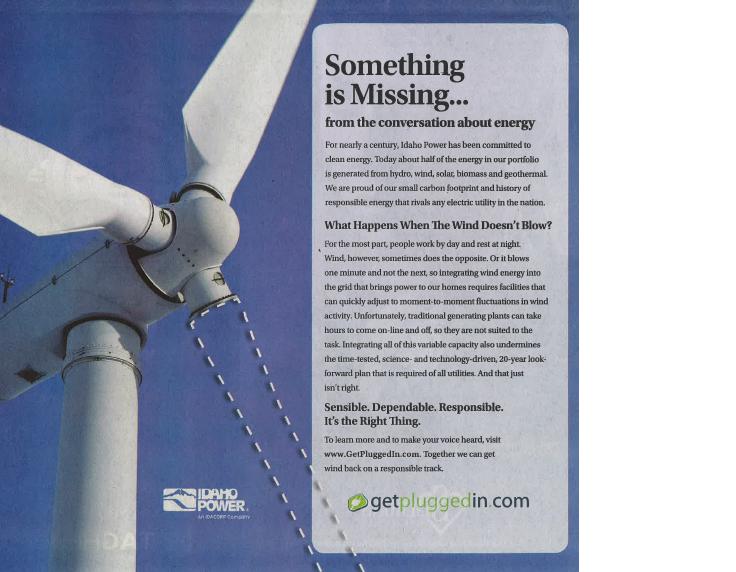
Stating the obvious about industrial wind – “Something is Missing”

I don’t want to be accused of putting words in their mouth, so I’ll just use Idaho Power’s own.  In fact, here’s an ad they recently published:

Stating the obvious … that the wind “blows one minute and not the next,” the ad goes on to explain that “integrating wind energy into the grid that brings power to our homes requires facilities that can quickly adjust to moment-to-moment fluctuations in wind activities.”  The problem, according to Idaho Power (and many others, in fact) is that “unfortunately, traditional generating plants … are not suited to the task.  Integrating all of this variable capacity also undermines the time-tested, science- and technology-driven, 20 -year look-forward plan that is required of all utilities.  And that just isn’t right.

Wow! … seems to me that Idaho Power might want to revisit their original assessment of wind integration.  Wait … they are???  “Idaho Power is revisiting its study of wind integration in 2011.”

Well, I’ll be darned.  Idaho Power notes that “installed wind generation capacity continues to expand in the Pacific Northwest, including Idaho. This expansion is accompanied by continuing concerns over the impacts and costs of integrating production from wind generators …

So Idaho Power states that “the objective of this study is to assess the costs incurred in modifying operations of dispatchable generating resources in order to allow them to respond to the variable and uncertain energy supplied by wind generators such that the reliable delivery of electrical power to customers is unaffected.

I’m anxious to see the results from this task, which is included as an agenda item in the study:

Task 3 –Determine operational violation status for base case

Parameters to be evaluated:

  • Unserved energy
  • Overgeneration
  • Non-spin
  • Spin
  • Reg-up
  • Reg-down

Seems Idaho Power is looking at the possibility of assessing penalties ($$$) if these items become an issue.

Anyway, Idaho Power provides a couple of links describing the 2011 Wind Study which you might find interesting:

Of course, this is all playing out just as the Bonneville Power Administration issued a policy Friday saying it will order wind power producers to shut down generation, due to greatly increased output from its hydro facilities.

We will, of course, keep an eye out for the results from the study and report them when published.  But, in the meantime, Idaho Power has an interesting site they’d like you to visit – getpluggedin.  I highly recommend you do so.  They are asking for your comments.

As we’ve said here at AT many times before, “The greatest threat to the wind industry’s growth is, in fact, the wind industry’s growth.”

AT Note:  Thanks to Glenn Schleede for pointing us to the Idaho Power advertisement.

Posted in Glenn Schleede, industrial wind failure, industrial wind poor performance, industrial wind v fossil fuel | Tagged , , , , | 3 Comments

Camp Allegheny Battlefield Nominated for the 2011 Most Endangered Historic Sites Listing

The Highlanders for Responsible Development (HRD) has released the following statement to the press:

Threatened by Wind Turbines: Camp Allegheny Nominated for the 2011 Most Endangered Historic Sites Listing of the National Trust for Historic Preservation

———————————————————————————————————–


May 15, 2011  –  Highlanders for Responsible Development

Camp Allegheny, a Civil War battlefield and winter encampment on the WV-VA border, has been nominated by Highlanders for Responsible Development to be listed on the National Trust for Historic Preservation’s list of America’s 11-Most Endangered Historic Places.  The National Trust is a private non-profit organization, and its highly competitive most-endangered list is intended to raise public awareness of threats to important historic places across the nation. Camp Allegheny previously appeared on the Civil War Trust’s 2009 and 2010 listings of Most-Endangered Battlefields. Camp Allegheny has also been listed on the National Register of Historic Places since 1990.

2011 is the 150-year anniversary of the battle at Camp Allegheny that helped to block the federal advance on Virginia from the west and set the stage for Stonewall Jackson’s Valley Campaign. The day-long battle at Camp Allegheny in December of 1861 involved approximately 3000 soldiers and 280 casualties.

Camp Allegheny, the highest-elevation and most-pristine Civil War battlefield east of the Mississippi, has been preserved due to the remote location of the site and thanks to the stewardship of the current private and National Forest owners. This well-preserved historic site is now threatened, however, by construction of 400-foot wind turbines that would dominate a panoramic mountain view from the battlefield that has been remarkably little altered in the century and a half since the engagement.

The nomination was submitted to the National Trust by Highlanders for Responsible Development (HRD), a citizen’s group formed in 2005 in response to Highland New Wind Development’s (HNWD) proposal to build 19 wind turbines in the remote mountain area along the border of VA’s Highland County and WV’s Pocahontas County.

The wind energy project has been at the center of continuous controversy and repeated legal challenges since it was first announced in 2002.

The location of the proposed wind project on the state border has created a interstate regulatory problem that has thus far defied solution. Camp Allegheny is in WV, the wind turbine project would be located in VA.

After the Virginia Department of Historic Resources complained to the Virginia State Corporation Commission (SCC) that HNWD failed to cooperate in an assessment of impacts to the battlefield, in 2010 the SCC took the position that it has no jurisdiction to address impacts across the border. Federal oversight of the wind project would require historic preservation offices in Virginia and West Virginia to cooperate with federal authorities in assessing impact to Camp Allegheny.  HNWD has avoided this federal oversight.

In addition to the battlefield issue, the HNWD project faces a number of other problems, including a pending complaint under the Endangered Species Act, potential violation of the Bald and Golden Eagle Protection Act, and potential pollution problems associated with extensive earth disturbance in the headwaters of Laurel Fork, a high-quality native brook trout stream.

Although HNWD owner and developer, Tal McBride, has declared that the turbine blades will be spinning this summer, a recent article in Virginia Business magazine indicates that the company has not been able to obtain a power purchase agreement with the electric utilities. An earlier warning by HNWD lawyer, John Flora, of Harrisonburg law firm, Lenhart Obenshain, PC, indicated that the stringent environmental conditions imposed on the project by the SCC would scare away investors.

It’s not clear at this point if the range of issues surrounding HNWD has deterred the power purchasers and investors needed for the $80 million project.

Contacts for the nomination:

  • Rick Webb; rwebb@vawind.org; 540-468-2881 (HRD Board Member)
  • Dan Foster; dan.s.foster@gmail.com; 540-468-3202 (HRD Board Member)

Contacts for Highland New Wind Development:

  • Tal McBride; talmcbride@comcast.net; 703-525-8331 (Owner/Developer)
  • John Flora;  jflora@kolawfirm.com; 540-437-3111 (Legal Representation)

Press release ends!

Allegheny Treasures note:

As mentioned in the press release, the Civil War Preservation Trust, (America’s largest non-profit organization (501-C3) devoted to the preservation of our nation’s endangered Civil War battlefields), named Camp Allegheny Battlefield to its 2009 and 2010 most endangered battlefield list due to the planned intrusion of the massive wind turbines along the Virginia side of the WV/VA border.  The Trust made special note that “the lush nature of this unique battlefield along the Virginia-West Virginia border stands to be compromised by a field of 19 massive wind turbines along a nearby ridgeline. Each unit would stand 40 stories high – 100 feet taller than the Statue of Liberty – and have a footprint stretching the length of a football field.

Brightside Acres was kind to provide this simulation of the proposed turbine placement to demonstrate the impact of these massive, yet dismally productive, tax shelters.

Courtesy of Brightside Acres

A little over a year ago I compared the turbine intrusion at Camp Allegheny Battlefield with the massive, 26 year long successful effort to remove a privately owned public viewing tower located next to the Gettysburg Battlefield (Virginia’s industrial wind and the “lessons learned” at Gettysburg).  As I noted then, “The parallels are striking! The arguments so similar! A commercial enterprise pitted against a reverence for history.”  If one considers that the insult to sacred Gettysburg was a single, 300 foot tall, privately owned observation tower bordering the Gettysburg Battlefield National Park, then how can we even begin to measure the impact of the State of Virginia’s approval to place several 400 foot tall, 747 size wind turbines at the edge of, and towering above, Camp Allegheny.  Virginia’s (appropriately named) State Corporation Commission, by granting permission to construct, ignored pleas from both the Virginia Department of Historic Resources and the West Virginia State Historical Preservation Office.

Of course, we’ll hear of personal property rights to develop land as they see fit, regardless of the impact on neighboring lands, but that argument fell short at Gettysburg when the rich and famous joined average citizens to successfully remove the eyesore from the border of the battlefield.  The vast majority of citizens were pleased with the removal of the commercial venture for the sake of protecting a historical landmark and, to me, the most meaningful comment made when the Gettysburg tower fell came from Barbara Finfrock, president of the Friends of the National Parks at Gettysburg: “Now, when we look at the battlefield, we will see nothing … which means we will be able to see everything.”  That statement certainly seems to speak to the issues facing Camp Allegheny today.

But, maybe things are different today, when the almighty dollar seems to rule above all else.  Industrial wind is certainly the poster child for corporate welfare – receiving huge tax incentives with so very little to offer in return.  And, for those of you having any doubt about the real goal of the industrial wind business, simply look to the words of Gabriel Alonso, chief executive of Horizon Wind energy, one of America’s “biggest wind-farm developers,” who told his employees that their goal isn’t to stage a renewable-energy revolution, “This is all about making money!” (Wall Street Journal – April 5, 2011)

Mr. Alonso, you took the words right out of my mouth!

We highly recommend you visit the following sites to learn more about the efforts to protect Camp Allegheny:  VA Wind and Brightside Acres

And, of course, please visit the many informative sites linked at Allegheny Treasures, including the excellent offerings by industrial wind experts such as Jon Boone, Glenn Schleede, John Droz Jr. and many others.

Please also visit the superb Civil War Preservation Trust web site.  If you’re not already a member, we encourage you to please consider joining this excellent organization.

Posted in Camp Allegheny, Environment, Friends and Citizens Groups, Industrial Wind and Local Governments, Virginia Wind | Tagged , , , , | Leave a comment