Allegheny Highlands Alliance comments on new Eagle “take” permits.

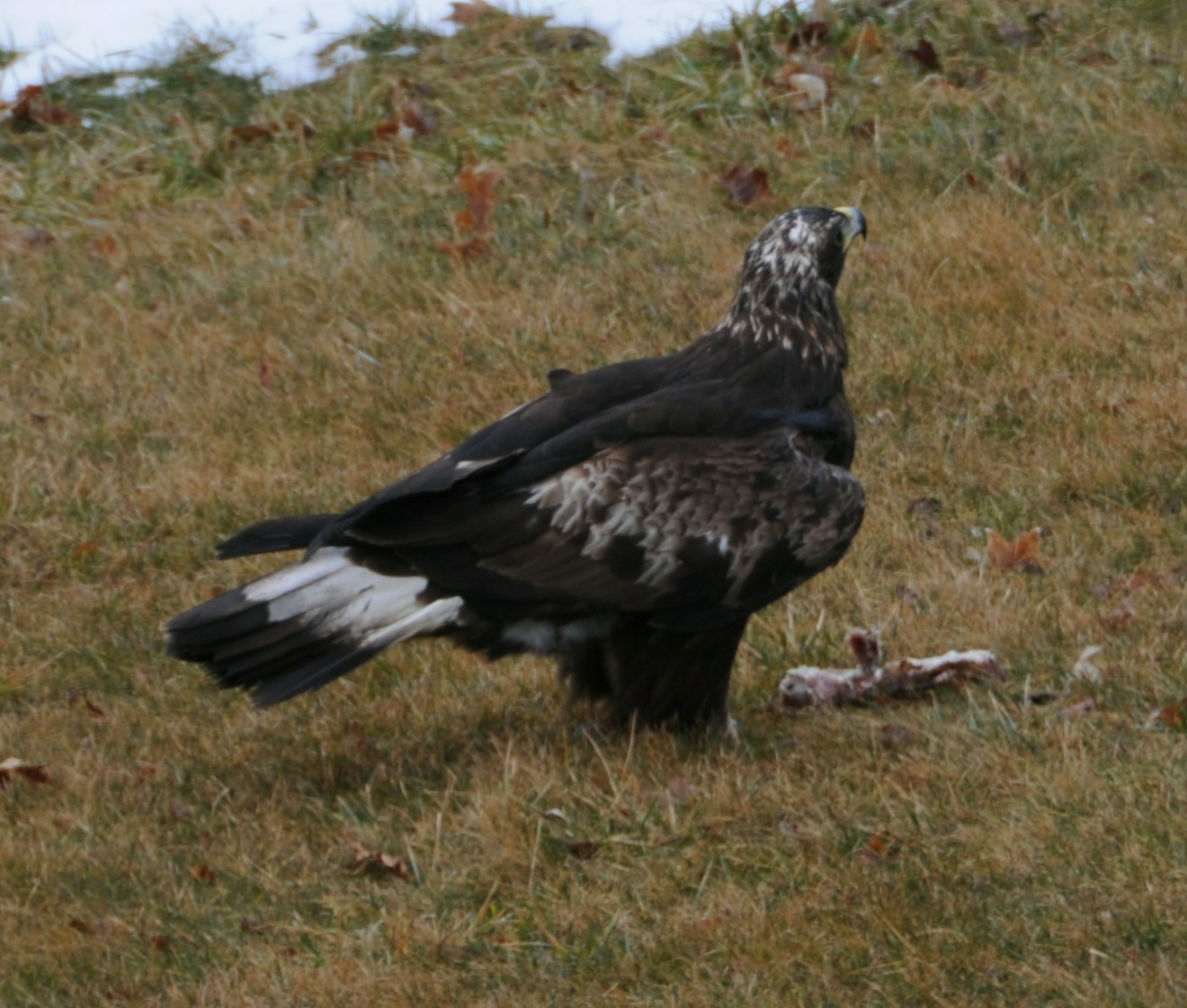
Golden Eagle 2(Photo Courtesy of Larry Thomas – Pendelton County, WV)

Environmental groups and the Senate GOP’s top environmental lawmaker are irate over a revised Interior Department  rule, set to take effect in January, 2014.  The modification will allow the Fish and Wildlife Service (FWS) to grant much longer programmatic incidental “take” permits to industrial wind energy facilities, transmission projects and other long-term energy operations to avoid current penalties, should they accidentally kill or injure bald and golden eagles.  The revised period for such industry protection will be thirty years, six times longer than the five-year term under current law.

Allegheny Treasures is pleased to offer the following discussion regarding this important topic with Mr. Larry Thomas, President of the Allegheny Highlands Alliance (AHA), which is a non-profit alliance of organizations and individuals  representing several states.  AHA is committed to protecting the mountain resources of the Allegheny Highlands.

AT Morgan:  Welcome Mr. Thomas.

Mr. Thomas:  Glad to be with you.

AT Morgan:  AHA, the organization you represent, has taken a strong position on industrial wind in the Alleghenies, specifically the high ridgelines traversed by these magnificent animals.  Yet the FWS has taken the position that it is necessary in order to further facilitate installation of industrial wind turbines at locations where the turbines present a clear risk to eagle populations.  What is your view of the FWS position.

Mr. Thomas:  We do not believe that anyone knows how many Bald and Golden Eagles there are, which is the reason 30 year take permits are a bad idea. There are no national studies confirming their numbers. Bald Eagles appear to be increasing in number, but many states stopped tracking their population around the year 2000. Golden Eagles have been estimated at 21,000 to 35,000 in western states in the lower 48 and 1,000 to 2,500 east of the Mississippi. Many experts believe their population is declining in the western U.S. and the eastern U.S. population is very small and vulnerable.

Unfortunately, even this six fold extension of authorized kills did not satisfy the wind industry.  In a statement published Friday, December 6, immediately following the FWS announcement; the wind industry stated that they still are not satisfied.  While praising the extension of “take” permits under the Bald and Golden Eagle Act from five years to a maximum of 30 years, the American Wind Energy Association (AWEA) said that “additional concerns” about the permit rule’s impact on the wind industry would require more negotiation between wind companies, FWS and AWEA’s “partners in the conservation community.”

“[T]his rule must only be a first step in creating a rational and effective approach to eagle permitting,” AWEA said, “and we look forward to working with FWS, the Department of Interior and our partners in the conservation community to address additional permit program concerns through future revisions to the Permit Rule.”

AT Morgan:  I included in a recent post comments from environmental groups who, to varying degrees, opposed the FWS ruling.  Are there any commentaries which stood out to you?

Mr. ThomasSave the Eagles International issued a biodiversity warning concerning the United States stating “contrary to the dubious studies financed and controlled by vested interests, the population of golden eagles in the Western States is on the decline. Wind farms are the main cause. The issuing of licenses to kill will accelerate the decline towards extinction.” Further, “considering that the Eastern and Central States are not acting any better, it is biodiversity in the whole of the contiguous 48 states which is in peril, including other species such as the Whooping Crane. No amount of bad science financed by the wind industry and government agencies has been able to convince honest conservationists that wind farms don’t harm bird and bat populations.”

Mark Duchamp, Save the Eagles International president, wrote the following letter to Secretary of the Interior Sally Jewell, which we provide for your convenience.

Letter begins:

“Dear Interior Secretary Salley Jewell,

As president of Save the Eagles International, I consider it my duty to make you aware of certain realities that your advisors won’t tell you about.

Allowing wind farms to legally kill eagles will result in the extinction of the Golden Eagle in the United States (1). It will cause numerous deaths in the Bald Eagle population.

Many more birds of prey will be slaughtered, causing some species to disappear from the contiguous United States. It turns out that wind turbines ATTRACT raptors (2). This is due to various reasons (3). No amount of mitigation will stop them from being decimated by the deadly blades: thirty years of efforts to solve the problem have failed. Compensation measures won’t help either, as young raptors born anywhere will eventually come in contact with the ubiquitous machines.

Wind turbines also attract insects, which in turn attract bats, swallows and swifts to their death (4). Bats are slow reproducers, and are already in decline due to White Nose Syndrome. Their disappearance would cause immense damage to agriculture.

For all of the above, I respectfully warn you that President Obama’s windfarm policy will cause a biodiversity catastrophe in the United States.

Sincerely,

Mark Duchamp

Footnotes:

  1. http://savetheeaglesinternational.org/releases/stei-opposes-licences-to-kill-eagles.html
  2. http://savetheeagles.wordpress.com/2013/05/28/raptors-attracted-to-windfarms-2/
  3. http://www.masterresource.org/2013/09/windfarm-mortality-disinformation/#more-27682
  4. http://wcfn.org/2013/07/24/biodiversity-alert/

Letter ends!

As you mentioned before, many other environmental organizations have now stated their concerns with this revised rule and some have stated that they will be taking action. To highlight a few:

American Bird Conservancy

Defenders of Wildlife

National Audubon

National Wildlife Federation

National Resources Defense Council

The Protect Our Communities Foundation

Sierra Club

The National Audubon Society took a particularly strong stand, stating: “Tell Interior Secretary Jewell the issuing of a 30-year incidental take permit for wind farms is unconscionable, and must be reversed.

AT Morgan:  What is the stated position of the Allegheny Highlands Alliance?

Mr. ThomasThe many organizations which form AHA are deeply concerned with this revised rule and documented attempts to circumvent existing Federal and state laws through governmental mandates, failures to enforce those laws that protect…and blatant disregard of those laws by the industrial wind energy industry.

As a result of our research AHA has concluded that compliance with major Federal and State laws established for the protection of our “Commons” is being circumvented, blatantly ignored and consciously broken by this industry and the federal and state agencies charged with enforcement thereof are ignoring their responsibilities. The industrial wind energy project developers and operators are relying on lack of staff and funding at federal and state agencies to provide adequate monitoring of their projects.

AT Morgan:  Perhaps you could provide examples of AHA’s concerns.

Mr. Thomas:  We are concerned regarding compliance to existing regulations.  For example:

In 1973 Congress passed the Endangered Species Act to “provide a means whereby the ecosystems upon which endangered and threatened species depend may be conserved, and to provide a program for the conservation of these species.”

The National Environmental Protection Act which was the first major environmental law enacted in the United States and is often called the “Magna Carta” of environmental laws.

The Bald Eagle Protection Act is extremely comprehensive, prohibiting the take, possession, sale, purchase, barter, or offer to sell, purchase, or barter, export or import of the bald eagle at any time or in any manner. In 1962, Congress amended the Bald Eagle Protection Act to cover golden eagles, a move that was partially an attempt to strengthen protection of bald eagles, since the latter were often killed by people mistaking them for golden eagles. The golden eagle, however, is accorded somewhat lighter protection under the Act than the bald eagle.

The Migratory Bird Treaty Act implements the United States’ commitment to four bilateral treaties, or conventions, for the protection of a shared migratory bird resource. The Migratory Bird Treaty Act protects over 800 species of birds that occur in the United States.

Federal and state decision makers must also consider the provisions and requirements of the National Forest Management Act, the Federal Land Policy and Management Act and the National Historic Preservation Act to assess the impact of industrial wind energy projects.

Additionally, numerous government agencies have spent enormous amounts of time and money developing ways to protect, preserve, or rehabilitate watershed areas on a regional scale and must be taken into consideration by the Federal and state decision makers in any consideration to allow the siting of industrial wind energy projects in “The Commons”. We list these projects to protect our environment on our website.

AT Morgan:  Perhaps, for the benefit of our readers, you could summarize the goals of the Allegheny Highlands Alliance.

Mr. Thomas:  First, it is important to note that the Allegheny Highlands Alliance (AHA) is a non-profit organization … a consortium of citizen/environment organizations with membership in five states along the Allegheny Front. Our organization is in the process of discovering the facts about industrial wind, its potential to reduce green house gases, its economics and the impact of industrial wind energy project installations on the ecology and human health.

Perhaps our goal is best explained by our Mission Statement – PROTECTING OUR MOUNTAINS FOR FUTURE GENERATIONS.

The purposes of AHA include:

  • To advance public knowledge and understanding of the cultural, biological, environmental diversity, uniqueness, and sensitivity of the major ridgelines that comprise the Allegheny Highlands;
  • To preserve and protect areas of particular scenic, geologic, biologic, historic, wilderness, and/or recreational importance in the Allegheny Highlands;
  • To aid in the establishment of responsible policies to protect scientific, educational or aesthetic values;
  • To conduct regional and resource studies as a basis for the wise use of the various resources of the Allegheny Highlands; to develop programs in energy conservation and wise production; and to serve local communities, the region, the people of the Allegheny Highlands as an agency for popular enlightenment, for cultural improvement, and for scientific advancement;
  • To advocate governmental policies for the conservation and wise management of energy and natural resources of the Allegheny Highlands.

AT Morgan:  Thank you, Mr. Thomas

Mr. Thomas:  You’re welcome!

AT Note: Should individuals or groups wish additional information, Mr. Thomas can be reached via email at larryvthomas@aol.com.

Bald Eagle 2(Photo Courtesy of Luci Ranes – Pendelton County, WV)

Posted in Allegheny Highlands Alliance, Allegheny Mountains, Appalachian Mountains, Archives, Bat/Bird Kills, Eagles, Endangered Species Act | Tagged , , , , , , , , , , | Comments Off on Allegheny Highlands Alliance comments on new Eagle “take” permits.

“DARN … if we could only place more wind turbines!”

From the University of South Denmark:  “Maybe the collapse (of the universe) has already started somewhere in the universe and right now it is eating its way into the rest of the universe. Maybe a collapsed is starting right now right here here. Or maybe it will start far away from here in a billion years. We do not know!

What are the chances that the industrial wind profiteers will claim they can save us from this catastrophe as well … if only we can help them convince Congress to extend the 20 year old taxpayer funded Production Tax Credit for a little while longer?

Hey!  I wonder if the US Fish and Wildlife Service had a heads up on this “collapse of the universe” study.  That would make perfect sense, if you think about it.  You know … why worry about the wind turbines whacking all those Bald and Golden eagles if we’re all just going to die anyway.

Sigh!

Posted in Bat/Bird Kills, Denmark, Eagles, Endangered Species Act, US Fish &Wildlife, Wind Power subsidies | Tagged , , , , , , , | Leave a comment

Killing Eagles – Rating The Responses (updated links)

Under pressure from the wind-power industry, the Obama administration said Friday it will allow companies to kill or injure eagles without the fear of prosecution for up to three decades.  (For your convenience, I’ve provided the complete FWS ruling as well as the official FWS Q&A at the end of this post.)  (UPDATE FOLLOWS FWS EMBEDS)

It is tempting to ramble on about industrial wind’s failings, most of which have been discussed here in earlier posts, but I’d like to focus on the initial responses of leading environmental groups to the US Fish and Wildlife’s cowardly decision to squander any remaining credibility and allow marginally performing for-profit companies to slaughter Bald and Golden Eagles at their wind plants for a full 30 years.

Oh, by the way … I’ve chosen to rate the responses offered by these folks because, well … because I can.

1 – Kelly Fuller, who formerly headed up the wind campaign at the American Bird Conservancy:  “The federal government didn’t study the impacts of this rule change even though the (law) requires it. “Instead, the feds have decided to break the law and use eagles as lab rats.”

Rating:  Excellent!  Clear, to the point, forceful!  (That’s precisely why we like her!!!)

2 – Dr. George Fenwick, President of American Bird Conservancy:  “Remarkably, this approach relies exclusively on the for-profit wind industry to self-report bird fatalities, even when such information may prove detrimental to the industry’s bottom line. While some companies may play by the rules, others may not, making this system highly vulnerable to deception. I don’t see how such a system will work to protect eagles.

Eagles are being asked to survive a brutal ‘one-two’ punch. On top of the impacts from the duration of take permits being extended six-fold, the birds will soon face an additional serious threat—a 12-fold increase in wind energy, if federal 2030 targets are achieved. So it is entirely conceivable, and probably even quite likely, that mortality impacts to eagles will get far worse.

Rating:  Very Good!  Full press release worth a read for additional issues raised by public-interest law firm Meyer Glitzenstein & Crystal and Dr. Michael Hutchins, National Coordinator for American Bird Conservancy’s Bird Smart Wind Energy Campaign.

 3 – National Audubon Society President and CEO David Yarnold:  “Instead of balancing the need for conservation and renewable energy, Interior wrote the wind industry a blank check. It’s outrageous that the government is sanctioning the killing of America’s symbol, the Bald Eagle. Audubon will continue to look for reasonable, thoughtful partners to wean America off fossil fuels because that should be everyone’s highest priority. We have no choice but to challenge this decision, and all options are on the table.

Rating:  Very Good!  It would be helpful if the National Audubon could exercise a little control of its Massachusetts offspring which, as Eric Bibler noted, “UNLIKE A HOST OF OTHER ENVIRONMENTAL GROUPS LED BY THE AMERICAN BIRD CONSERVANCY — DID NOT OPPOSE THIS LEGISLATION.”

4 – Sierra Club Senior Campaign Representative Sarah Friedman:  “After preliminary review, this move from the Fish and Wildlife service looks like it could cause serious harm to eagle populations. Wind projects can and should be developed and operated with the lowest possible impacts to eagles. Clean energy projects should be sited and developed in a way that helps to protect healthy and sustainable plant and animal populations. We should be able to choose safe clean energy for our communities while still protecting the places and wildlife that we love.”

Rating:  Weak!  Giving new meaning to fog, this wimpy statement is way too full of woulds, shoulds and coulds for my taste.  To me, the mush filled statement only confirms Jon Boone’s earlier suggestion that the Sierra Club’s “Support for Industrial Wind Technology Subverts Its History, Betrays Its Mission, and Erodes Commitment to the Scientific Method

AT Notes:

One thing that seems to be missing in this discussion is the fact that we have international treaties we are obligated to honor.  I find this particularly interesting, since the USFWS has a full section of their web site dedicated to that fact – A Guide to the Laws and Treaties of the United States for Protecting Migratory Birds.  Makes you wonder how we can expect other governments to take us seriously, doesn’t it?

In previous writings, I’ve stated that “I cannot abide the suggestion that we must sacrifice our environment in order to save it. This is an absurd argument enabling this energy imposter’s invasion of delicate habitat with little return. Sacrifice is, after all, a forfeiture of something highly valued for the sake of something one considered to have a greater value or claim. Environmentalists must consider the possibility that industrial wind, by its failure to perform to stated goals, does not then qualify for this sacred consideration.

This FWS ruling is simply sour fruit from the tree some environmental organizations, along with wind profiteers, helped to plant.

US Fish and Wildlife Service documents:

USFWS ruling:

USFWS Q&A:

UPDATED LINKS:

Kelly Fuller provided the following:

Below are press statements from conservation groups in response to the U.S. Fish and Wildlife Service’s rule change allowing 30-year eagle take permits. Right now, the final rule is on the Public Inspection desk, available at https://s3.amazonaws.com/public-inspection.federalregister.gov/2013-29088.pdf. It will be published in the Federal Register on Monday.

American Bird Conservancy: http://www.abcbirds.org/newsandreports/releases/131206.html

Defenders of Wildlife: http://www.defenders.org/press-release/fish-and-wildlife-service-tests-new-program-eagles

National Audubon: http://www.audubon.org/newsroom/press-releases/2013/interior-dept-rule-greenlights-eagle-slaughter-wind-farms-says-audubon-

National Wildlife Federation: http://www.nwf.org/News-and-Magazines/Media-Center/News-by-Topic/Global-Warming/2013/12-06-2013-Interior-Dept-Wind-Permit-Rule-Insufficient-to-Protect-Eagles.aspx

NRDC: http://www.nrdc.org/media/2013/131206.asp

The Protect Our Communities Foundation: http://protectourcommunities.org/2013/12/06/federal-rule-change-will-harm-eagles/

Sierra Club: http://content.sierraclub.org/press-releases/2013/12/us-fish-and-wildlife-service-rule-harms-eagles-and-sustainable-energy

If Center for Biological Diversity issued a press statement, it is not on their website.


Posted in Bat/Bird Kills, Endangered Species Act, Environment, Jon Boone, US energy policy, USFWS Guidelines | Tagged , , , , , , , , , , , | 10 Comments

Pinnacle – industrial wind’s fruit cake?

The holiday season is almost here.  It’s nearly time for the 100 year old fruit cake to make it’s trip to the next victim of re-gifting.  To use a joke I heard some time ago, there is suspicion that all the fruit cakes ever made were baked in 1913 and have just been passed around ever since.

That got me thinking about the Pinnacle wind plant in Mineral County WV and if, considering the suggestion made in recent news, the troubled local project might be well on it’s way to becoming one of industrial wind’s fruit cakes.

Granted, Pinnacle is only a couple of years old, but that’s kind of the point.  In it’s early stage I thought US WindForce LLC, headed by folks who wanted to be our forever and best neighbors, would be with us … well … forever.  It was only in testimony from the WV PSC approval hearings that I learned there was probably another party who would actually take over the actual building and operation of the project and that, contrary to my belief that USWFLLC were the “go to” folks, they were simply permit seekers.

While David Friend, leader of USWFLLC was confused during testimony about identity of the new entity, we later learned that it was Edison Mission Energy, a subsidiary of Edison International would take over responsibility to build and operate Pinnacle.

This seemed like a good outcome at the time because one of the cleary stated visions of the West Virginia Public Service Commission is to insure, as demanded in statement #5, “That consumers receive the best value in utility service from financially viable and technically competent companies.” The name Edison certainly seemed to satisfy the “financially viable” part and, after all, the list of names Mr. Friend bumbled his way through in his testimony all seemed to carry the name Edison.

As for the “technically competent” part, who better than the Edison name to insure the turbines to be placed among its neighbors would be tried and true.  Edison certainly wouldn’t be the kind of company to plop down some 23 untested behemoths and run the risk that they would negatively impact the quality of life of nearby residents.  Why, what would old Thomas Alva think?

All was right with the world, right?  Well, except for two minor issues:

  • Just weeks after the first blade spin, Mother Edison warned junior that it had better get it’s financial act together or ELSE.  Sadly, even though US taxpayers sent a thank you card to Edison with some $44,000,000 inside, Edison Mission filed for bankruptcy.
  • Simultaneously, with the beginning of the first blade spin, neighbors began complaining about the horrible noise and vibrations coming from the turbines which we’ve since learned … wait for it … were never used this close to homes before.  Of course, the noise issue also steps on the toe of Vision Statement #4 – “An improvement in the standard of living and quality of life for the people of West Virginia.”

Allow me the opportunity to commend the WV PSC for their superb review of the project, which led to the approval to construct.  Just kidding, of course.  Except for Vision #6, which insures the utility an opportunity to turn a “fair” profit, they, in my opinion of course, pretty much ignored their own Mission and Vision Statement.

Actually, my opinion of the WV PSC’s role in Pinnacle approval is that the outcome was preordained and the hearing was simply a required formality.

Ridiculous, you say?  During the initial noise complaints at turbine start up, PSC Staff notedPinnacle, nor the commission, expected noise levels of this magnitude. If noise levels are actually as high as the complainant alleges, Pinnacle is exceeding the noise levels inside a person’s home that the U.S. EPA believes is safe in the areas outside a person’s home,” the memorandum said. “Had the commission had this information before it when deciding whether to issue this certificate or not, the commission very well may have placed further conditions on this certificate to avoid exceeding the EPA’s noise guidelines for residential areas.

Further, the PSC Staff memo argued that “It is ludicrous to argue that because the commission possibly had incorrect information before it when it made its decision, it cannot now review that decision. Therefore, staff believes Pinnacle’s argument that this issue is beyond commission review should be rejected.

In spite of Staff recommendations, the WV PSC Commissioners decided that, because “the sitting order (which they generated) does not contain material terms and conditions related to noise or flicker and because the agency does not possess the statutory authority to address the issues raised by Braithwaite, (the initial citizen complaint),” they could do nothing to protect the citizens their Vision Statement directed them to do.

Why does all this wandering discussion matter?  Well, back to the fruit cake.

Some 32 lawsuits have now been filed against Edison’s Pinnacle wind plant.  The issues again center on the quality of life for residents surrounding the noisy turbines.  As I mentioned in an earlier post, now bankrupt Edison Mission Energy appears to have found a buyer in NRG Energy.

At first thought, the purchase might bode well for the individuals seeking relief.  NRG might add some financial stability to the floundering Edison Mission and perhaps NRG will take complaints seriously.

I thought that might work out well for the harmed neighbors of Pinnacle, and it still might.  Unless, that is, the suggestion that NRG Energy may “sell 1.1GW of wind capacity among generation assets that it seeking to buy from bankrupt developer Edison Mission Energy to subsidiary NRG Yield,” becomes another way to hand off this “fruit cake” to another entity further distancing Pinnacle from it’s original owners.  There’s no indication, that I can find, that the nomadic Pinnacle ownership will be part of this “sale,” but I do have to wonder, especially since Pinnacle is supported by long term agreements which appear to fit into the NRG Energy discussion.

Sure, it’s probably just a restructuring issue and hopefully, in the long run, will not complicate the ongoing lawsuits or, for that matter the outstanding agreements with the community.  That’s for the lawyers and elected officials to sort out.  But it seems, for an ignorant soul like me … all this name changing is not simply so the new guys can save on company stationary.

And frankly, to me, in the relatively short time Pinnacle has been around, it seems to have become the proverbial fruit cake, wondering where it will end up next.  And worse, the cooks with the original Pinnacle fruit cake recipe closed up shop here and moved a little way down the road to run another “bakery.”

I just hope our neighbors, some of whom likely supported the project, are treated with the respect they deserve by whichever corporate entity finally accepts ownership of, and responsibility for, Pinnacle.

I also hope our neighbors down the road at Dan’s Mountain can learn from our experience and demand, and receive, a full accounting of the pros and cons of the project.  They deserve a fair hearing before the Maryland Public Service Commission prior to any approval for the pending project is granted.

After all, as consumers and taxpayers, it’s their money.


Posted in Dan's Mountain Wind LLC, Mineral County WV, Pinnacle Wind Farm, US WindForce | Tagged , , , , , , , , , , | 1 Comment

November 19, 1863 – Gettysburg, PA

Posted in Uncategorized | Tagged | Leave a comment

Darn! If we’d only known!

From the New England College of Occupational and Environmental Medicine – Michael A. Nissenbaum, MD – “In summary, in many IWT (industrial wind turbine) projects, the preconstruction sound modeling has underestimated the eventual real world sound levels those turbine projects eventually produce.”

Hmmm!  With all the legal action swirling around about turbine noise and its severely negative impact on the quality of life of Mineral County WV residents, Dr. Nissenbaum’s study makes you wonder how closely the sound level estimates provided during WV PSC approval hearings for our local lawsuit magnet – the Pinnacle wind project – match the actual levels being experienced by the project’s many unhappy neighbors.

I don’t know if the poor folks who have now found it necessary to file some 32 lawsuits against the wind project due to noise and nuisance actually supported the construction of the Pinnacle wind project.  But, if they did support it, one would have to wonder if they would have, had they known then what they unfortunately know now.

Probably no sense asking the WV PSC for their opinion … they’re busy filling in for Sgt. Shultz.

h/t:  Industrial Wind Action Group

Posted in Edison Mission Group, Pinnacle Wind Farm, Pinnacle Wind Force LLC, West Virginia Wind, wind turbine noise | Tagged , , , , , | Leave a comment

Birthplace of Rivers

The producers of the following video suggest we “get to know West Virginia’s Monongahela National Forest in this preview of an upcoming episode of ‘This American Land,’ produced in collaboration with The Pew Charitable Trusts.”

Many thanks to Larry Thomas of the Allegheny Highlands Alliance for directing us to this video preview.

Visit the Birthplace of Rivers web page to learn more:  “The Birthplace of Rivers National Monument project is a citizen-based initiative to preserve a rare and iconic part of West Virginia’s Monongahela National Forest. The potential monument contains some of the state’s most recognizable and dramatic landscapes from the thundering Falls of Hills Creek to the limitless vistas of the Yew Mountains. Included in the proposed monument is the Cranberry Wilderness Area — the largest U.S. Forest Service wilderness in the East — and roughly 75,000 acres of wild Appalachian terrain that surround it. The area is home to some of the best hunting and the best trout fishing waters in Appalachia. Famed local author G.D. McNeill called the region the “Last Forest” and it’s easy to see why. The remote, rugged terrain is a haven for rare species and serves as the headwaters for six regional waterways.”

Posted in Appalachian Mountains | Tagged , , , , , , , , , , | Leave a comment

Germany’s energy future – COAL???

If shutting down Germany’s nuclear plants were a joke, this would be the punchline – “that power can’t be made up with renewable energy from wind or solar as such sources are too intermittent to provide reliable, round-the-clock power, according to analysts.

In addition, according to The Daily Caller article, “ten new hard-coal plants are scheduled to come online in the next two years” which will increase Germany’s coal capacity by some 33 percent.

More reason to thank our WV Representatives for their strong position on elimination of the production tax credit for industrial wind.

Posted in Wind Power subsidies | Tagged , , , , , | Leave a comment

“Fiscal Hawks” say no to industrial wind hand-out.

The Washington Free Beacon states that “Fiscal hawks in Congress are pushing to end a federal energy tax credit for the wind industry set to expire at the end of the year.”

Happy to report that all three Congressional Representatives from West Virginia, Nick Rahall – WV03, Dave McKinley – WV01 and Shelley Moore Capito – WV02, joined the list of 52 Members who signed a letter to the Chairman of the House Ways and Means Committee calling for an end to the generous subsidy, which began in 1992 as a means to jump start the industrial wind business.  Seems taxpayers are finally getting tired of cranking this old jalopy.

Sadly, our neighbors Pennsylvania and Maryland could only muster one Representative each, but we thank Scott Perry – PA04 and Andy Harris – MD01 for standing against this decades long multi-billion dollar handout to the wind profiteers.

The letter sent to the Chairman is provided here for your convenience:

Perhaps a note or a call to their offices to thank these Representatives is in order – US House of Representatives – Contact Information

Posted in West Virginia Wind, Wind Energy Legislation, Wind tax rebates | Tagged , , , , , , , , , | 1 Comment

Can you hear me now?

The most recent lawsuit against a Mineral County WV wind plant is sticking another fork into Edison VP Charley Parnell’s claim that installing louvers to eliminate turbine noise has “by all accounts … been a significant improvement.”

The WV Record reports that the new lawsuit brought by Gary and Amy Kalbaugh is “at least the 32nd lawsuit over the Pinnacle Wind farm near Keyser.”

According to the complaint, “This initial and continuing operation has unreasonably interfered with the use and enjoyment of Plaintiffs’ property along with unreasonably affecting the health and wellbeing of the Plaintiffs presently and believed to be on an ongoing basis.”

Seems the only thing quiet about the Pinnacle wind project might be the original developer – US WindForce LLC, which has since morphed into the Laural Renewable Partners LLC – the developer of the planned Dan’s Mountain wind project some 15 miles away in nearby Western Maryland.

Oh, I almost forgot about the cheer-leading officials who promoted Pinnacle as the new sliced bread … anyone heard from them lately?

Posted in Appalachian Mountains, Dan's Mountain Wind LLC, wind turbine noise | Tagged , , , , , , | Leave a comment