I’m confused: Salazar employs MMS support of Developer to approve Cape Wind, then splits the agency to eliminate potential “conflict of interest?”

A week ago we posed this:  “Cape Wind” Tribes might want to ask: Is the Department of Interior’s Minerals Management Service simply a rubber stamp for disaster?

As pointed out then, the MMS gave a pass on the design and construction requirements for the BP rig that self-destructed in the gulf.  This lack of oversight, to the benefit of BP, is suspected as contributing to the ongoing oil spill.

Secretary of the Interior Ken Salazar, during his decision process regarding the Cape Wind project, looked to two of his agencies for advice.  Representing the “move forward” position of the Developer was the MMS.  The National Park Service, on the other hand, agreed with the local Tribes who are very concerned that their ancient and sacred lands in the area of the “wind farm” will be destroyed by the turbines.

Well, it turns out the Secretary chose the advice of the MMS – supporting developers, over that of the National Park Service – supporting the Tribes position.

Now we learn that Secretary Salazar’s decided make a change to the MMS and break the incompetent monster into pieces.  Why?  Well, according to the Federal Eye, Richard Charter, a senior policy adviser for the advocacy group Defenders of Wildlife, said in an interview that there has always been “an inherent conflict of interest.”

Interesting!  If Mr. Charter’s suggestion is accurate, how reliable was the advice Secretary Salazar received from the MMS regarding Cape Wind.  Hopefully, there was no conflict of interest in play when the MMS suggested to the Secretary that he should not worry about the burial grounds, since they’ll be keeping an eye on things.

I guess it’s too late to reconsider your support for Cape Wind, Mr. Secretary?

Oh, by the way … you’ll like this from Jake Tapper’s blogIn the wake of the BP disaster in the Gulf of Mexico, the Department of the Interior’s Minerals Management Service (MMS) has continued to issue “categorical exclusions” for oil companies, allowing them to bypass the last stage of environmental review before proceeding with drilling projects, an Interior Department official told ABC News Wednesday.

Posted in Uncategorized | Tagged , , , , | Leave a comment

Google and the business of wind.

Newspapers must sell ads to survive.  Obviously, a good readership number increases their chances to secure advertisers.

Likewise, to pay for bandwidth and hopefully make a profit, online publishers either require readers to pay for access or rely on advertising.  The number of “hits” or site visits is the “readership number” businesses evaluate when deciding to advertise on a web site.  Sites with high traffic offer advertisers a larger pool of potential hits on their own web pages where they can, in turn, sell goods or services.

Using technology to link article content with advertisers is a very effective means of pushing readers and no one does that better that Google.  Read an article on fishing and up pops a Google generated ad for a wholesaler of lures, fishing poles and hip-boots.  Same is true of an article about the great outdoors, which might lead to Google generated ads for everything from Time Shares to spelunker hats.  Google seems to have mastered the selection logic which plays into ad placement.  After all, Google’s huge success has been putting advertisers and publishers together.

But something I noticed recently gave me pause.  As I’m reading an online news article discussing wind energy I noticed Google generated advertising blocks promoting the American Wind Energy Association (AWEA).  This bothered me a bit because I know that the AWEA is industrial wind’s multi-million dollar lobbying group.  Folks who happen to oppose industrial wind, of which I am admittedly one, have to do so on their own nickle and you’ll not likely see an ad campaign representing that side of the argument.

What bothered me, that might not have before, is the fact that Google has just entered the wind business in a fairly large way – nearly $40 million! So now, at least to me, Google’s placement of “click-able” ads promoting the wind industry in such close proximity to “news” stories about wind issues is a problem.

In “pre-Google wind” days, I understood the game.  The Google folks hoped the reader would click on the AWEA ad because that’s how Google earns revenue.  The AWEA would be tickled pink to see readers sent to their site via the Google ad where their pages will either reinforce a wind positive article, or counter one which speaks negatively about the wind industry, because that’s how the AWEA can influence folks to give the wind energy a positive nod.  Perfect then, now … not so much!

My problem now is that Google has become part of the wind industry which the AWEA promotes.  I’m not off on a “single-bullet” conspiracy, however one would hope that, as Google enters this business in a significant way, they don’t put themselves in a position to be accused of undue influence of their client’s (the Newspapers) readers.

Admittedly, Google does place a tiny “Ads by Google” notation on the ad they place on the Newspaper’s web site.  A reader with a keen eye might actually pick up on the note and conclude that the Newspaper didn’t solicit the ad or even place it,  It’s probably in the site owner’s interest to not appear  to have made the connection.  After all, a similar practice occurring in a hard copy paper might prove problematic for the Newspaper.  But, in reality, it wouldn’t surprise me if most readers didn’t notice that Google actually placed the ad.  In some ways, it might be beneficial to the AWEA if folks came away from the experience thinking the Newspaper saw fit to place the ad with the article.

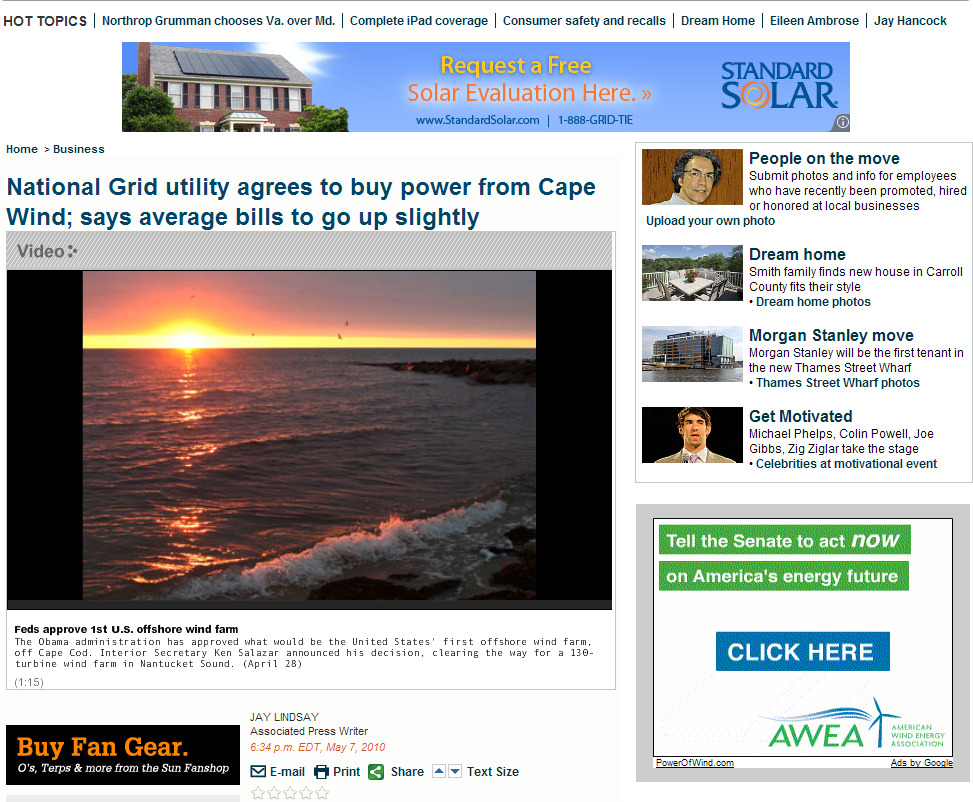
Oh, well!  I imagine many will see this as “much ado about nothing!”  They might be right.  But take a look at a few screen caps from recent local articles.  I wouldn’t be shocked to find that the folks who took the time to read the article might also be curious enough to click on the link demanding that the readers “TELL THE SENATE TO ACT NOW ON AMERICA’S ENERGY FUTURE.”

After all, like the Google ad says, you simply need to “CLICK HERE.”  And how easy is that?

h/t to Frank O’Hara for the Cumberland Times-News article.

Posted in Wind Energy Shenanigans | Tagged , , , | Leave a comment

Italian Study: “green investments are an ineffective policy for job creation.”

Jon Boone comments on the recent study:  “Are Green Jobs Real Jobs?  The Case of Italy

Mr. Boone’s comments begin:

A new Italian study reviews the evidence for creating so-called “green jobs” and the net effect of green subsidies on employment. The authors are Luciano Lavecchia and Carlo Stagnaro, members of the Bruno Leoni Institute (a well known independent think tank). The study is written in English, although with some clear translation problems. Still, its main points are clear:. Here is an excerpt from the conclusion:

“In this paper we have reviewed the available evidence on green jobs, finding that no conclusive evidence is possible regarding the net effect of green subsidies on total employment. Ac cording to the existing literature, though, the net occupational effect of green subsidies may be positive insofar a country is a technology-producer and –exporter. Italy is neither, which leaves room for a presumption of a negative net impact on employment. Moreover, some studies—most notably Calzada et al. (2009)—find that the net occupational effect may be negative in Spain, which is a technology-producer and –exporter.

In order to assess the situation in Italy, we have first of all estimated the amount of subsidies that have been spent or committed on renewables. To do so we have assumed the country will meet its 2020 “maximum potential” for wind and PV power, as calculated by the Italian Government (2007). This is likely to be an overestimate, leading to overestimating the num- ber jobs that will be created. Then, we have reviewed the existing estimates on the actual number of green jobs. Even though we feel like virtually all these studies overestimate the number of green jobs, we have taken them as a given, in order to use them as a basis for our projection of job creation by 2020. With these data, we have been able to estimate the total stock of capital embodied in the wind and PV capacity that will be on field in 2020, and hence to estimate the average stock of capital per worker.

Finally, we have compared the average stock of capital per worker in the RES with the average stock of capital per worker in the industry and the entire economy, finding an average ratio of 6.9 and 4.8, respectively. To put it otherwise, the same amount of capital that creates one job in the green sector, would create 6.9 or 4.8 if invested in the industry or the economy in general, respectively,—although differences exist between RES themselves, with wind power more likely to create jobs than PV power. This fact is particularly relevant be- cause we didn’t even consider the non-trivial value of the renewable energy produced, but we focused on pure subsidies. If we had considered the energy value, the average stock of capital per worker would result even higher. Since subsidies are forcibly taken away from the economic cycle, and allocated for political purposes, it is especially important to have a clear vision of what consequences they beg.

This does not necessarily mean that the creation of one green job would destroy 7 jobs in the industry. This just suggests what is obvious by anecdotal and financial evidence, i.e. that the green industry is a capital-intensive, not a labor-intensive industry. It is no surprise, there- fore, that green investments generate less jobs than investments in other sectors of the economy, and most notably the industrial sector. This does not even necessarily mean that the green economy is a net loss of resources, although there is some evidence even for this.

The only scope, and we dare to say the only result, of our study is to show that green investments are an ineffective policy for job creation. Regardless to their other merits, that we have not reviewed in this paper, to the extent that the “green deal” is aimed at creating employment or purported as anti-crisis or stimulus policy, it is a wrong policy choice.”

Mr. Boone’s comments conclude.

The complete study can be found at the Istituto Bruno Leoni, and is provided here for your convenience:

AT Note:  Mr. Boone is a  former University Administrator, Environmentalist, Artist, Author, Documentary Producer, and Formal Intervenor in Wind Installation Hearings.  Visit Mr. Boone’s informative web site for an extensive library of his writings at stopillwind

Mr. Boone, at the request of the Sicilian Government, recently addressed the conference which created The Charter of Palermo – To protect Europe’s “essential cultural landscape heritage” from the “leprosy of wind.”

Posted in Industrial wind jobs, Jon Boone, Wind Power subsidies | Tagged , , , , , | 1 Comment

Developing wind farms: It all comes down to money.

So, let me get this straight … if we don’t let you build your turbines anywhere you want, you won’t buy any of the electricity we might accidentally produce from ours?

Well, that seems to be the “take my ball and go home” shenanigans taking place in New York state.  Clean and green be damned.  And you good folks probably thought everyone was clamoring for the occasional belch of electricity generated from these tinker toys to save the planet.  Sorry to burst your bubble, but it really is all about the money!

These clunkers actually contribute nothing to the environment except to take up space in it … often destroying animal habitat and ancient view shed in the process.  But that’s a whole other conversation, as they say!

From the Watertown Daily Times:  “North wind farm market dries up

Richard M. Kessel, president and chief executive officer of New York Power Authority (the really big guns) said, “We respect their decision, and we won’t place any of our wind turbines in the area but, …” (and take this, you little whippersnappers of the local Jefferson County legislature) “we won’t enter into any agreement with any wind power project in the county.”

So effectively, New York Power pulled the plug on four proposed wind farms in Jefferson County, and likely the already permitted Galloo Island Wind Farm unless the locals can round up another stooge or two to cook up a power purchase agreement, described in the paper as “a guarantee from a utility or large end-user that it will buy Upstate’s electricity. Those agreements generally last 10 years.”

And why is power purchase agreement important?  Without that or a contract with the state for renewable energy credits from the power that is deemed environmentally friendly, it becomes “much more difficult to get financing,” said Carol E. Murphy, executive director of the Alliance for Clean Energy New York.  “You need to have something to show the bank,” she said.

And why aren’t Investors breaking down the doors?  Investors don’t want to bank on the price of electricity alone, because that fluctuates. And right now, electricity prices remain low — 2009 brought the lowest average price for electricity on the wholesale market run by the New York Independent System Operator in its 10-year history.

And when it comes down to “saving the planet” or making a couple of bucks, what do Investors want?  PROFITS!!!

But don’t give up on the wind developers, they will even dupe our states and major universities into these commitments in order to plop these poor performing whirlybirds on the land.

Still think wind energy is all about the green? … Well, you’re right!

Posted in industrial wind cost, industrial wind poor performance, Wind Energy Shenanigans | Tagged , , , , | 2 Comments

Glenn Schleede: Highly Misleading ACORE Report on Potential for Wind Energy

From Glenn Schleede, May 6, 2010:

A friend recently asked for my comments on the May 2009, “ACORE 20 GW Plan for Kansas,”[i] report, which claims that Kansas could get 20,000 megawatts (MW) of electric generating capacity from “renewable” energy sources (more than 18,000 MW coming from wind) and enjoy economic benefits.

I had heard of the ACORE report when it was issued but had not taken the time to read it since ACORE reports generally are biased and designed to promote the interest of ACORE members – as opposed to being objective and useful in advancing the national and public interest.

However, my friend claimed that the Governor of Kansas and other political leaders believe the report was useful so I downloaded it from ACORE’s web site and read it from cover to cover.

In summary, and as detailed below, the ACORE report:

  • Is highly biased, totally lacking in objectivity, based on unrealistic and often undisclosed assumptions, and certainly is not useful as a basis for public policy decisions.
  • Is highly misleading, particularly in its exaggerated claims of economic and job benefits.
  • Ignores the high cost that its recommendations would imposed on the people of Kansas.
  • Fails to identify and consider arguments against building a massive transmission system advocated by some electric transmission system owners and planners.
  • Raises questions about the discernment skills of political leaders if they have taken the ACORE report seriously.
  • Demonstrates the arrogance of the highly subsidized special interest groups that use misleading “reports” to influence the public, media, and government officials, and force high cost wind and other renewable generation into the nation’s energy mix and citizens’ tax and electric bills.

Allegheny Treasures Note:  “Mr. Schleede is the author of many papers and reports on energy matters.  He is now retired but continues to analyze and write about federal and state energy policies, particularly those affecting wind energy.”

“Until retiring, Schleede maintained a consulting practice, Energy Market and Policy Analysis, Inc. (EMPA)  Prior to forming EMPA, Schleede was Vice President of New England Electric System (NEES), Westborough, MA, and President of its fuels subsidiary, New England Energy Incorporated. Previously, Schleede was Executive Associate Director of the U.S. Office of Management and Budget (1981), Senior VP of the National Coal Association in Washington (1977) and Associate Director (Energy and Science) of the White House Domestic Council (1973).  He also held career service positions in the U.S. OMB and the U.S. Atomic Energy Commission.”

“He has a BA degree from Gustavus Adolphus College and an MA from the University of Minnesota.  He is also a graduate of Harvard Business School’s Advanced Management Program.

Posted in Glenn Schleede | Tagged , , , , | Leave a comment

Wind v Oil: The battle between electricity’s Lilliputians.

As a result of the explosion and subsequent oil spill in the Gulf, the barker at the industrial wind carnival finds another opportunity to claim that, with the continued generosity of US taxpayers and rate payers, they could replace oil as a source for electricity generation.

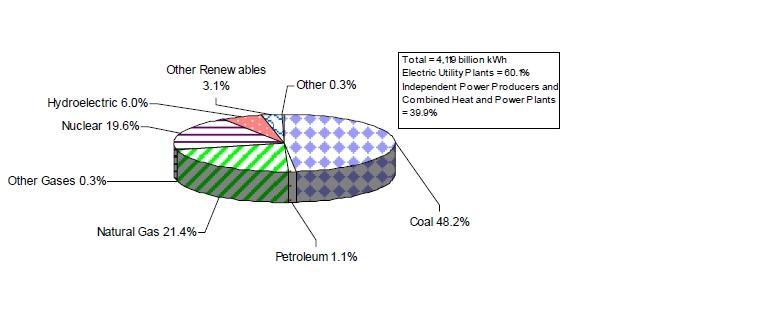
We thought a visual might be helpful.  This pie chart comes from the Department of Energy’s Energy Information Agency and represents the electricity generated from various sources.  Take note at the contribution of Industrial Wind (not enough to earn a category) and Oil at 1.1%:

Source: US Electric Power Industry Net Generation, 2008 – Department of Energy

All the more reason to check out Robert Bryce’s “Five Myths About Green Energy” column and his new book, “Power Hungry – The Myths of Green Energy and the Fuels of the Future.”  You can read Jon Boone’s comprehensive review of the book here.

Posted in industrial wind v fossil fuel, Jon Boone, Robert Bryce | Tagged , , , | 1 Comment

“Cape Wind” Tribes might want to ask: Is the Department of Interior’s Minerals Management Service simply a rubber stamp for disaster?

In a New York Times opinion piece, which I commented on recently, there was some dispute about moving forward with the Cape Wind project, which Interior Secretary Ken Salazar has since approved.

In my post I noted this, ““In addition, and more problematically for Mr. Salazar, two Indian tribes have said that Nantucket Sound is of great cultural and spiritual significance to them and that building the turbines could disturb ancestral burial grounds on lands that were above water thousands of years ago.

Mr. Salazar’s own department is divided on the matter. The National Park Service believes the tribes have a case; the Minerals Management Service says the project should proceed.

I bring this up again because, since the oil rig disaster that killed 11 people and threatens the environment, many want to use the explosion to promote wind power and installations such as Cape Wind.

Leaving all that debate aside for the moment I ask you to focus on another issue, one I raised in another related post which had to do with respecting the Native American’s heritage and the potential impact Cape Wind could have on ancient grounds held sacred by the Tribes.

I suggest if you’re seeking to link the oil rig explosion and the offshore industrial wind plant at the Cape, perhaps try the Department of Interior’s very own MMS.  The Washington Post published this article today titled “U.S. exempted BP’s Gulf of Mexico drilling from environmental impact study.”

The Post article today states that “The Interior Department exempted BP’s calamitous Gulf of Mexico drilling operation from a detailed environmental impact analysis last year, according to government documents, after three reviews of the area concluded that a massive oil spill was unlikely.”

Further, “The decision by the department’s Minerals Management Service (MMS) to give BP’s lease at Deepwater Horizon a “categorical exclusion” from the National Environmental Policy Act (NEPA) on April 6, 2009

Fast forward to Secretary Salazar’s Cape Wind’s decision.  He chose to side with the MMS suggestion that the project move forward implying there was no danger that drilling for the wind turbines massive foundation pads would disturb the ancient grounds.  Secretary Salazar elected to ignore the statement by his own National Park Service which suggested the Native Americans had a case in believing that Cape Wind would destroy their ancient grounds.

A stretch on my part?  Consider what a Massachusetts Congressman said of the MMS decision to waive the detailed study of the BP platform, “I’m of the opinion that boosterism breeds complacency and complacency breeds disaster,” said Rep. Edward J. Markey (D-Mass.) on Tuesday. “That, in my opinion, is what happened.”

Well, Congressman … we share your opinion on the results of of “boosterism!”  We see it in the increasing negative impact of industrial wind.

Posted in Cape Wind, Native Americans | Tagged , , , , , | Leave a comment

“… and as the sailors of Cape Cod will tell you over a quiet martini, the wind doesn’t always blow.”

Excellent commentary regarding Cape Wind from Stuart Burns, “Green Light For 130 Wind Turbines Off Cape Cod

Well intended as the detractors arguments are meant to be however they appear to have missed the most compelling reason for questioning the project – who is going to pay?”

Read full commentary here at MetalMiner.

Posted in Cape Wind, industrial wind cost | Tagged , , , | Leave a comment

Audubon Society, perhaps seeking to reduce the time spent counting hawks, supports industrial wind.

Here’s one to defy all logic!

In his commentary today, “Drawing a line on Shaffer Mountain,” Jack Buchan is concerned that Gamesa, a wind turbine manufacturer headquarted in Spain will be placing the massive structures on Shaffer Mountain, which sits on the eastern edge of the Allegheny Plateau, four miles east of Central City, PA.

As Mr. Buchan mentions, “Although it has been designated a Pennsylvania Natural Heritage Area of Exceptional Significance, boasting two of the highest-quality trout streams in the East, a world-renowned raptor migration flyway, an endangered Indiana bat colony and 11,000 forested acres with only two dirt roads, Gamesa USA insists on building an industrial wind plant there.”

Where Mr. Buchan, the Shaffer Mountain/Sensible Wind Solution folks of which he is a member and I part ways is that the group thinks industrial wind is OK, but just not here … on Shaffer Mountain.  See, I don’t believe industrial wind has a place on any mountain, plateau, valley or flatland.  They are the worst possible solution to our energy needs and serve only to pull financial resources out of the pockets of taxpayers and rate-payers while providing unreliable, minuscule amounts of electricity at the whim of the wind, not at the demand of the end user.  And for so little, it is extremely expensive and consumes vast land and air space.

Unfortunately, the Audubon Society uses similar logic in its support of industrial wind.  They seem to think Global Warming is going to kill a bunch of birds so they’re willing to kill a bunch of birds to make sure that doesn’t happen.  They think industrial wind will reduce the amount of greenhouse gases in the atmosphere even though that has not been the case, and there is no evidence industrial wind will ever do so.  If Mr. Buchan and the folks at the Shaffer Mountain group would read more of what Robert Bryce, featured on their web page, and Jon Boone have to say about industrial wind, they would soon see that the Audubon folks are wrong and perhaps, they might want to re-think their position.

What struck me most, when Mr. Buchan spoke of the Allegheny Plateau, and having been to the area a number of times, was that area, like my own further down the Alleghenies, is ripe for birds of prey and migratory flocks.  So, with a Google I learned that the Allegheny Plateau Audubon Society has this little spot up in the neighborhood to count raptors.  In fact, the announcement on their web page informs that “The Spring Raptor Migration Count  at the Allegheny Front Hawk Watch is underway.

The great thing about the Audubon folks is they even have a web page bragging about the views and encouraging bird watchers to come out and see it all for themselves.  They call it the “The Allegheny Front Hawk Watch Experience!”  How cool is that?

Heck, they count Golden Eagles, Bald Eagles, Vultures, Hawks of all varieties and birds, birds, birds.  It’s a really big deal, gathering to watch all these special creatures!  Want to know where you’ll find it?  It’s a cleared area at the top of Shaffer Mountain outside the town of Central City, PA.  Sounds familiar, doesn’t it?

Seems to me the Allegheny Plateau Audubon Society might want to revise their web page to let the visitors know that in order to do an accurate hawk count in the future, they’ll have to look at the ground as well as the sky.

I understand Mr. Buchan’s issues and support him on these entirely.  Again, where we part ways is his group believes wind energy has a place and I don’t.  But that doesn’t mean we can’t work together to save the Alleghenies from these erector set killers.  We’ll sort the rest of it out later.

Posted in Allegheny Mountains, Bat/Bird Kills, Jon Boone, Robert Bryce | Tagged , , , , | Leave a comment

Defense Secretary Gates: “homeland security concerns shouldn’t thwart home-grown renewable energy”

Iran building nukes; two wars with hundreds of thousands of troops placed in harms way; the Middle East ready to blow at any time and heaven knows what North Korea is up to and Defense Secretary Robert Gates has time to sit down with two Senators whining about a wind developer’s groundbreaking ceremony?

What’s next for this cast of buffoons, wedding planning?

As I wrote a couple of weeks ago, Senators Wyden and Merkley of Oregon had their shorts all in a knot because a wind developer was going to miss his opening day ceremony because the Air Force had concerns that the useless tinker toys planned for the Oregon landscape might interfere with their radar and, I don’t know, kill people?

So, in the typical political thuggery we’ve come to know and love, the good senators took three Defense Department nominees hostage.  Now I know we’re told the US Armed Forces won’t negotiate with terrorists, but that doesn’t apply to those who control your budget.  The hostage negotiations included Defense Secretary Robert Gates and Rahm Emanuel, White House chief of staff. A pretty high level negotiation for a private business, don’t you think?

Anyway, “under heavy political fire, the Pentagon has dropped its opposition to the huge Shepherds Flat wind energy farm in north-central Oregon.

Seems Gates agreed in a meeting Wednesday that homeland security concerns shouldn’t thwart home-grown renewable energy, Wyden said: “It was clear to me that he understood it was possible to do both.

And did they do both?  I mean cut the project loose and resolve the radar interference concerns?  You know, the issue that caused the FAA, with Air Force backing, issued a “notice of presumed hazard” to the project in March after years of planning … the one that contained the notice indicating that: Shepherds Flat’s turbines — and 1,800 other turbines built or proposed within the Fossil station’s range — would “seriously impair the ability of the (Department of Defense) to detect, monitor and safely conduct air operations.

Well, apparently not:  Dorothy Robyn, deputy undersecretary of defense for installations and environment, said Friday that the Defense Department isn’t sure how it will mitigate the radar concerns, though it’s likely to be a combination of software upgrades and physical improvements at the station.

Is this all of a sudden OK with the Pentagon?  Miraculously, having done nothing except hold meetings, the Pentagon concluded that it could do the mitigation work while the project is being built over the next 18 months, she said. “We wouldn’t be moving ahead here if we weren’t comfortable that any additional risk is very low,” Rabyn said. Ha, Ha, Ha … did she really say that???

As every fairy tale reader knows, there must be a warm and fuzzy ending … and this one did not disappoint:

“Hostage Taker,” aka Senator Merkley said defense officials made it “very clear” that the Shepherds Flat approval was not a precedent for future wind farms in Oregon or nationwide. (the precedent to hold the White House hostage remains intact)

But the Defense Department and Oregon’s delegation pledged to ensure that radar concerns are raised early in wind farm planning, not at the 11th hour. (even if they find that jet planes will be misdirected to Japan)

And everyone lived happily ever after.  Awwwwwww!

You can read the complete article at the Industrial Wind Action Group.

Posted in Industrial wind lobby, Wind Energy Shenanigans | Tagged , , , , , | Leave a comment