Just a little reminder – wind won’t replace coal. Sorry, but it’s just a fact!

Which begs the question … what the heck will it do?

Anyway, FactCheck.org writes in its article, Hot Air on Wind Energy – “Don’t expect wind power to replace coal as the nation’s main source of electric power, whatever Obama’s interior secretary said

If you recall, back in April of this year, Ken Salizar – Secretary of the Interior made a comment that was translated as saying there is enough offshore wind to replace every coal fired plant in America.  The highly respected, and neutral – I might add – FactCheck.org did an analysis and concluded … NOPE!

Well they actually said a lot more than that and it’s worth your while to read the entire article.  You can do it!  I promise it’s worth your time … especially when they say good-bye to Rhode Island.

Here’s the article in it’s entirety.  It’s pretty neat because they start with the summary and then break it all down for you.

FACTCHECK ARTICLE BEGINS

Summary

Interior Secretary Salazar said that the amount of “developable” wind power off the East Coast could produce more energy than all the coal-fired electric plants in the U.S., and that wind’s potential to replace most of our coal power “is a very real possibility.” We find his claims to be wildly optimistic, to say the least.

It’s true that government studies show there’s enough offshore wind to generate far more than coal plants currently do – in theory. But converting that wind to enough electricity to replace what’s now produced by coal won’t happen anytime in the foreseeable future. The Interior Department itself made clear its offshore wind estimate was a gross figure of potential resources only, saying in a report that there are several obstacles to achieving that.

We calculate that converting wind to enough electricity to replace all U.S. coal-fired plants would require building 3,540 offshore wind farms as big as the world’s largest, which is off the coast of Denmark. So far the U.S. has built exactly zero offshore wind farms.

Another government study last year concluded that to supply just 20 percent of U.S. electricity with wind turbines would require land-based equipment taking up an area “slightly less than the area of Rhode Island,” plus scores of offshore wind farms.

A Salazar spokesman says the secretary did not mean to say that replacing coal power with offshore wind power was a realistic goal, but was only trying to draw attention to its potential.

Analysis

At a public hearing in Atlantic City, N.J., on Monday, Interior Secretary Ken Salazar said that wind turbine installations off the East Coast could generate 1 million megawatts (1,000 gigawatts) of energy, enough to replace 3,000 coal plants. The Associated Press quoted Salazar claiming that wind power could replace most of the coal power in the United States. The AP account was syndicated in papers across the country. Salazar’s department says that he never implied that wind power would be immediately or even eventually capable of replacing fossil fuels. What did Salazar actually say? And is replacing coal power with wind power really plausible?

What Salazar Said

Here’s what Salazar said at the hearing, a public discussion of the offshore energy potential of the Outer Continental Shelf.

Salazar, April 6, 2009: According to our report there is over 1,000 gigawatts of power, that’s a million megawatts of power, that are developable off the Atlantic coast. You think about that, put it in the context of what it means, with respect to an analogy to, or a comparison to coal-fired power plants, it’s the equivalent of the amount of energy that would be produced from about 3,000 medium-sized coal-fired power plants. That’s a tremendous amount of energy that’s out there in the Atlantic.

The AP also quoted Salazar as saying:

Salazar, April 6, 2009: The idea that wind energy has the potential to replace most of our coal-burning power today is a very real possibility. … It is not technology that is pie-in-the sky; it is here and now.

According to the AP’s reporter, Wayne Parry, Salazar made the “here and now” claim in remarks to reporters, not during his public remarks on camera.

DOI spokesman Frank Quimby says of Salazar’s 3,000 coal plant claim: “He was using it as a metric, as a frame of reference,” not as realistic goal-setting. Salazar “has said many, many times that we’re going to need conventional fossil fuels … for the foreseeable future.”

But we find that Salazar’s claim that a million megawatts of offshore wind power is “developable” and that replacing coal with wind power is “a very real possibility” are far-fetched propositions.

A Mighty Wind

The report to which Salazar refers in his remarks is a recently released Department of the Interior publication that reviewed the available research on resources from the Outer Continental Shelf. In contrast to Salazar’s enthusiastic description, the report itself is sober about the challenges involved.

So what would it really take to replace coal with wind? Salazar is correct to say that there is evidence that winds along the East Coast offer a potential 1,000 gigawatts of energy production. The DOI report showed a potential 1,024 gigawatts from that area, based on information from the National Renewable Energy Laboratory. And if power plants with 1,000 gigawatts of capacity were running at full power 100 percent of the time, they could theoretically generate 8.8 million gigawatt hours of energy a year, more than twice as much as the entire United States 2008 electricity production. Of course, the wind doesn’t blow all the time and so wind turbines don’t operate at peak capacity all the time, either. But even if they ran at an average of 40 percent capacity, the DOE’s base assumption for offshore wind, the plants could in theory generate enough energy to replace coal and most other electricity sources as well.

That’s the theory. In reality, some backup source of power would still be required for those times when winds were not producing enough. Jonathan Cogan of the Department of Energy told us: “You couldn’t really, just by themselves, replace a steady baseload supply like coal-fired or nuclear plants with an intermittent supply” such as wind turbines.

And in any case, a number of factors stand in the way of achieving the full 1,000-gigawatt potential. For one thing, Interior report shows that 75 percent of the wind energy is far offshore and would require development in waters of greater than 30 meters in depth, which the report finds too deep for economically and technologically feasible turbines. DOI shows only 253 gigawatts of energy resource potential from turbines off the East Coast in shallower water. And as the report points out, that still doesn’t “account for other competing uses of the ocean that may conflict with offshore wind development.”

NIMBY Power

So far no offshore wind farms have been built in U.S. waters, even in shallow water. Turning “potential” offshore wind energy into real electricity requires overcoming huge practical problems including the NIMBY (“Not In My Back Yard”) factor. In a celebrated case, Cape Wind Associates is proposing to build 130 wind turbines on Horseshoe Shoal in Nantucket Sound, off Cape Cod. The project would occupy 25 square miles of ocean and come within 5.6 miles of Cotuit, near Hyannis. On a clear day, the 258-foot-tall towers (with blades reaching as high as 440 feet, taller than the 305-foot Statue of Liberty) would be visible on the horizon.

View from Hyannis
View from Hyannis

Opponents complain of “aesthetic pollution” and raise other objections on their “Save Our Sound” Web site. Project foes include former Gov. Mitt Romney and Sen. Ted Kennedy, who would be able to see the wind farm on the horizon from his family’s Hyannis compound (as in the simulated photo view from Hyannis Port at left, which was commissioned by Wind Power Associates for a federally required environmental review.) Former CBS News anchor Walter Cronkite, a longtime yachtsman, appeared in a TV commercial opposing the project, though he withdrew his opposition in 2003.

The project has been in the works for years, and plans were first made public in 2001. It now has the support of the current governor, Deval Patrick, and in January it cleared a major regulatory hurdle when the Interior Department’s Minerals Management Service concluded that it would have little lasting impact on wildlife, tourism or navigation. But according to the Boston Globe, the project still lacks nine state and local permits. Meanwhile opponents are fighting on, including local Native American tribes who say they are “spiritually connected” to Nantucket Sound and that the project would desecrate a “sacred site.” Nevertheless, Cape Wind says it expects to begin construction next year. Its maximum expected production will be 454 megawatts, but Cape Wind says it expects the actual average to be 170 megawatts.

If that’s the case, it would take more than 1,300 such projects to equal the current annual output of all U.S. coal-fired electric plants.

There Goes Rhode Island

Another way to look at the practical problem of locating wind turbines is given in a Department of Energy report from last May. It concluded that to produce enough wind power to satisfy only 20 percent of U.S. demand (less than half of what coal plants fulfill) would require land-based turbines and related infrastructure that would take up an area “slightly less than the area of Rhode Island.”

And in addition to those land-based plants, the 20 percent goal would require another 54 gigawatts of wind turbine capacity in offshore, shallow-water wind farms. That’s the equivalent of 119 wind farms the size of the proposed Nantucket Sound facility.

DOE found that the goal of producing 20 percent of U.S. electric power from the wind – by the year 2030 – “could be feasible if the significant challenges identified in this report are overcome.” Those challenges include limits on turbine performance and high initial costs of installation.

A Quarter-Million Turbines?

But what would it take to go beyond 20 percent, and replace all the coal-fired plants that now account for nearly half the nation’s electricity? And to do that using only wind farms in waters off the U.S. East Coast?

The highest-producing offshore wind turbine installation in operation, Nysted Wind Farm in Denmark, has 72 turbines and a capacity of 165.6 megawatts. Assuming that 40 percent of that capacity can actually be realized, we figure those turbines put out an average of about 66 megawatt hours in an hour. Producing enough power to account for all of what is now put out by coal-fired plants in the U.S. would require 3,540 installations of that size, comprising well over 250,000 individual turbines.

Bigger wind farms are on the way. Planned projects like the 95-square-mile London Array could have capacities closer to 1,000 megawatts, with perhaps a 400-megawatt hour output. But it would take 569 farms the size of the London Array to equal the output of all U.S. coal plants.

Correction: We initially used the phrase “megawatts per hour” at several points in the story. In fact megawatts are a measure of power (a rate at which energy is transmitted), not energy, so it is inaccurate to refer to megawatts per hour. None of the numbers in the story are affected by this change in terminology.

—by Jess Henig, with Brooks Jackson

Sources

Parry, Wayne. “Salazar: Eastern wind could replace coal for power.” The Associated Press. 6 Apr. 2009.

Ebbert, Stephanie, “Cronkite urges full review of wind farm proposal.” Boston Globe. 29 Aug 2003.

Energy Information Administration. “Electricity Net Generation Total: All Sectors.” Mar. 2009.

U.S. Department of the Interior. “Survey of Available Data on OCS Resources and Identification of Data Gaps.” Apr. 2009.

European Wind Energy Association. “Offshore Statistics January 2009.” Jan. 2009.

Cassidy, Patrick. “Cape Wind Permit Considered Likely.” Cape Cod Times. 13 Mar. 2009.

Alliance to Protect the Nantucket Sound. “National Organizations Call Upon Feds to Halt Review of Cape Wind.” 10 Apr. 2009.

Daley, Beth. “Cape Wind Proposal Clears Big Obstacle.” Boston Globe. 15 Jan. 2009.

United States Department of Energy. “20% Wind Energy by 2030.” May 2008.

Posted by Jess Henig and Brooks Jackson on Friday, April 10, 2009 at 1:28 pm
Filed under Articles · Tagged with , ,

FACTCHECK ARTICLE ENDS

Now, before you roll your eyes and say here we go again – another shot at progress from the nut-job wind haters, take a look at FactCheckWe are a nonpartisan, nonprofit “consumer advocate” for voters that aims to reduce the level of deception and confusion in U.S. politics. We monitor the factual accuracy of what is said by major U.S. political players in the form of TV ads, debates, speeches, interviews and news releases. Our goal is to apply the best practices of both journalism and scholarship, and to increase public knowledge and understanding.

FactCheck.org is a project of the Annenberg Public Policy Center of the University of Pennsylvania. The APPC was established by publisher and philanthropist Walter Annenberg in 1994 to create a community of scholars within the University of Pennsylvania that would address public policy issues at the local, state and federal levels.

The APPC accepts NO funding from business corporations, labor unions, political parties, lobbying organizations or individuals. It is funded primarily by the Annenberg Foundation.

Related articles:  “A Conversation with Jon Boone – Industrial Wind and the Environment” … “A Conversation with Jon Boone – Toward a Better Understanding of Industrial Wind Technology” … “Maryland to open new Bald Eagle meat processing facility in Garrett County.

Posted in Jon Boone, Wind v Coal | Tagged , , | Leave a comment

Maryland to open new Bald Eagle meat processing facility in Garrett County.

Some folks say today is a sad day for the environment.  I’m an optimist, always looking for the bright side.

Today’s news is great news for hunter-gatherers!  The Maryland Public Service Commission just approved a twenty turbine industrial wind installation for placement in the migratory path of endangered and protected Golden and Bald Eagles, Song Birds, Bats and other Endangered species on the high peaks of Backbone Mountain in Garret County.  Known for their majestic beauty, dense woodlands and wide array of wildlife, these mountains located in far western Maryland should provide a bounty of feathers and body parts for collectors.

You folks upset by this approval have got to stop sulking.  Don’t you realize in some areas it is still a crime to “take” (love that word – like going on a long vacation) endangered species.  I was once told that an individual in possession of even one feather from an eagle could be fined thousands of dollars and even jailed.  But, good news … from the looks of things, the lid is coming off that pot.  Nowadays, if you’ve got an egg beater the size of a football field that occasionally twirls, you can not only receive massive government subsidies for producing nothing of value, you can kill stuff.  How cool is that?  Check it out –

But here’s what got some folks all tied up in their underwear – according to the Cumberland Times-News article today “More than five months after a public hearing in McHenry, the Maryland Public Service Commission on Wednesday approved a Synergics Wind Energy LLC project that will result in 20 turbines being placed atop Backbone Mountain. Skeptics are upset that it takes 20 turbines, producing at an efficiency of somewhere around 15 to 35% of their rated nameplate capacity, to produce the output of 3 to 7 turbines!  They get all wound up about all that land and air consumed by these massive things.  I say … so what!  After all, how many eagles can you wack if you only put up 3 turbines?

Known as the Roth Rock Project, the 50-megawatt complex qualified for expedited review by the PSC. State law holds projects of 70 megawatts or more to a higher level of examination.
The complainers would probably like every wind installation to meet high standards.  C’mon guys!  It’s not like they’re permanent or anything … chill out!

The project has long been supported by the Garrett County commissioners, according to County Administrator Monty Pagenhardt
.”  I suppose with all the new tax money promised, it was hard for these folks to pass on this deal.  After all, it is a chance to get back a little of the money the members of the community were taxed to support construction and operation subsidies, after profits to the developer, of course.  And hey! … no one will mind the higher electricity rates because these units will soon be replacing coal-fueled power plants.  Wait … they won’t?  You mean … “With nearly 100,000 huge wind turbines now in operation throughout the world—35,000 in the USA—no coal plants have been closed anywhere because of wind technology. And there is no empirical evidence that there is less coal burned per unit of electricity produced as a specific consequence of wind.”

The article reports that “Frank Maisano, a spokesman for a coalition of wind energy developers, said Thursday that Synergics has obtained leases involving four landowners including Interstate Hardwoods and will begin construction of the Roth Rock Project in the spring when weather conditions are favorable.”  Frank Maisano … where have I heard that name?  It will come to me … oh yeah … “Frank Maisano, a Washington, DC lobbyist and media spokesman for Nedpower and who lives near the Bay, said that any allegation that a wind-powered project will be an “eyesore” is generally a claim without merit.” However, when asked by a reporter, he declined to say if he would want such a project built within two miles of his home. “I’m not living next to one, so I’m not going to answer hypothetical questions for you just for the sake of answering them,” he said. (Charlotte, WV Gazette, November 30, 2005.) Well, I’d probably agree with Frank, but I don’t know what his answer was.

Anyway, to the article, “The PSC ruled Wednesday that Synergics must keep the power grid safe and reliable and meet international standards for building turbines.”  See, you pessimists!  They have to keep the power grid safe and reliable and, oh … darn, I almost forgot … I asked Jon Boone about that a little while back:  But can’t the grid engineers somehow compensate for the variance? And why is it so important to balance supply and demand so precisely?

Boone Given what is known of demand cycles, grid operators, using computerized automatic generation controls, bring supply to match demand on a less than second-by-second basis within plus/minus one percent. And this includes balancing on-going demand fluctuations. After more than a hundred years of experience, grid engineers can predict demand very accurately, which is possible because aggregate demand is not fundamentally random, unlike wind volatility. If there’s too little supply, widespread brown-outs and black-outs will occur; if there’s too much supply relative to demand, the surge can fry both transmission lines and appliances. Even brief dips, like surges, can harm sensitive electronics that many of our lives depend on. Excess supply is also sometimes dumped, which is a financial loss to all tax and ratepayers. Dumping excess wind energy and/or shutting down the turbines, is a common situation in Germany, Spain, and Texas, made necessary when large spikes of wind threaten the grid’s security.

Yes, engineers can make-work by adding wind flux to the system, which further destabilizes the match between supply and demand. They can lead a horse to water; but they can’t make it change its spots.  By its nature, wind will require repeated flippering—lots of whips and whistles, even at small levels of penetration—in ways that will negate the very reason for its being—which is reducing CO2 emissions and backing down coal. This is why people quickly switched to steam 200 years ago. Retrofitting modern technology to meet the needs of ancient wind flutter is monumentally “backasswards.”  It’s also a sure sign that pundits and politicians, not scientists, are now in charge. It will take much more than a smart grid to incorporate such a dumb, antediluvian idea successfully.

And it’s not just the engineers who would benefit, for there are many “suppliers” only too happy to profiteer from this situation. General Electric, which bought out Enron’s wind projects when the latter company went belly up in 2001 and is today one of the world’s largest wind suppliers, recently gave a presentation to the Canadian government detailing all the problems with wind—followed by a long list of products that would assist wind’s grid integration. Look for GE wind ads on its subsidiary, NBC.”

Ok!  But the PSC did insist they meet international standards.  There you go naysayers!  You know they’ve been building these things in Europe for a long time.  What could go wrong? –

Never mind that … what about tourism?  Got you there, sad sacks!  We know no one ever comes to the mountains to see the mountains, but now I’ll bet the buses are lining up.  Again, where else can you go to see this for free

It was so good I thought you might like to see it twice.

So, for all you complainers out there – knock it off!  This is just one more in a set of turbines planned to grace the boring mountain tops of the Appalachians.  As the article said “Backbone Mountain is also the site for another wind energy project that has already been approved. Clipper Windpower would build 28 wind turbines there.”  Mt. Storm in nearby WV has a bunch of eagle beaters over there and US WindForce is seeking approval for an installation they already plan to sell in Mineral County.  The race is on folks!

Remember what Rick Webb, senior scientist with the Department of Environmental Sciences at the University of Virginia, said “It would require more than 300 miles of wind turbines, stretching the entire length of the Blue Ridge Mountain chain in Virginia, from Mount Rogers to Harpers Ferry, to match the August peak-demand period output of Dominion’s controversial new coal-fired power plant in Wise County.”  Darn, add in WV, MD and PA and shezaam!  With a gauntlet like that, I’ll bet Canada will be wondering what the hell happened to the all the birds that used to show up.

And, here’s the best part of the joke – they’ll build thousands and thousands of these windmills and they still won’t replace any coal fired plants.  Heck, China is putting up a ton of wind plants and, at the same time, building coal fired plants just to make sure when someone flips a switch the light actually comes on.  Of course, China can afford to do so since a big chunk of the 85% of the stimulus package intended for renewables that blew overseas, landed there, and Europe is paying for the turbines China is making for themselves.

I mean, is this a great country or what?  The government takes taxpayer money, gives it to for-profit companies to build something that contributes virtually nothing.  The company then takes the taxpayer subsidy, proceeds to destroys the mountain’s environment, and kicks back a little to the locals for their troubles.  They then charge higher electricity rates to the end user located far, far away from where the couple of kilowatts that might actually enter the grid, is generated.  And everybody’s happy!  Well, except for those nuts trying to stop the killing and destruction.

Now that’s so smooth it reminds me of what my Dad used to say about a local politician from long ago, “He could tell someone to go to hell and they’d look forward to the trip.”

Well friends, we’re on a Highway to Hell and it’s named Industrial Wind!

Full Cumberland Times-News article here.

Related links:  “California has a novel idea to protect birds and bats. Don’t build wind plants where they fly! UPDATE: VIDEO SHOWS WHY!” … “A Conversation with Jon Boone – Toward a Better Understanding of Industrial Wind Technology” … “A Conversation with Jon Boone – Industrial Wind and the Environment” … “Agencies sworn to protect must not permit the kill.” … “The Allegheny Highlands – Where eagles dare!

Posted in Allegheny Highlands Eagles, Appalachian Mountains, Bat/Bird Kills, Eagles | Tagged , , , , | 1 Comment

The Windpower Industry’s “top ten” false and misleading claims … Number 7 – Industrial wind developers are interested only in providing a public service

From StopIllWind – Drop by for a huge library of facts about Industrial Wind Energy.

#7. Industrial wind developers are interested only in providing a public service.

All the false and misleading claims which this industry makes for itself work to disguise the fact that it is only a nominal producer of electricity in the eastern US. Its primary purpose is to increase profits by providing extraordinary tax and income sheltering opportunities for a few wealthy investors—such as Florida Power and Light, which owns the nation’s largest stock of wind projects, AES, General Electric (which purchased Enron’s windplants when the latter company went bankrupt), and BP—at the expense of average taxpayers and ratepayers.

Taxpayers presently cover between 65-80% of the capital costs of all wind installations, allowing wind ownership to avoid paying their fair share of taxes to the federal treasury.  On a per kilowatt hour basis, wind is the most heavily subsidized source of industrialized power in the nation, receiving 25 times more support than coal, natural gas and hydro, and 16 times more than nuclear generation.

Congress has provided wind developers with an accelerated double declining capital depreciation schedule and extraordinary investment and production tax credits.  With laws ensuring a captive market and with tantalizing incentives for profit, investment in wind seems nearly risk free.  The only remaining factor assuring success is access to land—and lots of it.

At the same time, also in response to a long term and very sophisticated political lobbying effort, Congress has re-authorized substantial subsidies to wind development, including an accelerated capital depreciation schedule and extraordinary investment and production tax credits. With laws ensuring a captive market and with tantalizing incentives for profit, investment in wind seems nearly risk free. The only remaining factor assuring success is access to land—and lots of it.

This is a major obstacle to the industry. A typical windplant is gigantic, consisting of dozens of 400 foot turbines arranged along many miles of access roads and communication/transmission line infrastructure. But the potential for profit is so great that wind investors are working hard to bulldoze opposition in order to secure the land they so desperately need. Meanwhile, Congress has made wind initiatives so lucrative that it seems to have discouraged responsible citizenship. Consider what’s at stake financially:

* Federal production tax credits remain front and center for wind developers and their investors, giving the industry tax credits worth 2.1 cents for each kilowatt-hour it produces. As cited in Claim #4, a modest 40 MW windplant should produce about one hundred million KW hours annually (each 1.65 MW turbine would yield about four million KW hours a year), generating over $20 million in tax credits over the ten year period allowed by the production tax legislation. Since this windplant, if it produced steady energy, would power about 9000 homes a year, the total subsidy, underwritten by taxpayers, would be about $2,500 for each household powered! But this is just the beginning of the story. At a recent Maryland Public Service Commission heading, a spokesman for Clipper Windpower, a company proposing to erect a 100MW wind facility in Western Maryland, told the hearing examiner that his company expected $150,000,000 from production tax credits leveraged over a ten year period.

* Moreover, federal tax benefits pay as much as two-thirds of the capital cost of each $4.5 million wind turbine, with many states creating incentives to cover on average an additional ten percent of these costs. Windplant owners can use these tax credits to reduce their corporate tax obligations by tens of millions each year, as the Marriott Corporation did a few years ago with a similar clean energy scheme, within a year reducing its corporate tax obligations from 36 to 6 percent—at a savings of nearly $100 million, with average ratepayers and taxpayers picking up the slack to the federal treasury (See “The Great Energy Scam: How a Plan to Cut Oil Imports Turned Into a Corporate Giveaway,” Time Magazine, October 13, 2003. Read an excerpt here).   And Florida Power and Light, using primarily its wind tax shelters, has not paid any income tax for years, despite having annual revenues in the billions.

* State renewable portfolio standards laws make it probable that wind companies will likely charge utilities double the price paid for coal. For example, a 140MW wind facility as a consequence will likely reap 25 million dollars annually for the product it generates, and almost all of that energy product will be wasted in the electricity grid’s spinning reserves. In addition to its lucrative production tax credits, the wind industry is a lusty cash cow.

One should be mindful that most of limited liability wind companies are merely “mom-and-pop” operations (US Windforce, Synergics, Critierian) formed to assemble the initial capital and grease the local officials. Once the wind project is approved, they either sell it to companies like Constellation Energy, Florida Power and Light, or AES, which have a lot of discretionary income to shelter, or enter into an “equity” partnership with them, which accomplishes the same purpose (but hides the situation from the public).

It is for these kinds of rewards that wind developers have placed private gain over the public interest. In the process, they have transformed the wind business into yet another extraction industry, relying upon false claims and the gullibility of those seeking easy solutions to complex problems. There are now about 35,000 industrial wind turbines in operation across the United States, producing less than one percent of the nation’s actual generation. No coal plants have closed anywhere. And no empirical evidence exits that there is less coal burned per unit of electricity produced as a specific consequence of wind. And, there is no evidence whatsoever that the nation has reduced CO2 emissions in the production of electricity. Indeed, none of the industry’s substantial subsidies are indexed to actual measured reductions of CO2.

Posted in Jon Boone, Wind Energy Shenanigans, Wind Power subsidies, Windpower Industry False Claims | Tagged , , , | Leave a comment

Hey, there’s this PSC hearing on a wind farm in my district. How about dropping by and slamming the folks I represent and, oh … would you drop off this note for me?

First I have to acknowledge I don’t know exactly how political stuff works in Charleston or other parts of West Virginia, but I know how it should work in Mineral County.  If my interpretation of a certain activity at the recent WV Public Service Commission hearing to gather evidence about an industrial wind installation is correct, I think our Mineral County representation needs a real – kick in the pants – shake up.

It seems WV State Senator Helmick shows up at the hearing for a project unrelated to his own 15th district and proceeds to tell the PSC the project should be approved so Mineral County can begin to pull it’s weight and send some more “bucks” to the state capitol.  Had I been in charge of the meeting I would have cut him off right about there and asked if he had any actual evidence to offer relevant to the proposed construction.  Lacking any, I would have asked him to sit.  But, professional courtesy often permits some folks to take a few extra steps toward the edge of their power, power we mere mortals can only dream of.  I’ll come back to that.

At the kick-off of his bash, Senator Helmick was proud to announce he was carrying “some letters written by my colleagues and political confidantes in that area, Senator Bob Williams, Senator David Sypolt, Delegate Allen Evans, County Commissioners Cynthia Pyles and Janice LaRue.”  Of course, these are the folks we elected to represent the area set up on Senator Helimck’s tee.

Now this could be all innocent.  Maybe Senator Helmick mentioned he was making a delivery in the area and would drop off all the notes written by his “political confidantes” to save postage and just thought he might as well clobber the hell out of Mineral County as a deadbeat area while he was there.  To believe this, you’d have to believe also that our Representatives had no clue he was going to insult Mineral County.  But, were that the case, you would think the local papers would be flooded with their letters of outrage for the suggestion made by their “colleague.”  I didn’t notice any!

Another possibility is that the “political confidantes” representing us freeloaders are intimidated by what the Charleston Daily Mail calls the “master doohickey finagler” for his penchant for attention grabbing “bizarre, creative gadgets (he uses) to cast his votes,” and chose to simply let him run down their county with their silent, implied agreement.  This seems a likely possibility because his out of left field feeble endorsement for a project having no impact on his life certainly should have garnered some attention in Mineral County, beyond that of the Allegheny Front Alliance.

See, Senator Mr. Helmick didn’t seem so much to endorse the project on its merit, but more as an opportunity for the citizens of Mineral County to gather some tax revenue to help pay bills.  I guess the good Senator thinks revenue from the wind industry is a good idea.  I suppose the logic resides somewhere that taxpayer dollars, once removed and recycled as heavily funded subsidies to wind projects by federal and state governments will, after profits are taken, return as tax revenue generated by new money.  To me, taxes on taxes as a good thing is a puzzling concept.  But maybe that’s because I pay taxes and don’t get to dole them out.

I don’t have, nor could I find copies of the letters from the district 14 Senators Williams or Sypolt or the one from Delegate Evans in the record, so I cannot comment on whether they supported or opposed the wind installation, but let me take a wild stab – I think they support,  Otherwise their “political confidant” might not have made an announcement when he presented them.  I can’t say if their letters agreed with Senator Helmick’s suggestion that Mineral County owed the state acceptance of the set of eagle grinders considered for placement in the migratory flyway of the Alleghenies as some sort of penance or restitution.  No matter, as that is their right as private citizens to speak for or against.  Just as it was the right of Mr. Helmick as a private citizen to drop by and listen to the testimony, just as it is mine to read it and comment.  But for the PSC to give any weight to his request for cash, simply because he has a job in Charleston, is silly.  This was a hearing to gather evidence.  The PSC already received dozens of letters from people outside the affected region asking them to approve the installation in someone else’s yard, so we didn’t really need Mr. Helmick’s private citizen point of view to consume hearing time gathering undue attention.  He could have dropped his letter off with the others.

Oh, don’t take this as disrespectful to Senator Helmick.  It just happens in my view it was not the Senator, but private citizen Mr. Helmick who showed up at the hearing and was simply taking advantage of a title related to his day job.  In fact, the opening line from PSC Commissioner Albert gives me that clue.  He said, “Okay. We did allow for additional public comment at this hearing.  I see Senator Helmick sitting out there. Senator, do you have a statement you want to make?”  Familiarity among peers is understandable, but by addressing a “public” commenter by his official title implies more weight might be given to his words than, say, an average person like me.

And, I guess my problem is this.  Entering into “evidence” what I consider oblique support for the project as a supplier of “bucks” to the state coffers he oversees coupled with a publicly expressed disdain for any county that doesn’t have ski lifts or mine coal, is ridiculous.  The fact that Mr. Senator Helmick gave no scientific, economic, health related, environmental or even valuable evidence directly related to the installation brings into question the whole reason for his appearance and frankly, what little he offered to the proceedings he could have easily sent in a letter.

What follows should be of particular interest to the citizens of Mineral County, WV.  The words of Senator Helmick may tell you a lot about what’s wrong in Charleston.  The lack of vocal outrage by the individuals representing Mineral County over Senator Helmick’s comments might tell you a lot about wrong with our representation.

The full text of Day 1, October 26, 2009 is at this link.

Hearing Statement begins:

PSC Evidentary Hearing – October 26, 2009

COMMISSIONER 1 ALBERT:  Okay. We did allow for additional public comment at this hearing. I see Senator Helmick sitting out there. Senator, do you have a statement you want to make?

SENATOR HELMICK:  I do, Your Honor.

COMMISSIONER ALBERT:  Why don’t you come up and take the witness stand?

SENATOR HELMICK:  Your Honor, prior to me making —.

COMMISSIONER ALBERT:  Senator, look down to see if the grey button is pushed down so that there’s a blue light shining.

SENATOR HELMICK:  We’re on.

COMMISSIONER ALBERT:  All right. Now we’re on.

SENATOR HELMICK:  Your Honor, prior to making a statement in support of Pinnacle’s wind farm application, I do want to offer some letters written by my colleagues and political confidantes in that area, Senator Bob Williams, Senator David Sypolt, Delegate Allen 1 Evans, County Commissioners Cynthia Pyles and Janice LaRue. I would offer those.

COMMISSIONER ALBERT:  All right. Fine.

SENATOR HELMICK:  My role in state government — and I think I have to go back there in order to be clear on what I’m about to say — is to watch the generation of dollars and to use those dollars the best that we possibly can and be as fair as we possibly can throughout the state.  We have several counties in West Virginia that are counties that generate. They carry their own weight, that use their resources in a way that’s very helpful to the entire package of state government.

And for instance, if you look at some of the counties that generate coal, Boone County gives us $20 million — $60 million extra per year from local resource. Pocahontas County, where I live, we utilize the top of the mountain at Snow Shoe and generate significant money.  We are the number one county in West Virginia in producing local share dollars, that is dollars toward our education system, which is our number one expense in West Virginia. And then we have other counties — Jefferson County, because of our gaming efforts there, last year gave us $171 million just by large — by all measures, the largest share of dollars.  So they recover their cost and help. And so each county  uses what they have available to them, if you will, to help out.

And throughout the eastern part of West Virginia, in this town, we don’t have great timber. We don’t have a lot of the other resources. We have no coal. We have very little resources, and so you have to be innovative in the things that you do and utilize, you know, what’s given to you in a responsible way. That’s why I support the effort there. I supported it in some other counties, said, okay, step up and be a part of and generate some activity in there. It will bring, in this case, $433,000 to the local tax structure. And the bigger part of that 70 percent — if you break it out, 70, 30. Seventy (70) goes to educating our youth, which indeed, as we all understand and know, is the future of West Virginia.

So looking at it from all sides and what they have to offer in Mineral County, they have something to offer here that they can help all the people of West Virginia and help the students and the base of Mineral County. Several counties have the distinction of — 35 of having the Board of Education being their number one employer and that’s not the way things really should work. We should see total activity. And in the case of Mineral County, we’ve put significant bucks in there from state level, from state government. We’ve put some in stage [sic] college, the education system there. So we do a huge amount, but this would be an opportunity to help in a responsible way to offset some of those costs that the rest of the state has to bear because basically all the nine counties — the 14 over the years that I’ve represented, we’ve had few counties like Webster County that carry their own weight because of the coal industry there. They’ve utilized their local resource and carried their own weight. Some of the others I’ve mentioned, but in this case here, it’s an opportunity for local folks to help themselves, and while they’re helping themselves, they’re helping the State of West Virginia. Thank you.

Hearing Statement ends:

Before everyone gets in a lather, I write this for myself and not for any group.  If I happen to see something I think needs a little daylight, I’ll try to open the blind a bit.  As always, I’m open for correction of any misunderstanding, error or broken link.  Just send a comment and it will all be fixed.  This whole process is not to end conversation, but to allow it to begin.

So, the comment section is open and available for any and all.  It would be greatly appreciated should any of the elected officials named as “political confidantes” by Senator Helmick respond to the good Senator’s implication about the community they represent.  I would suggest they do so in one of the local papers since the circulation of this little blog is just the few of us actually reading it.  Why do I have this feeling we’ll hear nothing?

And, by the way, I do have a little Mineral County coal for Senator Needsthebucks …  it’ll be in his Christmas stocking.  For the others, if you did speak or write to defend Mineral County I apologize for missing the piece and would be pleased to publish your comments here.  For those of you who permitted this to go unchallenged, your stocking might contain a Wizard of Oz official lion costume.

Posted in Mineral County WV, US WindForce, Wind Energy Shenanigans | Tagged , , , , | 1 Comment

Email to Governor Joe Manchin questioning the decision by the WV Division of Culture and History to allow wind installations to negatively impact historic sites.


In an earlier post I committed to ask Governor Joe Manchin his position of the “sale of landmarks” issue discussed in this post: “A question for the WV Division of Culture and History – What’s a Historic Civil War Site go for these days?

Following is the text of that email sent to the Governor today, November 17, 2009.

Governor Manchin,

“The mission of the West Virginia Division of Culture and History is to identify, preserve, protect, promote, and present the ideas, arts, and artifacts of West Virginia’s heritage, building pride in our past accomplishments and confidence in our future.”

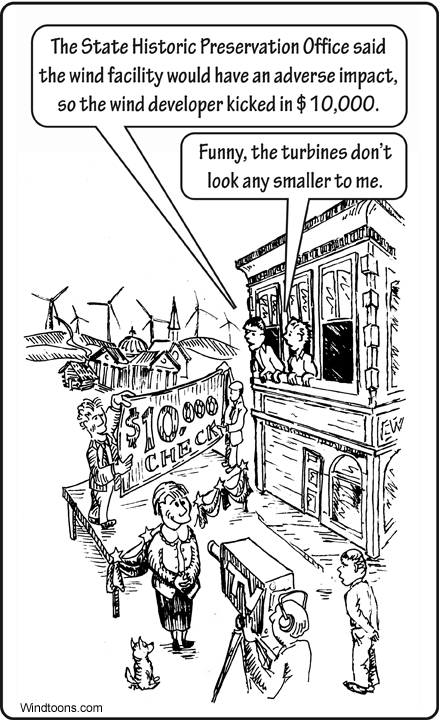
Taking this statement at face value, one wonders why the West Virginia State Historic Preservation Office feels compelled to accept a financial settlement in order to permit a “for-profit” business to adversely impact the very West Virginia historic sites they are charged to protect, in advance of the actual activity which will create the problem.  My interpretation of “identify, preserve, protect, promote, and present the ideas, arts, and artifacts of West Virginia’s heritage” does not include the statement, “unless we get a few bucks!”

The WVSHPO recently priced the negative impact of a pending industrial wind installation in Mineral County, which, by their own assessment, will negatively impact 18 historic landmarks, for the paltry sum of $10,000.  Should this project, which is before the WV PSC, be permitted, twenty-three huge turbines will be placed in the Allegheny Mountain migratory flyway, and reside there for some 25 years.  Whether you support the concept of wind energy as a viable resource or not, has no bearing on the fact that this “sale of landmarks” amounts to an incredibly ridiculous resolution to the problem, which, again, the agency itself has determined will exist should the turbines be erected.  If the issue is view, please explain how a $10,000 check eliminates the issue.  The very execution of this agreement between the WVSHPO and US WindForce, the wind developer, is insulting.

It is important to point out that the WVSHPO did not take into consideration the impact on our close neighbor’s historic sites in the study and resulting mitigation.  The WVSPO, at the same time it settled Mineral County and ignored Maryland, is asking that the state of Virginia take corrective action to a wind installation project which will cast a similar negative view impact on Camp Allegheny.  Based on the willingness of the WVSHPO to settle Mineral County for quick cash, the state of Virginia has to be asking, “Just how much does a Civil War historic site go for these days?”

My issue with this inconsistent application of a questionable power goes beyond the fact that we wish now to be treated differently by Virginia than we actually treated Maryland.  The very action of accepting cash to avoid adherence to the prime purpose for which the WV Division of Culture and History’s exists, might indicate the agency needs a strong review of its goals.

Perhaps a proper course for the WV Division of Culture and History, under their mission statement, would be to instruct US WindForce to remedy the problem.  Should US WindForce not provide a corrective action plan, the WVSHPO should advise its chain of command, within WV government, that the project should not proceed.

One would assume there is an avenue of appeal available to US WindForce in which they could present their justification for adversely impacting the community.  Presumably, at this level, US WindForce would be required to justify why this intrusion is necessary and for what reason remedy cannot be made.  In a formal review, citizens might actually be able to participate in their own little effort at “home rule,” instead of having a state agency some 240 miles from the circumstance “rule.”  While the decision to come from this appeal venue may not be popular to some, they may at least feel satisfied in its fairness and the invitation to participate in their own fate.

The inconsistent and questionable action taken by the WVSHPO in Mineral County and now in process at the state of Virginia is unnecessary and avoidable.  This agency must protect our heritage.  Should the ability to protect fall outside the agency’s mission, the agency should refuse positive endorsement by accepting mitigation and simply pass the violator to the appropriate agency for remedy.

I’ve detailed my concerns on this matter, including related links, at an amateur blog intended to provide information to its readers.  The specific link I refer to is https://alleghenytreasures.wordpress.com/2009/11/14/a-question-for-the-wv-division-of-culture-and-history-whats-a-historic-civil-war-site-go-for-these-days/  My apologies for the need to cut and past, however your contact mail service did not accept the live link.  Should you read the post, you will note that I told readers I would send this note to you requesting your position on the matter.  I told them I would publish your reply to this inquiry, or, should you choose not to comment, that as well.

Your time and consideration to this matter is very much appreciated.

Best regards,

Michael Morgan

Related post:  “WV State Historic Preservation Officer thinks adverse effects of wind turbines on historic sites worth around $17.39/turbine/year. Wait! You can’t be serious?

Posted in Allegheny Mountains, Environment, WV State Government, WVSHPO | Tagged , , , , | Leave a comment

A Conversation with Jon Boone – Industrial Wind and the Environment

We again welcome to our forum Jon Boone, an environmentalist with much knowledge about the wind industry. A few weeks ago, he spoke about wind technology as a problematic supplier of energy in A Conversation with Jon Boone – Toward a Better Understanding of Industrial Wind Technology. Following that conversation, he agreed to join us in a discussion about wind and the environment, which we now post here.

A Conversation with Jon Boone – Industrial Wind and the Environment

AT-MorganMr. Boone, thank you returning to this forum for a discussion of what some might call a collision between wind technology and the environment.  Which seems odd, since protecting the environment is the fundamental justification for wind projects. Could we begin by briefly discussing this conflict?

Boone: Because wind projects don’t emit CO2 into the air and their source of energy is recurrent, they offer the promise of a clean, renewable alternative to fossil fuels, along with a reduction in the significant environmental problems they generate. Indeed, the understandable desire to reduce a surfeit of greenhouse gasses, which many feel is responsible for accelerating the warming of the world’s climate, as well as the wish to eliminate such draconian extraction techniques for coal as strip mining and mountaintop removal, has enabled wind advocates to make strong gains in recent years.

AT-Morgan: If this is true, why should any environmentalist oppose wind initiatives?

Boone: When a bird on territory sees someone approaching the nest, its first instinct is often to attack in defense. But when it sees the size of the intruder, the next instinct is to flee. Caught between two equally powerful conflicting emotions, what does the bird do? It pecks its foot. Knowing it should do “something,” the bird performs a grooming displacement behavior at odds with the situation.

Our culture is awash in displacement behavior.  It is noticeable in the widespread virtual realities of super heroes and wonkish wizards. We are also pleasurably distracted by ritual spectacle in our movies, our sports, and our celebrities. Formulaic news stories told in high melodrama permeate our media.  Weather reporting is now the Severe Weather Forecast. Adults join with children to play in fantasy baseball and football leagues. University faculty “reconstruct” new historical realities, convinced these are as viable as those imposed by reason and experience. Is it any wonder that our children know so little of the natural world, or even recent history? Or that the spin of corporate lobbyists now dominates the political process?

There’s a lot of footpecking going on. Why else would anyone unquestioningly accept the claims of wind salesmen, unless their good intentions were whipsawed between the desire to do something about climate change, as if they could, while enjoying the comforts of a life fossil fuels make possible. Since wind developers promote their technology as both environmentally benign and effective, support for wind technology allows people to footpeckingly sooth their consciences without affecting their high-energy lifestyles.

As an environmentalist who believes we should minimize our footprint on the earth while conserving the land and protecting vulnerable species of our flora and fauna, I too was seduced some years ago by the lure of wind technology, hoping it would provide, as a reporter recently wrote, “abundant power without pollution or carbon emissions”—and, as claimed, replace dirty burning coal plants, eliminate the destructive practice of mountaintop removal coal mining, clean the air, improve public health, reduce dependence on foreign oil, and mitigate the forces evidently causing the warming of the earth. However, I knew that if something seems too good to be true, it almost always is.  I could have continued to peck my foot on this issue, or I could look beyond my prejudices. As I ask others to do today.

AT-MorganIt seems many other environmentalists continue to waffle, if not peck their feet, on this issue.  Was it the “too good to be true” consideration that drove you further?

Boone: I undertook a more considered evaluation of the potential for “renewable energy,” and I found it’s not all that it’s cracked up to be. A few hundred years ago, timber seemed inexhaustible, but our demand made short work of the supply. Coal, too, is renewable, but again, our demand will at some time overrun supply—and our meager lifespan won’t extend the tens of millions of years necessary to replenish it. A few generations ago, hydroelectric dams symbolized clean, sustainable, renewable energy. Because it generates bulk levels of reliable, highly responsive power, hydroelectricity became the symbol for renewable energy during much of the twentieth century; it still provides the country with 7% of its electricity. But it is now clear hydro is so environmentally treacherous, responsible for degrading millions of acres of invaluable watersheds, that no one outside China and some third world countries is building sizable new hydro plants; many are being dismantled across the continent, at taxpayer expense. Although all power generators have downsides, none are as destructive to as much land as hydro. Simply because a power source is renewable and produces cleanly without burning carbon does not mean it is green.

AT-Morgan: You’ve become a serious voice in the discussion of industrial wind and the impact on the environment.  What drew you to take such a strong stand?

Boone: To better understand the wind issue, I became an intervenor in several Maryland Public Service Commission wind hearings, where I heard the technology rarely killed migrating birds, makes only the slightest noise, like the sound of “leaves rustling in the breeze,” enhances nearby property, and is virtually invisible atop mountain ridges. Wind developers gushed about how neighbors loved their “wind farms” and “wind parks.” I challenged claims made about how harmless wind technology was to birds, knowing such claims to be false, for I was concerned that a cascade of many hundred industrial wind plants sited throughout the Appalachians, with thousands of skyscraper-sized turbines, each with rotors longer than a football field, would jeopardize many species. My footpecking on wind was over.

I began to investigate other claims made for the technology, frustrated with the inadequate and self-serving punditry from experts who had testified on behalf of the industry, watching them tailor their comments to suit the needs of their clients. The industry also employed “communication” specialists to pitch disinformation, inventing repetitious “he said/she said” sophistry to confuse the public, much like the melodies of commercial jingles that subconsciously infect the mind. And so I sought the truth. Armed with a good camera and sound recorder, I went to Meyersdale, Pennsylvania, asking the residents near the wind plant located there to tell their story in their own words while capturing on film images of the wind turbines around the town, recording the sounds they made. At the same time, I found devalued properties and the real story about the taxes, jobs and local revenues wind developers actually delivered, in contrast to what they had promised. The result is what you have seen in Life Under a Windplant, which I submitted as part of my PSC testimony.

AT-MorganYes, I’ve seen the documentary and it is a far cry from what we hear and what is published even in our local papers.  For some reason, wind technology has an almost reverential reputation, even in rural media.  Please, go on.

Boone: From there, I moved on to evaluate the industry’s bedrock claim: that it would reduce significant carbon emissions in the production of electricity while backing down the coal industry. To do this, I talked with many energy experts and read dozens of arcane journal articles, working to understand the process of modern electricity production.  The result is my paper, Less for More. A few years ago, at the behest of Congress, the National Academy of Science, through its Research Council, published a thorough analysis of the Environmental Effects of Wind Energy by examining trade-offs between the technology’s performance benefits and its limitations and liabilities. A little later, Jesse Ausubel, Chairman of Rockefeller University’s Program for the Human Environment and notable climate researcher, published a terse essay, Renewable and Nuclear Heresies. Both of these efforts reinforced and amplified what I had discovered.

The people who founded this nation believed democracy could survive only if citizens worked hard to stay informed. How can busy people untangle knowledge, if not wisdom, from the streaming strings of data dangled before them, particularly people caught up in a commercial culture where every message seems to be a sales pitch? They must start with a vibrant skepticism tied to an old fashioned BS detector that rings an alarm when something seems too good to be true.  They should ask good questions and demand solid proof, not relying on unsecured promises—and realize that the responsibility for substantiation must come from those making the claim. They should be especially vigilant about those who reside elsewhere and who have a financial or ideological stake in the outcome of a proposition.

AT-MorganAnd yet, the wind industry, with the aid of those promoting the enterprise, belittles those who would challenge it as backward thinkers.

Boone:  Environmental history is the chronicle of how adverse consequences flowed from the uninformed decisions of the well intentioned.

For eight years, I’ve studied the claims of wind industry developers, their trade organization, the American Wind Energy Association, and the National Renewable Energy Lab, an agency of the US Department of Energy, with staff whose jobs are dependent upon the success of renewable technologies. I’ve concluded that industrial wind energy exemplifies American business at its worst, promising to save the environment while wreaking havoc on it. Spawned, then supported, by government welfare measures at considerable public expense, it produces no meaningful product or service yet provides enormous profit to a few wealthy investors, primarily multinational energy companies in search of increased bottom lines. It’s an environmental plunderer, with its hirelings and parasites using a few truths, many half-truths, and the politics of wishful thinking to frame a house of lies. It’s all a bill of goods. Not a single claim made for industrial wind energy is true.

AT-Morgan: That is a powerful statement against an industry that is supported even at the highest levels of our government.

Boone: But, as we discussed in our first conversation, with nearly 100,000 huge wind turbines now in operation throughout the world—35,000 in the USA—no coal plants have been closed anywhere because of wind technology. And there is no empirical evidence that there is less coal burned per unit of electricity produced as a specific consequence of wind. Further, no coal plants will be shuttered and little, if any, carbon emissions will be reduced as a result of one, relatively small 100MW project—or thousands of them. There is not a shred of evidence in the real world that coordinating the aggregate output of widely scattered wind projects will substantially improve upon wind’s predictability sufficient to give it meaningful capacity value—as is claimed by wind pundits.

AT-Morgan: So this failure to accomplish the mission of replacing fossil fueled plants brings into question the whole matter of “sacrificing” a few eagles for the better good?

BooneWishful thinking about reducing dependence on fossil fuels should not be an excuse for becoming an environmental terrorist.

AT-Morgan:   Please explain.

Boone:  The reality is that no energy system is sustainable or renewable, although some are better, from the standpoint of human time, than others. The Second and Third Laws of Thermodynamics are inexorable; even black holes will evaporate.

Because they are so “energy diffuse” and require so much territory, wind and solar technologies offer only a tinker’s chance of doing anything effective at the scale necessary to produce a modern quality of life for 7 billion people. The energy density of fossil fuels has provided a relatively temporary solution, although they eventually will run out. And they do have negative environmental consequences; although I should point out that their overall benefits outweigh–by far–any negatives. Nonetheless, annually dumping over 3 billion tons of CO2 into the earth and sky, which is in addition to the natural transpiration cycles of the earth, may have negative consequences that we now only poorly understand.

However, no thoughtful environmentalist should condone precipitously unleashing untested renewable technologies like industrial wind that oafishly intrude upon the land and water, claiming that “one day” other technologies will come along to make them all work more effectively. This is precisely what is happening now!

What all must understand better is the gigantic scale contemplated by limited liability wind companies—and how that scale translates into a physical presence that jeopardizes virtually everything the environmental movement holds dear. Between Maryland and West Virginia, there is potential to place 2000 wind turbines, each nearly 500-feet tall, atop 400 miles of the Allegheny Mountain ridges. About 20 acres of forest would be cut to support each turbine, with 4-6 acres to accommodate the free flow of the wind per turbine; one or more large staging areas for each wind project; access road construction; and a variety of substations and transmission lines. Cumulatively, about 40,000 acres of woodlands would be transformed into an industrial energy plant. From my previous interview, you will note how relatively little energy such an enterprise would actually generate—an average of 1200 volatile megawatts into a system that produces over 140,000, and typically less than 400 at peak demand times.

Aside from the assault on the viewshed, made even more prominent because each turbine would be spinning differentially, visible for scores of miles in any direction, the threat to wildlife would be profound. So, you see, wishful thinking about reducing dependence on fossil fuels should not be an excuse to terrorize the landscape and its wildlife on such a vast scale.

We should say this in the corridors, atop the roofs, and in the meeting halls and offices of all the mainline environmental groups who sponsor such terrorism. Like terrorist cells, wind LLCs must have networked secrecy, moving in and out of the shadows, and then striking targeted victims with remarkable stealth. It’s past time for calling this operation what it really is: environmental terrorism.

AT-Morgan: But what about all those reports and studies the industry presents to justify its technology, showing how environmentally benign it is and how easily it can be integrated into the grid system?

Boone: These  “studies” are bought and paid for. I have little but contempt for pundits. Although I have a lot of respect for engineering ingenuity, I also share a distain for many projects that engineer’s have wrought over our land and waters. Perhaps this distain began in the good old days, when environmentalism meant opposing the ecological depredations of inane Army Corps of Engineer projects. The humorist Rube Goldberg made a career out of channeling the way they would often go about their business. (Some may recall the “tree swing” satire.) Not to mention those brilliant mining engineers who enable mountaintop removal coal extraction methods. Talk about ingenuity…! And the utter unmitigated gall…!  But least they’re at work producing a valuable service, unlike wind integration engineers, who specialize in producing only the stuff that dreams are made of. And the environmental consequences for both be damned.

I believe strongly that the many windplants targeted for the Alleghenies represent a staggering challenge—a semi-annual gauntlet– for migratory wildlife, which in their cumulative aspect may one day be responsible for slaughtering millions of birds and bats.

AT-Morgan: But again, doesn’t the wind industry claim its technology is safe for wildlife and has offered analyses that predict the flora and fauna of a targeted area will be relatively undisturbed?

Boone: Human behavior is already responsible for the annual slaughter of more than a billion birds annually on this continent. House cats, tall structures, windows, automobiles, and the destruction of key habitat all contribute. Huge wind turbines simply add to this toll; they should not, in any reasonable moral sense, be excused because they may inflict lesser damage than is caused, say, by our pets. Ten wrongs do not make a right.

For those eager to believe that massively tall and lighted wind turbines won’t kill migrating birds of prey, song birds, and bats, I urge them to read Bridget Stutchbury’s book, Silence of the Songbirds, in which she details her concerns about this issue, relating, among other instances, the infamous wind facility in California at Altamont Pass that kills thousands of birds annually, mostly birds of prey. In recent testimony before Congress, Dr. Michael Fry of the American Bird Conservancy concluded that by the year 2030 as many as 1.8 million birds annually could be killed by wind turbines. Chandler Robbins, the dean of American ornithologists, joined me as intervenor in a MDPSC wind hearing because he was concerned that building a network of large turbines in western Maryland, where millions of birds migrate twice annually, would result in the slaughter of thousands of birds, some species of which have dangerously low population levels. He was so concerned that, in his mid-eighties, he drove 200 miles in a blizzard to give testimony at the public hearing.

AT-Morgan: You mention Altamont Pass here, as you did in our first talk.  It has obviously had quite an impact on you.  I was amused, if that term can be used, by a recent study that determined that wind turbines could be made more wildlife friendly. What seemed funny was that, in all sincerity, the author simply suggested they not be built where birds fly.  It seems you might not have required this study to come to the same conclusion.

Boone: I am very concerned about wind’s potential to harm wildlife—on land and at sea.  This is a worldwide issue. At a recent conference in Italy, The Landscape Under Attack, scores of prominent European environments, such as Anna Giordano, who risked her life to preserve eagles, and Stefano Allaveno, a raptor specialist, spoke out against massive wind installations, citing their concern about increasing the risk of avian mortality with wind projects.

A few years ago, Ed Arnett, a biologist with Bat Conservation International, released his study of two Florida Power and Light wind plants in Pennsylvania and West Virginia. His research reaffirmed earlier studies showing major bat mortality. Faced with the news that its wind turbines were killing thousands of bats, Florida Power and Light reacted quickly. It barred scientists from pursuing follow-up work, removed its $75,000 contribution from the research cooperative studying bat mortality, and ended the doctoral work of a graduate student who had produced two years of data showing unusually high rates of bat death at the two sites. Although Florida Power and Light has pulled the plug on further research into avian and bat mortality on its properties, the company plans to construct hundreds more turbines in the mountainous areas of the region.

Wind developers repeatedly say their newer models won’t kill wildlife. Given where they wish to place them in the eastern United States, this is highly unlikely, since tall structures kill migrating songbirds birds; millions of them die annually after collisions at night. In conditions of fog and low clouds (which abound in the spring and fall throughout the Allegheny Mountains), night migrating neotropical songbirds in large numbers are sometimes forced to fly low enough to encounter 400-foot tall structures atop a 3200 foot ridge. These birds are attracted to the lights, and often fly into the towers, as they do into windowpanes. The rotors of wind turbines are moving about 175mph at their tips, far faster than any bird’s reaction time. During the day, these rotors also threaten migrating raptors—birds of prey—as the situation at Altamont Pass reveals. Once every several years, during a “perfect storm,” the potential exists for wind installations to produce massive bird kills.

AT-Morgan: But wind developers claim very low bird kill rates overall.

Boone: Wind pundits often use an apples to orangutans comparison, citing statistics (only two or three birds killed per turbine) derived from Western turbines averaging about 150 feet tall and located in fields not known for significant avian migration—stating these should be comparable to 400 foot turbines located on high forested ridges in areas well known as a major avian flyway. This kind of comparison is no basis for credible prediction, which is the purpose of scientific analysis. Given the evidence of bodies on the ground in California and West Virginia, wind industry pundits have admitted that windplant mortality may be higher than they had expected. But not high enough to deter the building of wind projects in risky areas, since, although the wildlife mortality at these sites may be significant, and may indeed eliminate one species from nesting in, say, Maryland, it may not threaten any species with extinction…. Oh, my, how money talks.

AT-Morgan: And bats?

Boone:  For reasons not well understood, bats seem unusually attracted to wind turbine rotors. Where independent studies have been permitted, the bat mortality indicates large-scale wind deployment might have catastrophic consequences.

But direct bird and bats kills from turbine collisions are not the only environmental threat. The montane forest fragmentation that would result from thousands of wind turbines will create hardship for a variety of wildlife and plants.

The scientific literature extensively documents concern for wildlife due to the harm such fragmentation will cause. Forest fragmentation has basically two components—the loss or reduction of habitat and the breaking of remaining habitat into smaller more isolated patches. Among the negative effects of fragmentation are:  the elimination of some species due to chance events; an increase in the isolation among species populations due to their lessened ability to move about the landscape; reductions in local population sizes sometimes leading to local extinctions; and often wholesale disruptions of ecological processes that jeopardize survival for many species.

The clearing of wide corridors for hundreds of miles along the crests of forested mountain ridges in order to construct and operate utility-scale wind turbines will be a major contributor to forest fragmentation and loss of important forest interior habitat (which is defined as woods that are more than 100 meters from a clearing) within our region.

For the forest as a whole, roads—and maintenance of roads and infrastructure—are known to have a number of negative effects, ranging from barriers to immigration and emigration, opening new corridors that provide an avenue for native predators and competitors to enter the area, as well as creating new pathways fostering the spread of non-native, invasive species.

High elevation forest interiors offer the only habitat conditions for some species– and it is the type of habitat most easily destroyed by development. When the habitat disappears, so does the species.

AT-MorganWhat of ongoing efforts to improve turbine design and operating techniques in order to mitigate negative wildlife impacts? Why not support impact studies that examine what is happening in the ecosystem before a wind project is built—and afterward?

Boone: Good public policy requires those who make claims about the safety of their product to substantiate those claims before introducing it into the environment, deferring to what Rachel Carson called the precautionary principle. Industry funded research is always suspect. Science insists upon conclusions that account for all the evidence, not selective pieces which fit the convenience of a developer’s agenda. Post construction studies are extremely problematic, for the horse has already left the barn.

Wind LLC avian risk studies mock the scientific method. Scientists are not just experts; they work in an analytic process characterized by rigorously evaluated if this, then that experimental “conditionals” constructed from hypotheses.  Analysis of this kind is supposed to have predictive power because it comprehensively considers the many variables individually– and then works to understand how they integrate to create “regularities”—patterns with a certain outcome. These predictable outcomes—and the processes used to achieve them—are then scrutinized by other scientists for validation in a process known as independent peer review. A particular experiment, however honestly and intelligently conducted, can yield the “wrong” answer for a variety of reasons. This is why experiments must be checked by other scientists, using other instruments, other conditions, even other ideas.

“Sponsored research” should always be suspect. “Truth” does not necessarily lie in the middle between two points of view. Adequate preconstruction study does not mean that, because such study is made, therefore windplants should be built. Rather, any studies should be made to determine whether or not they should be built at all. Consider the FDA model for risk assessment.  Environmentalists should demand more preconstruction studies not only as predictors of risk; but also as a means of assessing whether the risk is defensible.

AT-Morgan: In what way do you believe that science can be deployed effectively to study the environmental consequences of wind projects?

Boone: As an intervenor in several regulatory wind hearings, I questioned perhaps the country’s most prominent bat expert, Boston University’s Tom Kunz, during the evidentiary hearing, posing a number of questions, all of which he answered beautifully because, as he told me afterward, he found the questions both refreshing and helpful in clarifying his own thinking. Since he himself was present during three days of various testimonies, and heard how other experts had compromised their knowledge in order to please their client, he felt especially keen about the distinction I made between a pundit and a scientist. The former, of course, is an expert who gives his opinions in some public forum, typically for pay. On the other hand, a scientist is an expert bound by a particular methodological protocol, making predictions in order to test hypotheses and following the evidence where it leads. A scientist would work very hard to eliminate biased sampling and any taint of prejudice that might affect the outcome of a particular line of inquiry.

Kunz expressed deep concern about the importance given to the role of pundits in regulatory hearings, either for or against a given issue. He felt that the hearing officers, and their bosses, the regulators and politicians, did not properly understand science, since the roles of pundits and scientists seemed blurred and confused, much in the way the engineering grandeur of a huge wind turbine confuses people into thinking it must be effective, not understanding that science must insist on actually measuring the machine’s performance. Kunz concluded his testimony by stating that there were too many unknown and problematic variables involved in the project vis-à-vis its potential to harm bats–and that therefore the project should not proceed.

I know a great deal about three proposed Maryland wind projects, all of which involved pre and post construction bird and bat mortality studies. None of the post construction studies would be done with any threshold that would alter the operation of the wind projects in any way. In fact, none of the preconstruction studies met this criterion, either. It therefore seemed to me merely study for the sake of study, providing piecework income for pundits, not scientists, and PR cover for the wind salesmen. At best, it seemed a distraction from examining the real issue: does the technology fulfill claims made for it?

Scientists are classically and continuously involved with an ultimate issue of values. Should they attach themselves to societally questionable projects merely to pursue knowledge? My virtually unequivocal opinion is: ABSOLUTELY. But, as citizens, they are also obligated to understand their work in context, and not pretend to know what they do not. This is what concerns me about Erin Baerwald, a bat expert who blithely pursues her work as a pundit, for she’s paid in part by the wind industry, but who does so as a wind booster, not only unaware of her ignorance about the actual energy performance of wind technology but staunchly using her credentials as a bat expert to promote it.

All who are concerned about the practice of genuine science–and getting it inserted properly as an enabler of better public policy, should be appalled. Since I know that limited liability wind companies provide no meaningful product or service, organizations like Bat Conservation or Massachusetts Audubon, for a fee, seem to have been co-opted as a public relations tool—to give the public the idea that the industry is really concerned about protecting the environment. I see nowhere that any wind project has been halted or even modified because of the work of bird or bat experts. Quite the contrary.

I see little that captures the notion that wind projects should not be built because there are too many unknown variables, using the precautionary principle as justification. Rather, I see bird and bat experts used as engineers or plumbers, tinkering away, hoping to discover something that might mitigate bat or avian mortality, project by project, but with no sense of consequence if they do not. Meanwhile, the wind trade association trots out for public consumption its “relationship” with the wildlife experts, confidant that those experts are one with the organization. And, if the experts do come up with a solution—wonderful. If they don’t, well, they—uh—tried…. And all the while, new wind projects are proposed in areas with a high likelihood of causing problems to bats and birds. The whole enterprise seems, well, unseemly.

The perversion of the scientific method in order to “Believe in the Wind,” as one national ad campaign urged, is a major theme behind the success of the industrial wind juggernaut. That so many environmental organizations engage in it is cause for alarm.

All the issues raised by wind projects—threats to wildlife; potential for degrading historic and protected natural heritage views; negative effects on the health, safety, and property values of neighbors; little potential for local jobs, taxes, revenues, along with the negative effects on local economies largely driven by scenic tourism; and the veridical nature of the claims about energy effectiveness and public health, especially in the context of the climate change debate—pale toward insignificance if these projects are, as producers of energy and as off-setters of carbon emissions—WORTHLESS.

AT-Morgan: Isn’t the protection of significant natural views of environmental importance?

Boone: Bingo! Some might know that John Muir, who founded the Sierra Club, dedicated years of his fledgling organization to protecting the viewshed of his Hetch Hetchy Valley against the onslaught of another renewable energy project—a hydro dam. The idea that natural vistas nourish the human spirit has a long and honored place in the history of environmentalism.

Wind projects along the Allegheny ridges will transform the viewscape —and will do so for many miles. Still photographic representations will not do the visual experience full justice, however. One must see a windplant to observe that the turbine blades are often in motion at differing angles and speeds– and hear pulsing noise, like jet engines roaring on a runway, over distances more than a mile away. These turbines will simply take the 3000-foot ridge away from the viewing experience.  Contrary to wind developers’ assertions that their machines will disappear into the mountains, they will be a very visible presence for many miles more, as is the case at Meyersdale, Pennsylvania.  But today’s turbines, with the diameter of their rotors longer than a football field and a total height of over 400 feet, will be even more visible than the turbines at Meyersdale, creating an incredible visual vortex, with an aspect much like a wind amusement park. Indeed, many of the turbines that might one day be placed on the mountains could approach 500-feet tall.

Although some people find these turbines attractive, most have no concept of the scale and scope involved. Imagine, by way of comparison to the visual intrusion, that someone, through a series of boom boxes, was loudly and perpetually playing rap music (or any form of music) loudly throughout the Mineral County viewing experience.

Most people, even politicians, understand the need to restrain such an exuberant expression of one’s personal aesthetics. Such civic restraint should also apply in the visual arena. Pinnacle’s proposed turbines are not like a new tie or suit or even automobile. They will be quite literally an in-your-face presence to thousands of people, many of whom will find them repellent.

And I haven’t even mentioned how such bombast would mock federal and state scenic highways strictures or put at risk historically significant scenic views.

AT-MorganNearer to us, the Pinnacle Knob windplant in Mineral County WV is being promoted by suggesting that it will replace fossil fueled power plants.  The mitigation of CO2 seems to be the driver that causes some environmental groups to suggest these “few” kills of endangered bats, golden and bald eagles and migratory birds are acceptable losses in the name of cleaning up the planet.  But if, as you suggest, wind will not make a dent in the numbers of fossil fueled plants and, in fact may require additional fossil plants to be built, isn’t the sacrifice of even one bald eagle a real problem?

Boone: Installing industrial wind installations anywhere, including the prairies of the West and the Gulf of Mexico, given that they can do very little to back down coal generation and avoid meaningful levels of CO2 emissions, is an act of environmental terrorism. And people should have the hormones to say so. Given that wind is a bunco scheme, the death of a single nematode, an earthworm, in the wake of any wind project is an environmental outrage.

Killing any bird, except starlings, house sparrows, and designated game birds by permit, is illegal!  Killing the national symbol—an eagle—should be a sacrilege. The US Fish and Wildlife Service and both Maryland and West Virginia Department’s of Natural Resources are charged to protect wildlife, especially threatened and endangered species. However, the federal government has been an active enabler of the wind mess, not a dispassionate arbiter of the truth. Consequently, agencies like FW are caught with their knickers down, foot-pecking between serving God and mammon. The result is tortured new regulations, with their twisted language and acrobatic morality, allowing industrial wind buccaneers to “take” even endangered species.

AT-MorganI’ve come across an interesting term in my reading – “adaptive management.”  The attorney at the Beech Ridge wind installation hearing brought this up several times.  It seems to suggest, as counter to any statement of risk at the installation, that if one illegally killed Golden Eagle is found under a wind turbine, the facility will take corrective action, which one could only assume would be to dismantle and remove it from the migratory path?  That sounds ridiculous on its face.

Boone:  Indeed.  But it’s even more preposterous than you suggest. As I said earlier, who is really going to shut down a plant that costs hundreds of millions of dollars? No one. And who is even going to monitor bird or bat mortality? On private lands? In remote mountain habitat? Why, ah, the wind developer…. People who believe this twaddle about “responsible enforcement” remain clueless about these realities. As I’ve said many times, recommending siting guidelines for wind is akin to giving a second story burglary ring a ladder and an alibi.

AT-MorganAt the risk of turning this into a discussion of opposing views, it is important to note that several environmental groups, even lacking full support of their membership, condone – or at least participate in the policies that permit wind installations.  How do you account for this?

Boone: Massive wind technology damages much of what many knowledgeable environmentalists hold dear, not least intrusively increasing our footprint on the land in ways that will decrease other (often more vulnerable) species and valuable habitat while furthering the cause of civil discord.

Environmental organizations that support the wind mess by pretending that the ends justify the means, by falsely assuming that wind can do anything meaningful to alter our existing energy profile, are largely responsible for the depredations unloosed by the wind industry.  Their imprimatur gives the wind industry a legitimacy it does not deserve.   This “legitimacy” welcomes the wind suits to a place at the government table, which then basically compels politicians to bestow upon the wind lobby political favors, given the political penchant for compromise.

The result is what we now have, with the most recent embarrassment coming in the form of the federal F&W agency recommending environmentally lunatic siting standards for birds and bats that allow the wind industry to take even endangered species—all in order to placate their political bosses. This outcome is understandable only as a political result. And it was very predictable–even inevitable due to the circumstances. When you lay down with dogs, you often wake up with fleas.

Knowledgeable naturalists are appalled, even though their silence on the subject, and their ignorant complicity in endorsing wind as an effective (sic) displacer of coal, helped bring the situation about.  The very organizations formed to protect the environment have, by their failure to engage in science, undergirded the political support enabling the wind industry. Without them, I believe support for wind would have withered away in this country.

Let me cite a specific example here, using the Sierra Club. All should understand that energy religionists have run the Sierra Club for some time now, and it practices a high church kind of faith in wind that is akin to dogma (and as such is not susceptible to right reason). It attracts former save-the-world socialist types who became adrift after the cold war fizzled and who seek to serve a higher purpose. Remember that the Sierra Club worked hand-in-glove with Jimmy Carter to replace oil generation in the 1970s with coal, in the process substantially increasing coal generation in the production of electricity, in large part responding to the so-called Arab Oil embargo (let’s become “energy independent,” don’t you know) and in smaller parts because of the Club’s antipathy to hydro and, more recently, nuclear (although for a large part of its history it was a staunch supporter of nuclear, since it was the only “clean” energy source that could replace hydro). Of course, being oblivious to history, particularly its own, the organization is unaware of the irony: Be careful what you wish for….

AT-Morgan: I’m embarrassed to say that I’d forgotten that bit of history.  I recall sitting in long gas station lines and the furor surrounding the shortage, but did not remember hearing about that issue. I suspect I’m not alone!  Please continue.

Boone: MBA types who wouldn’t know a bat from a bowtie run the national Sierra Club. Their interest is in gaining membership and revenue. Science is, for them, not a method of seeking truth, but rather a commodity employed to sell soap. They routinely confuse engineering mechanics with science, and enjoy publishing all kinds of techno-gismo birth announcements about saving the earth from those badass corporations–but rarely do they provide their obituaries…. Perhaps the apotheosis of the Club’s recent history was embodied in the arm-in-arm photo op showing the executive director, Carl Pope, and T. Boone Pickens (Pope was also seen with “responsible” corporations like Wal-Mart and BP). As the great old Loudon Wainwright song lyrics suggest: “Roll up your windows and hold your nose….”

In twenty years, the Sierra Club will have moved on to shore up another world crisis with yet another technological fix, and all people will remember, as the countryside is littered with the wind mess, is its good intentions, especially since there’s no real accountability…. And it’s such hard work these days persuading people about the importance of protecting threatened habitat and species…. Far better to pursue the MacGuffin of wind. And scare the hell out of people about climate change.

Such organizations deserve nothing but ridicule. Their uninformed windbaggery comforts only the energy undead. For they spout nonsense greater than that produced by teenagers who routinely embarrass the society because they don’t know the century in which the civil war was fought and believe pi is something one eats with ice cream. At least these teenagers have inexperience as an excuse. The Sierra Club’s ignorance about wind is just as profound. And its leaders are smug about it.

AT-MorganIn our region, several notable environmentalists have written to dispute the concept that it should be legal for wind LLCs to “take” a few endangered species in order to reap the “benefits” of wind. Many other rather prominent environmentalists are urging better siting standards, even if they don’t condone the “takings” rationale. In this, they continue to promote wind energy as a meaningful part of our future energy portfolio.

Boone:  Yes, I know them well, and have for years. Many have the bona fides–but obviously not the fortitude–to do the right thing. Which was—is—to investigate whether wind technology had merit as an energy source before deciding whether it deserved cheerleading. Others have simply bought into the whole charade. Worse, they encourage the practice of doing pre and post wind construction avian and bat “risk” surveys, knowing those surveys will do nothing to mitigate any risks. This practice allows these “scientists” to make money while using them as political cover. To me, this is similar to the way prostitutes move as camp followers throughout military campaigns.  Barbara Durkin in Massachusetts has uncovered the ugly truth about Mass Audubon as just such a camp follower with the Camp Wind farrago near Cape Cod.

On the other hand, many of my associates have spoken eloquently about their concern for the rare and magnificent creatures of the Allegheny Mountains. The threat to wildlife is profound, not only here, in the Alleghenies, but throughout the country. Last summer I spent time in Jamestown, NY, at the Peterson Institute with my old friend, Gene Morton, former curator of birds for the Smithsonian’s National Zoo–and his wife, Bridget Stuchbury, the author and professor of ornithology at York University in Ontario. Both Gene and Bridget are very concerned about the wind mess and its impact on birds along the Appalachians and near Lake Erie. Don Heinzelman, the prominent raptor expert who lives near Pennsylvania’s Hawk Mountain, is at work promoting an important national raptor migration corridor along the Kittatinny-Shawangunk ridge. And there’s the recent State of the Birds report from the Secretary of the Interior, Ken Salazar, which warns about wind turbines posing a threat to migrating songbirds.

No environmentalist in his or her right mind would sanction wind turbines on the high ridges of the United States, as Chan Robbins pointed out years ago.  Ajax Eastman, my friend and noted environmentalist, just wrote an editorial stressing the dangers to eagles should the wind turbines of the Pinnacle Knob project be assembled.  Rick Webb, a scientist from the University of Virginia wrote a wonderful, well-publicized op ed piece, in which he pointed out how wishful thinking environmentalists are ignoring long-term problems.

AT – MorganTwo recent assessments from USF&W and the WV DNR say that the original risk assessment provided to the WV Public Service Commission by wind developers understates the potential for killing endangered species. Yet, they continue to call for siting guidelines and post construction inspection to determine mortality figures.  I hate to beat this dead ‘eagle’ but how do we citizen sdeal with kind of oversight?  Many of us are frustrated with federal and state agencies that are designed to protect the environment but nonetheless allow wind to kill.  Can you explain how this is not a violation of federal and state law—and even international treaty—to knowingly allow the killing of these protected species.  A naturalist for the State of West Virginia visited an organization (of which I’m a member) with an eagle, hawk and owl.  She explained rather forcefully that severe fines and imprisonment awaits anyone in possession of a feather.  Yet, these same agencies will assist construction of devices they know will grind them up like a blender.

Boone:  Well, as Charles Dickens once wrote, the law can be an ass. Tall structures are the second leading cause of bird mortality in this country, behind the mortality inflicted by house cats, although the latter focuses more on less vulnerable species of birds. Tall structures often wreak havoc with species that are at risk.  Adding a rotating blade to these structures only begs for more slaughter.

I continue to ask environmental organizations, such as the Audubon Society, the American Bird Conservancy, and the Nature Conservancy, to see the cognitive dissonance at work in their bipolar, if not schizophrenic, positions on wind and cell towers, for example. Every environmental group I know has expressed grave concern about bird mortality and cell towers. Wind projects are much more problematic.

AT Morgan:  Before we go, and there is so much more to discuss, I would appreciate if you could tell us how you became interested in the welfare of wildlife and your commitment to the environment.

Boone:  Nearly 30 years ago, I helped found the North American Bluebird Society to undo the damage resulting from well-meaning but ill-considered decisions made over 150 years ago. During my lifetime, I have witnessed countless examples of this kind of damage. I’ve previously mentioned hydro dams. The indiscriminate use of DDT cost us dearly, although it did help in the fight against malaria. The encouraging effort to restore the Bald Eagle and Peregrine Falcon after the chemical’s broad usage was banned cost hundreds of millions of public dollars. And now here we are with the swash, buckle, and spin of the wind industry, with its pretentious environmentalism and feckless energy production.

My interest in birds and nature began in childhood, and I have nourished that interest with considerable reading and observation over many years. I know the avifauna of the Alleghenies as well as anyone, spending much time here in recent years studying the nesting behavior of, to give but one example, the Maryland-endangered Mourning Warbler. Although my interest in birds is that of a passionate amateur, I nonetheless have written about the nesting cycle of the Golden-crowned Kinglet (having found the first kinglet nest located in Maryland,) as well as a number of other articles on the history and effectiveness of field guides. I also lecture on the subject of the region’s birds, and often take groups of people around the countryside for intimate looks at the way birds make their living in various habitats. I knew and corresponded with Roger Tory Peterson, the famed naturalist, and I am now a consultant for the Roger Tory Peterson Institute in Jamestown, New York. I continue to be informed and inspired by Chan Robbins, who has studied migratory birds in the mountains of Maryland for nearly 60 years.

My work on this subject is a public service. My sole interest is enlightened public policy.

Neither I nor members of my family own property in the proposed viewshed of a wind project. And I accept no funding from any source from my work on wind.

I am a retired university academic administrator and now a painter, often using the forms of nature to inspire my work.  In recent years, I’ve written extensively on the Dutch artist, Johannes Vermeer.

AT – MorganThere are issues specific to the Pinnacle Knob wind installation that would benefit from your experience, some of which are developing as we speak.  Would you consider another discussion?

Boone:  Certainly.  But here’s the thing. Any information I provide will be meaningless — unless people get angry about this kind of exploitative trifling with the community and the economy. And the values we hold dear. Once you get past the nonsense and look these wind projects squarely in the face, all you should be able to see is the destruction that will occur over many overlapping concerns—to your community ethos, wildlife, a host of social and environmental benefits, the way you literally see your neighborhood, and, not least, your intellectual integrity.

Wind represents nonsense in and a whole lot of dumb and ugly out.

AT- MorganThank you.

Boone:  You’re welcome.

Related Posts:  “A Conversation with Jon Boone – Toward a Better Understanding of Industrial Wind Technology” … “stopillwind.org” … ““Life Under a Windplant” – a documentary. Will you hear the wake-up call Mineral County?” … “The Windpower Industry’s “top ten” False and Misleading Claims … Number 9 – “Those who are concerned about windpower are not true environmentalists” … “California has a novel idea to protect birds and bats. Don’t build wind plants where they fly! UPDATE: VIDEO SHOWS WHY!

Posted in Allegheny Mountains, Bat/Bird Kills, Environment, Jon Boone, Pinnacle Wind Force LLC | Tagged , , , , | Leave a comment

“I get confused sometimes. There’s an Edison Mission Group and Edison Mission Energy, and there’s a little bit of synonymous use of the two names.”

I’m very confused too, Mr. Friend.  In fact, what you said in the quote I used for this title is pretty much how I feel after reading an article by Richard Kerns in the (Keyser, WV) Mineral Daily News-Tribune last week – “Managers say firm is focused on safety and community.”

By the way, sorry for the long title, but I wanted to quote Mr. David Friend of US Wind Force LLC directly from a statement he made to WV PSC Commissioner Albert, to describe the Edison group that may or may not purchase Pinnacle Wind Force LLC from US WindForce LLC.  The actual testimony interchange I pulled the title from is this:

BEGIN

COMMISSIONER ALBERT: “Do they own that — Edison Mission Group sounds like a division or an organization as opposed to a legal entity. Is each of those projects individually owned by, say, Edison Mission Grantown Project, Inc. for instance or something as opposed to — I take it Edison Mission Group is not the legal entity?”

Friend:  “I believe it is. I get confused sometimes. There’s an Edison Mission Group and Edison Mission Energy, and there’s a little bit of synonymous use of the two names.  Every once in a while I’m confused, but it’s the unregulated subsidiary that holds the generation assets.  Homer City, for instance, I suspect — I don’t know this for a fact, but I suspect that Homer City is an LLC that’s owned. It’s owned by Edison Mission Group.  Edison Mission Group is in turn owned by Edison International.”

END

So, what’s the big deal?  Business today is a mash of LLCs tucked within an Inc. or a Corp. with maybe a wholly owned subsidiary and one or two non-profits to cash out philanthropy.  Maybe even a sole proprietorship in the structure to make it interesting which is all owned by a couple of LLCs tucked within an Inc. or a Corp. with … well, you get my point.  Businesses are structured in a particular way for very specific reasons, not the least of which is to take advantage of tax laws and protect itself from liability and lawsuits … those pesky protections we consumers learn about if we feel like we’ve been taken and want to do something about it.

Anyway, with the high visibility US WindForce has by direct participation in conversation, applications to the PSC, verbal agreements and contracts, vague discussions about construction jobs, full time jobs, tax rebates to the community and article after article in the hometown newspapers, not to mention a pretty nifty project schedule, I just assumed US WindForce would be designing, building and running the project under their offspring LLC named Pinnacle Wind Force, and would actually be here to see it all take place.  Now, I’m not so sure.

It did make sense that after construction, should US WindForce decide to sell the project, they have everything wrapped up in a neat little bundle so the sale would be clean and all the stuff that was done up to that point would move to the new owner.  That’s sorta what I thought Pinnacle Wind Force LLC would be … the little bundle of spinning propellers all in a row.

But, fly met ointment when Mr. Kerns wrote in the above article dated November 4, 2009 that “The (Community Advisory Panel for the Pinnacle project) was commissioned by U.S. WindForce, which as the developer of the 23-turbine Pinnacle wind farm, has invested several years in designing the project, researching its effects on the environment and addressing the many other issues related to wind energy development. If the West Virginia Public Service Commission approves the $131 million project, WindForce will essentially turn the keys over to Edison Mission Group, which will build and operate the wind farm.”

Let me repeat … “If the West Virginia Public Service Commission approves the $131 million project, WindForce will essentially turn the keys over to Edison Mission Group, which will build and operate the wind farm.”

See, that flies in the face of the article Mr. Kerns wrote way, way, way, way back on September 1, 2009 titled “WindForce panel this Thursday” saying, “US WindForce has been holding Community Advisory Panel meetings since early 2008 as a way to gauge public reaction to the proposed Pinnacle Wind Form, and to help the company respond to concerns about the project. The meetings are open to the public.  After several years of research and preliminary development, the Pinnacle project is nearing the end of what will be a nearly year-long review by the PSC. A decision on the permit application is due by early January. If approved, WindForce officials expect to begin construction in the spring, with completion by the end of 2010.”

Let me repeat … “If approved, WindForce officials expect to begin construction in the spring, with completion by the end of 2010.”

I hate to bore you with this but, within a month:

RICHARD KERNS News-Tribune Tue Sep 01, 2009, 11:58 AM EDT – “If approved, WindForce officials expect to begin construction in the spring, with completion by the end of 2010.””

RICHARD KERNS News-Tribune Wed Nov 04, 2009, 12:23 PM EST – “If the West Virginia Public Service Commission approves the $131 million project, WindForce will essentially turn the keys over to Edison Mission Group, which will build and operate the wind farm.”

That sorta floored me!  I read Mr. Friend’s testimony before the PSC and it seems to lean toward the Nov 04 explanation because, if for no other reason, Edison controls all the specifications.  Mr. Friend testified that “The challenge is we don’t know quite for sure when it will go to construction. In other words, Edison’s — the very high echelons of Edison have to make a final go/no-go decision for this project. And if for some reason something changed between us getting the permit and they’re making that final determination, some kind of a significant change in the economy, they may look at it and say, look, we don’t want to do this. And then if they don’t, then it’ll be my job to go find another suitor. And frankly they may have a different turbine. It may be very similar, but it might not be the Mitsubishi MWT 952.4.”at the , however it is never clearly said that.”

So, US WindForce or Pinnacle Wind Force … whoever Mr. Friend was representing doesn’t control when or what will be built, then what exactly do they control?  Seems there’s not much left besides the approval paperwork.  All I can tell you is the more I dig the less comfortable I feel about the firm that’s been going about in the community making presentations and deals and estimates and applications to the PSC.  Perhaps this begins to explain why more specific questions I and others have raised about construction, jobs, equipment design and other items of interest were never answered.  It might explain why, on two different meetings I attended, where the project was blasted to smithereens and there was opportunity for representatives of US WindForce to counter, they did not.

Then, it struck me … perhaps US WindForce just doesn’t know.  It’s probably not their fault if they really have nothing to do with anything but the up front paperwork?  Not to minimize that effort, but that’s a far cry from construction and operation!  And that might not bother others, and maybe shouldn’t bother me, but somehow it just does.

You see, US Wind Force, at least for me, has been the name on the placard.  They were the guys walking up and down main street for a few years with the sandwich board signs basically saying “we want to be your good neighbors.”  Now I’m concerned they may not even be here for the ground breaking ceremony.

Maybe it was clear to others.  Maybe others that received commitments from the folks at US WindForce don’t have concerns that the hands they shook might not be here to hold if problems should arise or a deal falls through.  I really thought US WindForce was serving a larger role than permit broker.  Again, not that that’s a small task.  But it’s not what I thought.  If I’m wrong about the role, please correct me.  I’m just going by what I’ve read.  Here are a few examples that lead me to believe that US WindForce was taking this thing all the way.

From surrounding communities:

The June 25, 2009 News-Tribune article “County has face-to-face with U.S. Wind Force reps” in addition to the title contains these references:

  • Finally face-to-face, the Mineral County Commissioners questioned representatives of U.S. Wind Force
  • David Friend, vice president of sales and marketing for US Wind Force
  • Friend said U.S, Wind Force is committing approximately $50,000 in the first year and $25,000 each year after
  • Friend noted that, when the company signs a lease with a landowner, the documentation includes the requirement that U.S. Wind Force set up an escrow account for decommissioning of the structures
  • “We have an agreement with local labor,” Friend said, noting that the company hires as many local workers as they can.
  • “We are very much committed to hiring local folks. The item we don’t know the answer to is how many local workers will be available,” added Jim Cookman, vice president for Wind Force project development.

The October 30 News-Tribune article “County, WindForce agree to tax income ‘floor‘” (written after the WV PSC evidentiary hearing) contains these references:

  • send a letter in support of the proposed U.S. WindForce Pinnacle Wind Farm project to the Public Service Commission
  • U.S. WindForce has been distributing a tax table estimating that the total property taxes
  • U.S. WindForce Community Advisory Panel
  • U.S. WindForce therefore agreed to enter into a contract with the county in which they would guarantee a “floor”

That’s why, after the most recent News Tribune article indicating the US WindForce role might end at permitting, I started digging around to find how these companies I thought I knew, fit into the process and, sure enough, I got more confused.  That’s when I read the short clip of testimony from the PSC evidentiary hearing a couple of weeks ago I’m providing below for you.  The full PSC hearing is linked at the end.  But for now, follow the conversation between PSC Commissioner Albert and US WindForce or Pinnacle Wind Force or both’s, David Friend.  It looks longer than it reads, and believe me, it’s well worth the read.

Because, if you are clear on the whole US WindForce LLC and Pinnacle Wind Force LLC arrangement, even after Mr. Friend’s explanation of the connection to Edison Mission Group and Edison Mission Energy and, oh yeah … just plain Edison, is added to the mix, then maybe you can set me straight.

My question is simple.  When Commissioner Albert of the PSC asks in regard to Edison, “can they come in and say, I want to buy it, or do you have to offer it to somebody else first and then they can say, I want to match that?  There’s a difference.” Mr. Friend replies,  “In other words, if they said, we don’t want to buy it, we have the right to sell it to someone else. But they have the right to buy it if they chose,” is the “it” they both speak of a complete set of 23 turbines US WindForce has completed and is operating on Green Mountain, or simply a “permission package” that would supply the buying group with the PSC’s  permission to finalize design, contract and build?

It’s either yes, US WindForce will be here and responsible to complete construction or no, they won’t.

Here’s my recap of the testimony:

COMMISSIONER ALBERT: All right. Mr. Friend, you in your — I’m looking at your Direct testimony, page two. You talk about the Edison Mission Group.  There isn’t much testimony anywhere else about the Edison Mission Group and I’m just trying to find out a little bit about them.  There was some concern raised at public hearings, and I want to talk about them. Who or what is the Edison Mission Group?

Friend:  Edison Mission Group is a subsidiary of Edison International, which is a holding company based in California that owns Southern California — it’s one of the largest utilities in the country.  They have a financial arm, I think it’s called Edison Capital.  They have an unregulated subsidiary, Edison Mission Group, that owns and operates much of their unregulated generation, it’s about 10,000, 12,000 megawatts worth of
generation.

COMMISSIONER ALBERT: And Edison Mission Group is going to operate the Pinnacle project after its constructed?

Friend:  They will likely be the acquirers of the project.  They are not required to purchase it under our agreement, but we believe they will be the entity that purchases it.

COMMISSIONER ALBERT: Under what agreement?

Friend:  We have a joint development agreement. I’m sorry.  There was a reference in there, I believe, where we work collaboratively on the development of certain wind projects. And long story short, it gives them sort of a right of first refusal to the projects.

COMMISSIONER ALBERT: Are they, in fact, partners or co-venturers in the Pinnacle project?

Friend:  Technically they are, yes.

COMMISSIONER ALBERT: And what has been their role in the Pinnacle project?

Friend:  Largely providing financial capital for the development process, and they provide some oversight where they help us with certain issues.

COMMISSIONER ALBERT: And they have the right to acquire the Pinnacle project on a right of first refusal or as an option?

Friend:  Right.

COMMISSIONER ALBERT: Which? I mean, do you — can they come in and say, I want to buy it, or do you have to offer it to somebody else first and then they can say, I want to match that?  There’s a difference.

Friend:  Actually, they can do either one. In other words, if they said, we don’t want to buy it, we have the right to sell it to someone else. But they have the right to buy it if they chose.

COMMISSIONER ALBERT: And can they trigger that, right, I guess is my —?

Friend:  Yes.

COMMISSIONER ALBERT: All right. They’re not a party to this proceeding in any way?

Friend:  They are not.

COMMISSIONER ALBERT: All right. Is Wind Force or Pinnacle Wind Force or any of Wind Force’s affiliates an affiliate of the Edison Mission Group?

Friend:  No.

COMMISSIONER ALBERT: So it’s only through this agreement that you all have a relationship with respect to this project?

Friend:  Correct.

COMMISSIONER ALBERT: What are the — I don’t want to get into confidential information. I don’t know whether it is, but what is the understanding with respect to the purchase of the system? I mean, is there a fixed price or a factor of construction costs or —?

Friend:  Essentially the way the deal is constructed is they would, at a point of financial closing on the project, they would pay us a development fee for having brought the project to fruition. So essentially it’s not unlike a commission or a fee for having provided those development services. They would buy the project and pay us a fee.

COMMISSIONER ALBERT: So they will be then the operator —owner/operator of the project?

Friend:  That’s right. And so they would be buying the entire project company, the LLC, Pinnacle Wind Force, LLC and we develop the assets of — we have a lease with the counter party or we have a commitment to an agency or a commitment to a landowner or a commitment to a community.  All of those assets that they own, that the project owns and the commitments that it has made go with the project LLC.  They buy it in its entirety.

COMMISSIONER ALBERT: Does that include all of the obligations with respect to — if the project is unsuccessful or over time the towers become inoperable or they’ll be removed, is it their obligation at that point?

Friend:  Right. Any thing that Pinnacle Wind Force, LLC has committed to becomes an obligation of the current owner of Pinnacle Wind Force, LLC. It’s our way of keeping it in a bucket separate from other U.S. Wind Force assets so it’s easy to transmit the entire bucket of obligations, assets and liabilities all to that other party whether it be Edison or anyone else.

COMMISSIONER ALBERT: Is there anything in the application that I’ve missed that describes Edison beyond sort of the general description you got here?

Friend:  No, I don’t think there’s actually much in the application, but their website is readily available.  I’m sure we can make that available to you quite easily.  Just as a point of reference, they own the Homer City plant, the coal fired station in Pennsylvania. It’s one of the largest coal fired generators in, I think, the whole PJM.  They have the Grantown facility near Morgantown, Fairmont, in that direction.

COMMISSIONER ALBERT: Do they own that — Edison Mission Group sounds like a division or an organization as opposed to a legal entity. Is each of those projects individually owned by, say, Edison Mission Grantown Project, Inc. for instance or something as opposed to — I take it Edison Mission Group is not the legal entity?

Friend:  I believe it is. I get confused sometimes. There’s an Edison Mission Group and Edison Mission Energy, and there’s a little bit of synonymous use of the two names.  Every once in a while I’m confused, but it’s the unregulated subsidiary that holds the generation assets.  Homer City, for instance, I suspect — I don’t know this for a fact, but I suspect that Homer City is an LLC that’s owned. It’s owned by Edison Mission Group.  Edison Mission Group is in turn owned by Edison International.

COMMISSIONER ALBERT: Does the application contemplate in any way that — since it’s merely an EWG application, I assume it doesn’t contemplate that we’re approving the sale to Edison Mission Group?

Friend:No. Certainly as I understand the siting rules, we would have to come back and ask for permission from the Commission to transfer ownership to Edison or any other entity.

COMMISSIONER ALBERT: And is that your commitment here?

Friend:  Certainly.  Otherwise you won’t grant it.  I didn’t mean that to sound —.

TESTIMONY GOES TO VIEWS WE’LL SKIP FOR NOW – ON TO THE EDISON RELATIONSHIP

COMMISSIONER ALBERT: And on page seven of your testimony you talk about the general size and scope of — size and scale of the project. You talk about the final determination of the turbine locations and models will affect the size and generating capacity of the project. What does that mean exactly?

Friend:  You mean the first paragraph?

COMMISSIONER ALBERT: Yes, at the end of the first full paragraph on page seven of your Direct testimony.

Friend:  I think I can speak to that.  We’ve modeled the project built on a specific turbine, and we believe that that turbine will be available at the time of construction. The challenge is we don’t know quite for sure when it will go to construction. In other words, Edison’s — the very high echelons of Edison have to make a final go/no-go decision for this project.  And if for some reason something changed between us getting the permit and they’re making that final determination, some kind of a significant change in the economy, they may look at it and say, look, we don’t want to do this. And then if they don’t, then it’ll be my job to go find another suitor. And frankly they may have a different turbine. It may be very similar, but it might not be the Mitsubishi MWT 952.4.

COMMISSIONER ALBERT: The Edison Mission Group makes that call?

Friend:  They make the call as to whether or not they assign that turbine to this project.  Right now they preliminarily made that determination, but they haven’t made the last sign offs to say this is the turbine that will be on that project.  They could be switched out.  I think it would be a similar turbine, you know, in size and scope.  It would be the same kind of turbine, but maybe not the same brand and maybe not the exact same
dimensions.

COMMISSIONER ALBERT: Are there larger turbines than the ones you’re proposing?

Friend:  Not much. Just very, very slightly there are a couple that — I don’t know that they’d even work on the site.

End of testimony recap.

If you made it this far you can see why we’re not going to stop here.  We plan to break this into small bits to make sure we all understand this maze.  If any parties would like to participate, they are welcome to do so.

We make every effort to be accurate.  Should you find an error, omission or broken link let me know in the comment section and I’ll remedy as quickly as possible.  If you find I’m totally full of “it,” be sure to specify what your meaning of “it,” is!

Related links:  “WV PSC Testimony Pinnacle Wind Force LLC Day 1

Posted in Allegheny Front Alliance, Archives, Pinnacle Wind Force LLC, US WindForce | Tagged , , , , | 1 Comment

I’d love to kick in a little more Congressman … but, as you know, I only get a 77% subsidy to build my wind farms.

The Boston Herald has an article titled, “Ex-partner of Boston wind exec charged,” about the business ties between the Massachusetts native who helped found controversial wind-energy developers Cape Wind and First Wind, Brian Caffyn, and the arrest in Italy of his ex-partner, Oreste Vigorito.  A National Wind Watch post says Vigorito, head of the IVPC energy company and president of Italy’s National Association of Wind Energy, was arrested on Tuesday in Naples. Vito Nicastri, a Sicilian business associate, was arrested in Alcamo, Sicily.

Speaking from Hong Kong, where Mr. Caffyn is now building wind-energy farms in China and the Philipines., he said, “I know of no fraud with (former partners) Oreste (Vigorito) and IVPC.”

The Boston Herald article centers more on Mr. Caffyn, a Massachusetts native who worked with Vigorito for seven years in Italy and, according to the article, even lived next door to each other for a time.

It seems, “Caffyn, who has amassed a fortune starting wind-energy companies, sold his interest in Cape Wind in 2002. He sold his interest in IVPC in 2005, according to First Wind spokesman John Lamontagne. Caffyn remains a shareholder and director with First Wind, Lamontagne wrote in an e-mail statement.”  Darn, it seems there are more wind companies than there are wind turbines!

But the little gem tucked away in the article that caught my eye was this, In 2006, the Beacon Hill Institute at Suffolk University undertook the most comprehensive review yet of Cape Wind’s public subsidies.

What we found was quite remarkable,” David Tuerck, the institute’s executive director, said at the time. “Cape Wind stands to receive subsidies worth $731 million, or 77 percent of the cost of installing the project and 48 percent of the revenues it would generate. The policy question that this amount of subsidy raises is whether the project’s benefit is worth the huge public subsidies that the developer gets.”

Yeah, we’re wondering the same thing here in the Allegheny Mountains.

(used with permission of Windtoons.com)

Related links:  “Chugging soon into your home town – “The Green Energy Subsidy Express” – be careful not to play on the tracks!” … “West Virginia’s Pinnacle Knob Wind Project – So many questions, so little time!” … “If the wind is free, why do we have to pay you to take it?” …  “AFL-CIO, upset about China/US Wind venture, says, “Hell No! We Won’t Send Our Tax Dollars to China!”

Posted in Allegheny Mountains, Wind Power subsidies | Tagged , , , , | Leave a comment

A question for the WV Division of Culture and History – What’s a Historic Civil War Site go for these days?

Funny thing about these industrial wind deals.  The more questions you think you answer, the more questions that pop up.

A couple of days ago, we had a piece on the fire sale of 18 historic landmarks negatively impacted by 23 wind turbines planned for the high ridges of the Allegheny Mountains above Keyser, WV.

Then, a commenter – The Allegheny Front Alliance – replied to that post pointing out that the same officer, Ms. Susan Pierce, (the signatory to the agreement that priced the adverse impacts to 18 historic sites at a fairly paltry sum of $10,000), was also involved another adverse impact discussion bordering Virginia.

By the way, it would be great if Ms. Pierce, or anyone familiar with the situation would clear up any misunderstanding I may present here, because this wind stuff is a tangled web to average citizens, like me.

To recap my understanding, this past September, a few weeks before she sold out Mineral County historical sites, Ms. Pierce, on behalf of the State of West Virginia, wrote a letter to the Virginia State Counsel – State Corporation Commission asking that they work to resolve an impasse regarding a negative view-shed issue.   Seems the turbines in question will have a negative impact on Camp Allegheny, a Historic Civil War site in West Virginia.  Ms. Pierce’s complete letter is provided for your review at the end of the post.

The AFA thought this a little odd since, by all accounts, the West Virginia State Historic Preservation Office Ms. Pierce draws her authority from, didn’t offer the very same courtesy to our friends in Maryland.  See, the adverse impact Pinnacle Knob brings upon 18 historic sites in the radius Ms. Pierce established for the Mineral County survey, had she allowed, would extend into Maryland and likely demonstrate negative impact on some of their historic sites.  But perhaps that just wasn’t on her radar so, as a result, no consideration of potential negative impact Pinnacle Knob might cause our Maryland neighbors appears to have been considered.  Testimony before the WV PSC seems to confirm that suspicion.  Sad to say, but Maryland won’t even get a chicken wing from the bucket of Kentucky Fried Ms. Pierce was happy to accept as mitigation to Pinnacle Knob.  Hey! … maybe the Colonel can add a specialty item to the menu now that we’ll be chopping them up anyway – “Golden Crispy Eagle” – what do you think?

So, how does that all wash out?  Well, we at Allegheny Treasures, and it seems the AFA, don’t really have a problem with Ms. Pierce’s fight to correct the negative view-shed issues these giant turbines have on historic landmarks.  The AFA, for quite some time, has been doing the same thing here in our little West Virginia Community some 240 miles from Ms. Pierce’s office in Charleston, WV.  Our way of correcting a view issue seems to differ with that of Ms. Pierce, however.

But here’s the rub.  Based on her performance “solving” the Pinnacle Knob intrusion for cash, the debate with Virginia may boil down to how much Ms. Pierce thinks Camp Allegheny is worth.  Sound ridiculous?

  • Don’t we already know she’s happy to settle negative impacts with a check since that’s been confirmed by the Agreement between WVSHPO and Pinnacle Wind Force LLC that set up the petty cash fund for Mineral County?
  • Doesn’t Ms. Pierce confirm cash mitigation is acceptable by her actions and statement in her letter to the Counsel General of Virginia? … “The intent of the state review process is consultation with an applicant to insure the adverse effects are avoided, reduced and/or mitigated prior to the initialization of work.”
  • Isn’t setting the mitigation standard for her own state at near peanuts and expecting another state will do better by us with a big check perhaps a little naive?
  • Worse, could Virginia point to Ms. Pierce’s treatment of Maryland and ask why West Virginia should receive any consideration whatsoever?
  • Doesn’t it seem doubtful, simply on Ms. Pierce’s clear signal that cash mitigates view, that the State of Virginia would actually require elimination of turbines based on her appeal?  Should they do so, I imagine it will be out of respect for historic treasures, something our own state seems willing to sell.

In my opinion:

  • had WVSHPO worked to actually correct the problems in Mineral County, they might have a stronger case for correction at Camp Allegheny.
  • had they considered Maryland in the view-shed issue here in Mineral County, they might have a stronger case to appeal to the “better neighbor” side of Virginia.
  • had they shared in the “fortune” of Mineral County mitigation with our neighbors in Maryland, they might have a stronger case to receive a few mitigation dollars for the adverse impact at Camp Allegheny.

Hopefully, the State of Virginia will treat us better than we treat ourselves and our neighbors.

The AFA is right to be outraged.  I’m personally outraged that this state agency would treat Mineral County in the dismissive manner it has chosen and elected to ignore entirely our friends across the Potomac.  Further, I can only assume Governor Manchin is on board with this attack on the concept of home rule.  I will write him to clarify the issue.  If he replies, I’ll post here.  If he doesn’t, I’ll post here.

One last point before I close.  As the AFA points out, Ms. Pierce tells the Counsel General in her letter relative to Camp Allegheny, “If this visual simulation (received at some time by WVSHPO) is correct, then the historic character of the landscape surrounding Camp Allegheny will change with the introduction of these wind turbines.”

OK, call me stupid, but doesn’t the “historic character” of the Keyser community “change with the introduction of these wind turbines” considering the 23 twirling tinker toys, one and a half times the size of a football field will be plopped on a mountain ridge above it?

And, oh yeah, one more salt crystal in the cut for our friends in Maryland, courtesy of Ms. Pierce’s appeal to Virginia, “Generally, that applicant and the SHPO would consult regarding altering the number of wind turbines or their location to reduce the impact to this historic resources [sic].  To our knowledge, insufficient discussion has taken place.”  Seems “To our knowledge, insufficient discussion has taken place” concerning our friends in Maryland.

So, a few thoughts for the West Virginia Division of Culture and History and the WV State Historic Preservation Office:

  1. If I had to choose a group to “have my back” in this wind business, I’d be picking the Allegheny Front Alliance over the West Virginia Division of Culture and History.  They understand what taking care of a visual problem really means.
  2. To the WV SHPO – If you’re going to ask our neighbors in Virginia to help, your credibility will be much enhanced should you be able to say, “just like the courtesy we extended to our friends in Maryland, a couple of miles away.”
  3. Consider consistency as a guiding force in your actions.
  4. Most of all, follow the rule you set for yourselves:  “The mission of the West Virginia Division of Culture and History is to identify, preserve, protect, promote, and present the ideas, arts, and artifacts of West Virginia’s heritage, building pride in our past accomplishments and confidence in our future.”  Perhaps the WVDCH could point to the phrase in their own statement I missed that says, “unless we get a few bucks!”

But, if all fails at Camp Allegheny Ms. Pierce, we’ll need to look at the bright side.  Maybe the millions of tourists, some in our community claim travel the earth simply to look at windmills, will now accidentally get the benefit of seeing a piece of West Virginia history at Camp Allegheny when they come to see the nearby Virginia towers.  You might say, it’ll draw ’em in just like the blue light special at K-Mart.  I think I’ll recommend to my buddies at Gettysburg to drop a couple of these beauties on Little Round Top to boost attendance.

If you want to know more about the project affecting Camp Allegheny, there is no better resource than VA Wind.  The VA Wind folks have loaded their site with information concerning regional, national and international wind issues.  You gotta go there!

And, what I learned at VA Wind confirms this wind installation seems another monstrosity of big business running over every citizen, legislator and agency in its path.  What is it with these wind folks that tell us they have such a great product, yet feel forced to ram them down our throats?

What follows, should you miss Perry Mason, is a recap of the consultant to the WV SHPO testifying at the evidentiary hearing before the WV Public Service Commission in October.  Enjoy the interchange regarding consideration of the State of Maryland and it’s communities separated from the proposed Pinnacle Knob wind facility only by the Potomac River.

Kathryn Kuranda is senior vice president for architectural and historian services for R. Christopher Goodwin & Associates, coincidentally located in Maryland, a cultural resource management firm.  She is questioned by Brad Stephens, Attorney for the Allegheny Front Alliance.  The full Day 2 testimony is found at this link to the WV PSC.

This is the letter from Ms. Pierce, WVSHPO to Virginia General Counsel:

This is the mitigation Agreement between WV SHPO and Pinnacle Wind Force LLC:

We make every effort to be accurate.  Should you find errors, omissions or broken links, please contact me via the comment section and I’ll remedy the issue.

Posted in Allegheny Front Alliance, Archives, Camp Allegheny, Mineral County WV, Pinnacle Knob, Pinnacle Wind Force LLC, WVSHPO | Tagged , , , | Leave a comment

WV State Historic Preservation Officer thinks adverse effects of wind turbines on historic sites worth around $17.39/turbine/year. Wait! You can’t be serious?

Adverse Impact 72ppi

The West Virginia Division of Culture and History, not wanting to be accused of “close enough for government work,” calculated that each turbine would require an amount $434.7826086956521739130434… each, to mitigate the negative impact on the 18 historical sites in Mineral County, WV.  Coincidentally, this added up to $10,000 for the set.

But wait!  The fine for graffiti is what? Plus restitution?  C’mon Officer!  The turbines are a 25 year exposure.  The graffiti washes off.  You’re just kidding with us, aren’t you?

Here’s the agreement.

Related links:  “New York Times – “Wind Industry Faces ‘Prairie Rebellion’ in Kansas County.” Hmmm … and perhaps elsewhere?” …  “Wind turbine proposal denied; Advisory panel’s vote unanimous

Posted in Mineral County WV, Pinnacle Knob, Windtoons, WV State Government | Tagged , , , , | 1 Comment