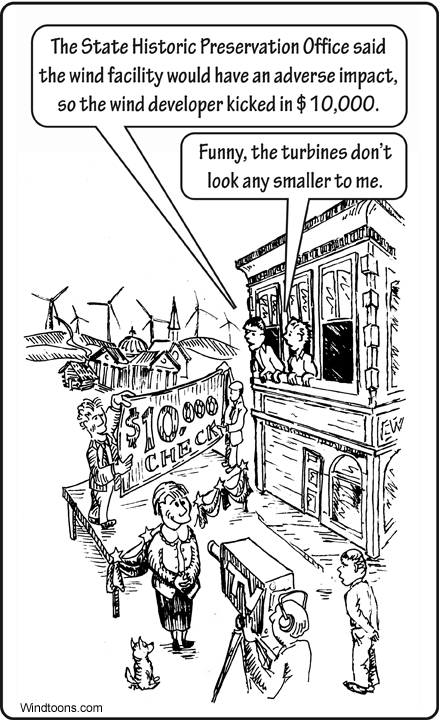
WV State Historic Preservation Officer thinks adverse effects of wind turbines on historic sites worth around $17.39/turbine/year. Wait! You can’t be serious?

Adverse Impact 72ppi

The West Virginia Division of Culture and History, not wanting to be accused of “close enough for government work,” calculated that each turbine would require an amount $434.7826086956521739130434… each, to mitigate the negative impact on the 18 historical sites in Mineral County, WV.  Coincidentally, this added up to $10,000 for the set.

But wait!  The fine for graffiti is what? Plus restitution?  C’mon Officer!  The turbines are a 25 year exposure.  The graffiti washes off.  You’re just kidding with us, aren’t you?

Here’s the agreement.

Related links:  “New York Times – “Wind Industry Faces ‘Prairie Rebellion’ in Kansas County.” Hmmm … and perhaps elsewhere?” …  “Wind turbine proposal denied; Advisory panel’s vote unanimous

Posted in Mineral County WV, Pinnacle Knob, Windtoons, WV State Government | Tagged , , , , | 1 Comment

Yeah, but that was in Minnesota! The wind plant tax deal we have here is rock solid!

From The Worthington Daily Globe via The Industrial Wind Action Group,

Counties deal with tax issues on turbines” by Julie Buntjer.

November 11, 2009 by Julie Buntjer in Worthington Daily Globe

WORTHINGTON – A couple of years ago, Murray County collected more than $1 million in production tax revenue from the wind turbines that span the horizon along the Buffalo Ridge.

For several years, in fact, the county collected large amounts of tax dollars from the wind turbines and spent the money on special projects. They built a new grandstand at the Murray County Fairgrounds, constructed a new county human services building on the edge of Slayton and erected a new storage building for county property.

“We had some major building projects,” said Murray County Deputy Auditor Barb Lewis. “The (production tax revenue) went a long ways to help.”

Then, in 2008, the Minnesota Legislature decided to make a change. Instead of letting all of the production tax dollars flow into a county for use as the county saw fit, lawmakers told counties the production taxes received must be included in the calculations used to determine maximum levies.

In essence, the move limited how high counties could set their levies, thereby providing some tax relief to property owners.

Because of the limits, counties can no longer afford to do special projects or, in some cases, maintain what they have.

In Cottonwood County, Auditor Jan Johnson said only about $3,000 was collected in production tax in the year before the change took effect. It wasn’t enough to do a special project with, but it was a start.

In 2009, Cottonwood County collected more than $78,800 in production tax from 35 wind turbines.

“The sad thing about the whole thing is it means nothing,” said Johnson. “There are no dollars for the county. In fact, with that law change, the county actually loses money on this.”

With the way the legislation was written, 100 percent of the production tax must go toward the county’s levy. From there, the county had to distribute 14 percent of the proceeds to the townships where the towers are located, with the remaining 6 percent paid to the school district.

In 2010, school districts will be removed from the funding formula, shifting 20 percent of the production tax income to the townships while the county retains 80 percent of the share.

“On the outside, it appears that we break even, but in our case, it cost us a little over $15,000 in 2009,” Johnson said.

Cottonwood County has the production tax issue at the top of its priority list, and county officials have repeatedly talked with state leaders to request the production tax be removed from the levy limit.

“The idea behind the production tax was to give the county and the townships extra income to pay for infrastructure,” said Johnson. “(The heavy loads) do some severe damage to the roads.”

Annette Bair, a staff member with the Rural Minnesota Energy Board, said not only was the option taken away from counties to use the income for special projects, but the money can’t be used on road or infrastructure projects either.

“It may be that special projects were never done because there weren’t the funds to do it,” she said.

That was the case in Murray County.

In 2009, Murray County collected nearly $1.3 million in production tax from its 228 wind turbines in operation. After paying the township and school shares, it was left with little more than $1 million and no option to use the funds as it sees fit.

Pipestone County, on the other hand, had used its proceeds from the production tax for property relief even before the state enacted the legislation requiring counties to do so.

Sharon Hanson, who has served as Pipestone County administrator for the last five years, said the funds in that time have always been used to offset the levy.

“Hopefully, what we’re able to do with those savings then is to prioritize one project or another,” she said.

Pipestone County, while home to 199 wind turbines, collected $443,937 in production taxes in 2009. In 2010, Hanson said the county stands to collect $357,000.

“Our wind turbines are smaller than the ones that are being sold now,” she said.

While the change in state legislation didn’t really impact Pipestone County, Hanson said, “We don’t really need the state telling us how to spend the money. I think locally we can make the right decisions. It’s better to do it that way and not have strings attached.”

Thursday: The impact on Nobles and Jackson counties with major wind farms projects planned in 2010.

And darn, all those projects the county was planning on!  But surely, that couldn’t happen here … or could it?

Related posts:  “Mineral County Commissioners – Ready – Fire – Aim!” … “Mineral County Commissioner: “If you make a promise, why be afraid to sign a contract to keep that promise?” … “West Virginia’s Pinnacle Knob Wind Project – So many questions, so little time!” … “A Conversation with Jon Boone – Toward a Better Understanding of Industrial Wind Technology

Posted in Mineral County WV, Wind tax rebates, WV State Government | Tagged , , , | Leave a comment

The Windpower Industry’s “top ten” false and misleading claims … Number 8 – Wind technology consists of “wind mills” on “wind farms.”

Another gem from StopIllWind – Drop by for a huge library of facts about Industrial Wind Energy.

Number 8 – Wind technology consists of “wind mills” on “wind farms.”

As if 400-foot tall differentially moving turbines were bucolic Dutch windmills, and their arrangement—eight to a mile on tall ridgetops, each with a four acre clear-cut when sited in the forest, and spread out in rows over many miles of upland habitat—was akin to a family farm.

The reality is that the technology consists of mammoth industrial factories often targeted for areas that pride themselves on their natural beauty. This inherent incompatibility makes for a hard sell. Consequently, the wind industry has commandeered the terms “windmill” and “wind farm” to make its outsized machinery more attractive to rural areas. But when a windplant is built, the rift between promise and reality becomes stark. Contemporary industrial wind turbines are taller than most urban skyscrapers, rivaling the size of the Statue of Liberty. Pittsburgh has but one building near 400 feet, while Cleveland has none.

Wind developers sometimes misrepresent their turbines’ size in the press to make the machines appear even more hospitable. Press releases describing “wind farms” occasionally state the turbines’ size in meters, causing some readers to think that a 125-meter turbine is really only 125 feet—and not over 400 feet. More often, they will only refer to the height of the turbine tower, not mentioning the size of the enormous propeller blades. However, a turbine tower that is 265 feet tall with a propeller blade that is 135 foot long is 400 feet tall. Even when they concede the actual size, they maintain wind facilities won’t be intrusive because the turbines will be hidden in the trees, as if trees over 400 feet tall exist on forested ridges.

Watch for this classic bait-and-switch technique. Wind developers will often initially propose a facility consisting of a number of “smaller” turbines, typically 1.5 MW-340-400 foot machines. When the public begins to realize the threat to its basic qualities of life, and rushes to oppose the project, the wind developer will appear to offer appeasement—in the form of lesser numbers of turbines but 10-15 percent larger (430-465 foot—2.5 MW) with a much greater rotor sweep (the propeller blade will be more than 310 feet long). The developer will claim this is possible because of “newer technology.” It is more likely, however, that this is a cynical ploy to make the industry seem more congenial to the communities it seeks to exploit, always “ready to compromise.” In fact, however, this is a tactical move that will actually increase industry profits while playing havoc with the community.

Related posts:  Save Western Ohio – “Wind . . . Farming?”

Posted in Jon Boone, Windpower Industry False Claims | Tagged , , | Leave a comment

AFL-CIO, upset about China/US Wind venture, says, “Hell No! We Won’t Send Our Tax Dollars to China!”

In line with the position of Democratic Senator Charles Schumer of New York, the AFL-CIO is concerned that the newly announced consortium of Chinese/American companies, formed to build a massive wind installation in Texas, is being funded by US Taxpayers, and will, in fact, boost China’s efforts to increase jobs in China at US worker’s expense.

Welcome to the real world!  In just the past two weeks this blog has posted several items related to the real destination of taxpayer subsidies set aside for US wind projects.  The post linked in the text, for example, comments on the early story in the New York Times, which initially described the joint venture.

In addition to the China/US venture, we posted the story that AES is selling 35% of its wind business to a Chinese investment firm as well.  This may be of interest to citizens of West Virginia who face a project named AES New Creek.  It is interesting to think if support would have been less, had citizens known that the installation would be 35% owned by the Chinese, if that’s how it shakes out.  I suppose we’re past that point now!

But the point I thought would have everyone howling would be this post:  More good news from the Wind Energy Sector – “More than eight out of 10 US stimulus dollars spent on wind energy farms have gone to foreign companies,”

At any rate, the full text of the AFL-CIO commentary begins here:

United Steelworkers (USW) President Leo Gerard is outraged—as we all are—over the news that a planned $1.5 billion Texas wind farm—seeking financing with U.S. stimulus money—will create only 30 permanent jobs here, but 2,000 jobs in China.

Taking candy from a baby: A consortium of Chinese and American companies goes to Washington and announces plans to build a $1.5 billion windmill farm in west Texas using $450 million in U.S. stimulus funds, which will create 2,330 jobs—2,000 of them in China.

The baby—Washington’s Energy Dept., specifically—doesn’t cry or whine or spit in the consortium’s face. That’s what’s really wrong with this story.

So accustomed to being bought and sold, Washington simply begins processing forms so it can hand over your tax dollars to create jobs in a turbine factory in the city of Shenyang, China, at a subsidy of $193,133 each.

It’s like these bureaucrats live in Wonderland. Or an America where the unemployment rate isn’t 10.2 percent. Or where 40,000 American manufacturing facilities didn’t disappear in the past decade. Or where banks didn’t repossess nearly a quarter million American homes in the past three months.

We’ve got a message for Washington: Hell no! We’re not giving tax dollars to China. What’s wrong with these businesses and our government? It is the $787 billion American Recovery and Reinvestment Act of 2009. It’s not the Chinese Recovery and Reinvestment Act.

It’s bad enough that we’ve off-shored our factories and technology and jobs over the past 20 years. We’re not off-shoring our stimulus cash, too. In fact, we’re tired of serving as the schoolyard wimp of the world. We need our own industrial policy so we can stand up and compete in the world market, manufacturing the likes of wind turbines. And we need it now.

China has an industrial policy. And it uses that policy to dominate. Here is how Keith Bradsher of the New York Times described China’s policy to become a world leader in renewable energy, which, of course, would include construction of wind turbine factories:

Calling renewable energy a strategic industry, China is trying hard to make sure that its companies dominate globally. Just as Japan and South Korea made it hard for Detroit automakers to compete in those countries—giving their own automakers time to amass economies of scale in sheltered domestic markets—China is shielding its clean energy sector while it grows to a point where it can take on the world.

China protects its chosen industries in many ways. It provides low-interest loans, some of which don’t have to be repaid. It may give free land on which to construct buildings. And there are other perks that Bradsher described:

When the Chinese government took bids this spring for 25 large contracts to supply wind turbines, every contract was won by one of seven domestic companies. All six multinationals that submitted bids were disqualified on various technical grounds, like not providing sufficiently detailed data…even as Chinese companies that had never built a turbine were approved….

Later, Bradsher describes European disgust at the Chinese treatment:

European wind turbine makers have stopped even bidding for some Chinese contracts after concluding that their bids would not be seriously considered, said Jorg Wuttke, the president of the European Union Chamber of Commerce in China.

China has a policy. It ruthlessly protects its own industries.

China was among the many countries that complained bitterly when the United States included “Buy American” provisions in the stimulus bill. In fact, Vice Commerce Minister Jiang Zengwei told a press conference in Beijing in February that China would not do such a thing. “We won’t practice a ‘Buy China’ policy,” he said. Four months later, that’s exactly what China did, instituting its own stricter “Buy China” policy as part of its economic stimulus program.

China did what China felt was necessary for its economy. And it ignored foreign criticism.

That’s hardly the U.S. tactic. Wilting under criticism, Congress diminished the Buy American provisions before passing the stimulus.

As a result, we’ve got a consortium—U.S. Renewable Energy Group, Cielo Wind Power and A-Power Energy Generation Systems—so bold that it believes it can get nearly half a billion dollars in American stimulus money for 2,000 Chinese wind turbine jobs. The consortium says it would import 240 Chinese turbines to Texas, where 300 temporary construction jobs would be created and another 30 permanent jobs established.

The wind turbines could easily be made in the USA. Bradsher, of the Times, says the Chinese concede that while their turbines cost slightly less initially, they have higher repair costs. He wrote:

United Nations data from trading of carbon credits shows that the Chinese-brand turbines produce less electricity because they are more frequently out of action.

Really, is that what we want to buy with American tax dollars for a wind farm in west Texas?

If the United States put half the effort into supporting its renewable energy industry that China does, there would be no way this consortium building windmills in Texas would be looking overseas for turbines.

China has a plan. In its strategy, it doesn’t consider America first or the remainder of the world first. And that’s what the United States must do. We need an industrial policy that makes no apologies for putting America and American workers first. And when that’s the calculus, no American official would ever countenance a request to give $450 million in American taxpayers’ dollars to a turbine factory in China. And no American consortium would consider making such a stupid request.

In the meantime: Hell no! They don’t get our dough!

End of AFL-CIO Commentary

Related posts:  “Wow! Someone’s starting to get the message: “Senator (Schumer): No fed money for US-China wind project” … “Oh! … and about that wind energy stimulus money going overseas … you’ll really like this!” … “AES agrees “to sell stock and a 35 percent stake in its wind-power business to China Investment Corp.” AES, hmmm … why does that name sound familiar?” … “More good news from the Wind Energy Sector – “More than eight out of 10 US stimulus dollars spent on wind energy farms have gone to foreign companies” … “”

Posted in Politicians and Wind Energy, West Virginia Wind, Wind Power subsidies | Tagged , , , , | Leave a comment

AES agrees “to sell stock and a 35 percent stake in its wind-power business to China Investment Corp.” AES, hmmm … why does that name sound familiar?

According to an article on Bloomberg.com, “AES to Sell Stock, Wind-Power Stake to China’s CIC

If anyone, anywhere, anytime actually believes this wind business is for the benefit of United States Citizens, I encourage them to comment.  I’m at a loss so see any redeeming value to the sham that is wind power.  Maybe I can be persuaded.

Here’s the text of the article:

By Mark Chediak

Nov. 6 (Bloomberg) — AES Corp., the U.S. power producer with operations in 29 countries, agreed to sell stock and a 35 percent stake in its wind-power business to China Investment Corp. for $2.2 billion to raise cash for expansion.

A CIC unit will buy 125.5 million in new shares for $12.60 each, or $1.58 billion, Arlington, Virginia-based AES said today in a statement. CIC will own about 15 percent of the power company. AES also signed a letter of intent to sell a 35 percent interest in its wind-power operations to CIC for $571 million.

The transactions will give AES greater financial flexibility and allow the company to move more quickly on project developments, Chief Executive Officer Paul Hanrahan said. AES, which will need approval from the Committee on Foreign Investment in the United States to close the stock sale, also will gain cash for acquisitions.

“This just gives us a war chest of dry powder to execute on mergers and acquisitions,” Hanrahan said in a telephone interview. Access to capital markets has been “choppy,” he added, and any investment AES makes would need to be funded with equity or cash flow.

AES rose 17 cents, or 1.2 percent, to $14.03 in New York Stock Exchange composite trading. The stock has jumped 70 percent this year.

Asia Expansion

The company sees a number of “attractively priced” acquisition prospects around the world, Hanrahan said, without identifying any specific targets. AES is looking to expand its generation capacity in Asia, where power demand is growing faster than in the U.S., he said.

“This will be a great way for us to do business in Asia,” Hanrahan said.

Earlier today, AES posted a 28 percent gain in third- quarter profit after gains from its operations in Latin America and Asia made up for a demand slump in the U.S. The CIC transactions will reduce 2010 earnings per share from continuing operations by about 12 cents, the company said.

CIC, China’s sovereign wealth fund, said last month that it has $110 billion for overseas investments and will focus on buying into commodities companies and property to protect against accelerating inflation.

On Sept. 30, CIC said it bought an 11 percent stake in JSC KazMunaiGas Exploration Production, the London-traded unit of Kazakhstan’s state-run energy company, for about $939 million. A week earlier, it bought $1.9 billion of debt from PT Bumi Resources, Indonesia’s biggest coal producer, and paid $850 million for a 15 percent stake in Noble Group, a Hong Kong-based commodity supplier.

Chinese Investments

Overseas investments by Chinese companies surged 190 percent from a year earlier to $20.5 billion in the third quarter, according to the nation’s Commerce Ministry. AES gets more than 80 percent of its revenue from outside the U.S.

“The Chinese government has a lot of money to invest globally, and investing in AES is a great way for them to do this,” said Ryan McLean, an analyst at Morningstar Investment Services who rates AES shares at three stars out of five and owns none.

AES got 7.5 percent of its 2008 revenue from Asia, according to data compiled by Bloomberg. To the extent CIC’s investment gives AES more access to China, the world’s most populous nation, the transactions will be a positive for the power producer, McLean said.

AES said it expects regulatory approvals for the stake sale in the first half of next year.

Stimulus Funds

The CIC transactions shouldn’t raise any concerns over national security, AES’s Hanrahan said. CIC’s investment will help fund purchases of wind turbines and solar panels in the U.S., he said. The company plans to use U.S. suppliers.

The Obama administration should bar a $1.5 billion Texas wind-farm project from receiving government stimulus funds because most of the turbines will be made in China, U.S. Senator Charles Schumer, a New York Democrat, said yesterday. A-Power Energy Generation Systems Ltd., developer of the Texas wind farm, said its project doesn’t involve stimulus funds.

Hanrahan said he doesn’t expect CIC’s involvement to affect AES’s access to stimulus funds. “Anyone can buy our equity, and this is just new capital coming into the company,” he said.

The company applied for stimulus money for a renewable- energy-storage project, Hanrahan said. AES has 1,300 megawatts of wind-power projects under development. One megawatt is enough power for about 800 average U.S. homes, according to an estimate by the Energy Department in Washington.

Project Pipeline

“A lot of the value that we have, I think, is in the development pipeline,” Hanrahan told investors today on a conference call.

AES spokesman Meghan Dotter said the company was advised by Deutsche Bank AG on the stock sale and by Citigroup Inc. on the wind-power deal.

China’s Cnooc Ltd. bowed out of a 2005 battle with San Ramon, California-based Chevron Corp. to acquire Unocal Corp. after concluding U.S. lawmakers would scuttle any deals on national security concerns.

To contact the reporter on this story: Mark Chediak in San Francisco at mchediak@bloomberg.net.

Last Updated: November 6, 2009 16:08 EST

Additional posts: … “Wow! Someone’s starting to get the message: “Senator (Schumer): No fed money for US-China wind project”” … “Oh! … and about that wind energy stimulus money going overseas … you’ll really like this!” … “More good news from the Wind Energy Sector – “More than eight out of 10 US stimulus dollars spent on wind energy farms have gone to foreign companies”

Posted in Allegheny Mountains, Wind energy | Tagged , , , | 1 Comment

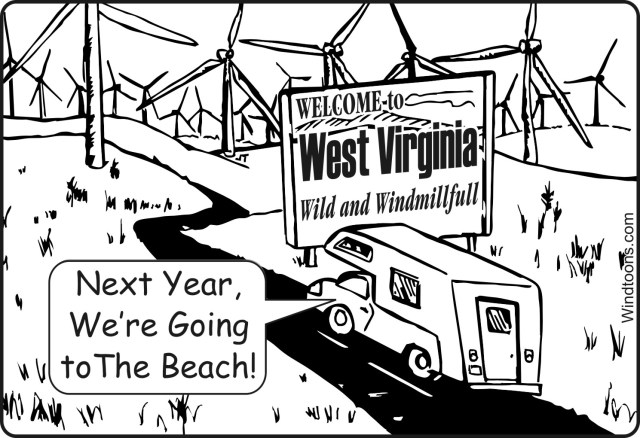
Wild and Wonderful West Virginia – Come to see our magnificent mountains! Uh, but you better hurry.


Hey, as an added bonus, if you get here soon enough, you’ll be able to see the Bald and Golden Eagles that actually survived the turbines.


Next Year The Beach

(used with permission – Windtoons)


Posted in Allegheny Mountains, Windtoons | Tagged , , , | 2 Comments

Memorandum of Agreement between the West Virginia Division of Culture and History and Pinnacle Wind Force LLC – Gee! Is anyone missing?

Below is the agreement between the WV Division of Culture and History and Pinnacle Wind Force LLC.

I didn’t get a warm cozy feeling that this really satisfied everyone in the immediate area affected by the attack on view-shed, but then Charleston is only 240 miles away, give or take a few golden eagle wing flaps.  And surely, Governor Manchin’s administration makes all such decisions with the best interest of us “local yokels” in mind, don’t you think?

Look for more on the takeover of local community’s right to self-rule.

Related posts:  “Look! You guys just pass the laws forcing them to subsidize construction and then to force them to buy the product. I’ll convince them this turkey is a great product!” … “West Virginia: “It’s Wild” – “It’s Wonderful” and “It’s For Sale!” … CHEAP!” … “The Windpower Industry’s “top ten” False and Misleading Claims … Number 10 – “Locals who oppose the wind industry are NIMBYS” … “New York Times – “Wind Industry Faces ‘Prairie Rebellion’ in Kansas County.” Hmmm … and perhaps elsewhere?

Posted in Allegheny Mountains, WV State Government | Tagged , , , , | Leave a comment

Look! You guys just pass the laws forcing them to subsidize construction and then to force them to buy the product. I’ll convince them this turkey is a great product!

Sound incredible? … well!

From the Boston Herald, via National Wind Watch:  “Wind law could benefit company

Read carefully for the tangled web of politicians and developers and politician/developers and developer/politicians and money money money!

Sorta makes me queasy!

The entire post follows:

Despite significant opposition in Western Massachusetts, state environmental affairs secretary Ian Bowles is pushing hard to get a controversial wind-turbine law passed before the legislative session ends on Nov. 18.

The bill could benefit a wind-energy firm, recently relocated to Boston, whose chief executive helped co-author the proposed law and whose financial backers have close ties to the Obama administration.

With the bill before the Legislature’s joint committee on telecommunications, utilites and energy, Bowles met this week with House Speaker Robert DeLeo in an effort to move it along.

“The secretary is very supportive of this bill and anxious to see it move,” Bowles’ spokesman Robert Keough told the Herald.

The Wind Energy Siting Reform Act aims to streamline the permitting process for commercial wind turbine developers. Supporters say its passage will make it much easier for wind-energy firms to operate here, while critics say it will strip communities of their rights.

“Massachusetts is a state of independent communities,” said Eleanor Tillinghast, who lives in the Berkshires, where the turbines will most likely be erected. “If this bill is passed, it will undermine towns’ abilities to develop in the ways they think are most appropriate.”

Keough disagreed, saying the bill has been revised to better protect local interests.

Still, the Berkshire Regional Planning Commission maintains its opposition to the proposal, while some environmental groups say it hasn’t been properly vetted.

On Beacon Hill, the bill is seen by some as the next step in Gov. Deval Patrick’s broad plan to position clean energy as the state’s next economic development engine.

Now, the bill’s critics are wondering if a controversial wind-energy firm with ties to the White House may be poised to benefit.

First Wind Energy Holdings, LLC, which runs five wind farms and has many more in development, just relocated to Boston.

Its chief executive, Paul Gaynor, sat on the state commission that wrote the bill, and its main investors are Chicago private-equity firm Madison Dearborn Partners and the New York hedge fund D.E. Shaw.

Rahm Emanuel, President Obama’s chief of staff, has in the past called executives at Madison Dearborn supporters and friends. Lawrence Summers, director of Obama’s National Economic Council, made more than $5 million as a D.E. Shaw managing director.

Obama’s decision to give the firm $115 million in stimulus funds outraged people in New York, where the attorney general has investigated First Wind for corruption.

A First Wind spokesman said the company has no immediate plan to build in Massachusetts.

Keough said if the bill passes, that could change. “They’ve shown little interest in (Massachusetts) so far, because the permitting process is so uncertain and perilous,” he said.

By Christine McConville

Boston Herald

www.bostonherald.com

6 November 2009

Related Posts: ... “West Virginia: “It’s Wild” – “It’s Wonderful” and “It’s For Sale!” … CHEAP!” … “Chugging soon into your home town – “The Green Energy Subsidy Express” – be careful not to play on the tracks!” … “Mineral County Commissioners – Ready – Fire – Aim!

Posted in Allegheny Mountains, Politicians and Wind Energy, Wind Energy Shenanigans | Tagged , , , | Leave a comment

New York Times – “Wind Industry Faces ‘Prairie Rebellion’ in Kansas County.” Hmmm … and perhaps elsewhere?

This New York Times article, “Wind Industry Faces ‘Prairie Rebellion’ in Kansas County,” discusses the impact of the Kansas Supreme Court decision upholding local ordinances preventing installation.

So, what does all this Kansas dust-up mean for the other wind projects?

The Times reports, it is not just a problem for Middle America. (to which I ask … how is not having a wind installation that generates infinitesimal power, and what little is generated is unreliable, and consumes vast land and air space, and kills bats and birds and, and, and so on … a problem?)

Frank Maisano, an energy specialist at the law firm Bracewell & Giuliani, which represents wind-power developers in the mid-Atlantic, said officials in western Maryland’s Allegany County all but killed a proposal to build 25 turbines on a local mountain crest by adopting retroactive zoning requirements limiting where the turbines could be sited. (yes, and which then caused wildlife not to be killed?)

The project, sought by Pennsylvania-based U.S. Wind Force LLC had already obtained two building permits to start construction, but the Allegany commissioner’s zoning changes “made the project unworkable,” Maisano said. (I’m not sure if the zoning changes made the project unworkable or if the project could not accommodate the requirements of local citizens.  But, hey – the Citizens rule – sorry!)

Of course, local officials are entitled to pass laws that preserve landscapes and protect community standards for development. But, Maisano said, by rejecting clean energy development, communities risk undermining their long-term economic stability. (undermining long-term economic stability?  Boy, I’d love to hear the logic that backs up that statement!)

“I think it’s a stupid policy,” Maisano said of zoning ordinances aimed at banning wind farms. (“I think it’s stupid” is a legal term, I think?)

As for the Kansas case, Maisano said the issue is less about the Supreme Court’s decision to uphold the ban than the local officials’ decision to impose it in the first place. “It seems to me that in Kansas if that county commission wants to take that approach, they’re missing a great opportunity,” he said. (Is there any possibility the rest of us can miss the great opportunity too?  Please!)


Posted in Allegheny Mountains, US WindForce, Wind Energy Legislation | Tagged , , | 1 Comment

Exclusive: Windtoons explains how $10,000 view-shed grant to Mineral County, WV will be spent.

Windtoons scoops the secret agreement between Pinnacle Wind Force, LLC and the West Virginia Division of Culture and History.

Hey!  This mitigation thing is pretty cool!

Posted in Windtoons | Tagged , , , , | 1 Comment