Glenn Schleede challenges Virginia leaders to review “Federal and State Wind Energy Tax Breaks and Subsidies”

We are grateful to Mr. Glenn Schleede for providing us with a copy of his paper titled “Federal and State Wind Energy Tax Breaks and Subsidies,” which he sent yesterday to Governor McDonnell and Lt. Governor Bolling of Virginia.

The full text is provided here for your convenience:

Be sure to also read Glenn Schleede: “The True Cost of Electricity from Wind is Always Underestimated and its Value is Always Overestimated”

Allegheny Treasures Note:  “Mr. Schleede is the author of many papers and reports on energy matters.  He is now retired but continues to analyze and write about federal and state energy policies, particularly those affecting wind energy.”

“Until retiring, Schleede maintained a consulting practice, Energy Market and Policy Analysis, Inc. (EMPA)  Prior to forming EMPA, Schleede was Vice President of New England Electric System (NEES), Westborough, MA, and President of its fuels subsidiary, New England Energy Incorporated. Previously, Schleede was Executive Associate Director of the U.S. Office of Management and Budget (1981), Senior VP of the National Coal Association in Washington (1977) and Associate Director (Energy and Science) of the White House Domestic Council (1973).  He also held career service positions in the U.S. OMB and the U.S. Atomic Energy Commission.”

“He has a BA degree from Gustavus Adolphus College and an MA from the University of Minnesota.  He is also a graduate of Harvard Business School’s Advanced Management Program.

Mr. Schleede has contributed many writings to the issue of wind energy, most of which can be found at one of the following web sites:  www.wind-watch.org,  www.windaction.org, or www.savewesternoh.org.  Type his last name (Schleede) in the “search” box on any of the sites to review more of his fine work.

Posted in Glenn Schleede, industrial wind cost, Wind Power subsidies | Tagged , , , | 1 Comment

Global ignorance … industrial wind’s best friend!

This article arrived today courtesy of our good friend Cathy Stafford, of the Action for Planning Transparency group, based in Scotland.

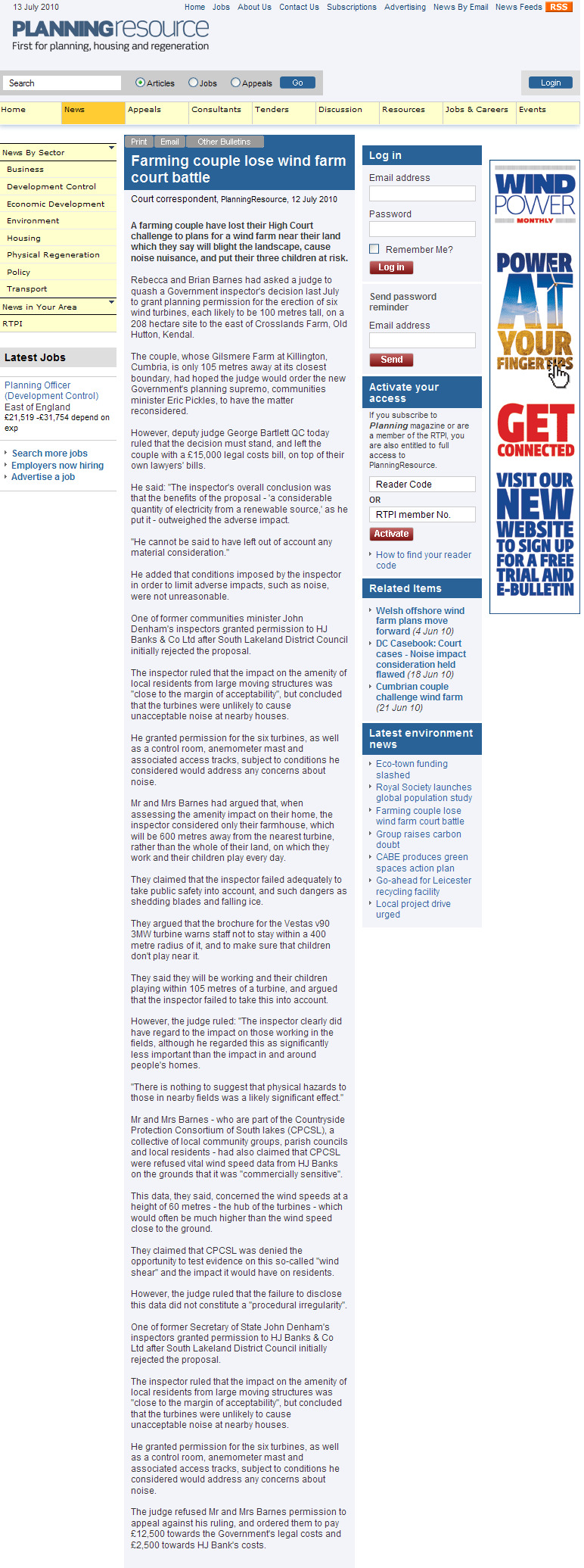
Proving once again that ignorance is industrial wind’s best friend, especially when it rests in a position of power, we find “a farming couple have lost their High Court challenge to plans for a wind farm near their land which they say will blight the landscape, cause noise nuisance, and put their three children at risk.”

According to the article written by the Court correspondent for the UK based Planning Resource journal, the project was initially denied by the South Lakeland District Council, but then permitted by an inspector for former communities minister John Denham.  The couple, Rebecca and Brian Barnes, had asked a judge to quash a Government inspector’s decision because the turbines would be set only 105 meters away at its closest boundary.  The inspector measured to their house, which is some 600 meters from the nearest turbine.  The judge dismissed the potential for ice throw, collapse of the 100 meter plus turbines or failure which would toss blades and other debris well onto the farmer’s property.  When the fact that the family’s children played and farm hands worked in the newly created “danger zone”, the judge was unwavering and stated, “”The inspector clearly did have regard to the impact on those working in the fields, although he regarded this as significantly less important than the impact in and around people’s homes.  There is nothing to suggest that physical hazards to those in nearby fields was a likely significant effect.”  Clearly regarded the impact but significantly less importantDoes this judge really value the safety of these folks so little as to write the hazards off as not a “likely significant effect?

Oh, but there’s more from the genius jurist.  When the couple told ‘hizzoner’ that “they were refused vital wind speed data from HJ Banks (the developer) on the grounds that it was “commercially sensitive” and that such data concerned the wind speeds at a height of 60 metres – the hub of the turbines – which would often be much higher than the wind speed close to the ground,” it fell on deaf ears.  They stated that “CPCSL was denied the opportunity to test evidence on this so-called “wind shear” and the impact it would have on residents.”  The judge decided the failure to disclose the data did not constitute a “procedural irregularity.”  Well, it seems to me after reading these proceedings that if anyone knows about “procedural irregularity,” it’s probably deputy judge George Bartlett QC.

So what do Mr. and Mrs. Barnes get for trying to protect their kids and the farm hands?  First ol’ Judge (I hate the use the title Justice) Bartlett denies them permission to appeal his well-informed ruling and then orders them to pay £12,500 towards the Government’s legal costs and £2,500 towards HJ Bank’s costs.

The driving factor that swayed the Judge, by the way, was this, “The inspector’s overall conclusion was that the benefits of the proposal – ‘a considerable quantity of electricity from a renewable source,’ as he put it – outweighed the adverse impact.  He cannot be said to have left out of account any material consideration.”  That statement in itself qualifies the judge and the inspector for starring roles in the sequel to “Dumb and Dumber.”

And irony of ironies, look at the US web presentation of the article and note the rather prevalent advertisement on the right.  Cool, huh?

Posted in Wind Energy Shenanigans | Tagged , , , | Leave a comment

Wind energy in the classroom: “It does a disservice to students when teachers present them with information in the guise of science which is not supported by good scientific evidence.”

Recently, the National Education Association web site carried a posting titled “10 Ways to Go Green.”

As we at Allegheny Treasures focus on industrial wind, our attention was drawn to Number 10, which pictures youngsters building a little windmill with several industrial giants in the background.  For your convenience, we will post the text from that section, followed by a comment we received related to that article:

Featured article segment begins:

10. Build a wind turbine

Is there a windy season in North Dakota?

“Every day,” laughs Grand Forks teacher Tim Schanz.

It billows across the Plains like an old iron horse, whistling and chugging with engine force— the kind of force that America needs to harness. Just two years ago, wind energy provided less than 1 percent of the country’s electricity, but by 2030, it’s expected to provide 20 percent, according to Colorado Wind for Schools.

Many school districts already are riding the headwinds: 24 states have schools with turbines on their property and more are on the way. They power up classrooms and provide learning opportunities for students. But you don’t have to build a 10-story turbine to teach kids about wind.

In Grand Forks, Schanz’s students build small-scale models, purchased from KidWind Project. They set them up in front of fans, so that they can control wind speed, and test different kinds of blades: balsa, cardboard, even paper plates. “This one got three volts—and that one just got two volts!” Schanz recounts.

Out on the highway, Schanz and his students sometimes see a locally made turbine blade on the back of a truck, heading to wind farms across the country. His kids know that’s the future right there.

Send comments to mflannery@nea.org

Featured article segment ends!

The segment did not miss the scrutiny of Mr. Richard Laska who was kind enough to share the text of the email he sent to Ms. Flannery at the NEA, and permitted us to share it here.

Mr. Laska writes:

First, the wind does not blow every day.  And that is exactly the problem with wind energy.  Our electric grid does not store electricity.  Every home and industry requires reliable electricity where and when they want it regardless of how much wind is blowing.  For every collection of wind turbines we build, we must also build a new fossil-fueled power plant to take up the slack when the wind fails.  Otherwise the entire grid would crash every time the wind stopped.

Second, the photograph shows a family within a few hundred feet of a wind turbine.  There is a growing body of evidence in Europe and America (see Dr. Nina Pierpont’s work) indicating that people living within two or three miles of an industrial wind turbine suffer serious illnesses due to exposure to the loud infrasound produced by the turbines.  In eastern mountains, families who have lived here for generations are being forced to abandon their homes — robbed of their health and property by wind turbines erected on a neighbor’s land.

Third, the statement that “many school districts” … “power up classrooms” with wind turbines is misleading.  A few 10-story wind turbines won’t provide enough reliable energy to heat or air condition a normal school.  I know.  I have two such windmills and they only produce useful electricity one day out of three.

Fourth, the statement that wind is “expected to provide 20 percent” of the country’s electricity by 2030 is extremely naive.  The maximum demand for electricity in this country is in the summer when wind resources are at a minimum.  All of the estimates of wind’s contribution to our electric supply are based on theory and public relations.  Owners of wind turbine power plants keep their actual electric production top secret.

Fifth, despite all the hype and tens of billions of dollars in taxpayer investment in wind turbines, there has not been even one study showing that wind turbines have saved one ounce of carbon emissions.  For example, the production of concrete is a major source of greenhouse gases.  The entire electric output of an industrial wind turbine two to five years is required to merely make up for the carbon emissions produced to make the concrete pads on which they stand.

Sixth, industrial wind turbines are not green; they are environmental disasters.  In the east, they are killing endangered bats and protected eagles and hawks.  And they are rapidly destroying the last few uncluttered scenic vistas and once-protected historic sites.

Seventh, the photograph shows a number of wind turbines sited in a near featureless plain with no buildings nearby.  Therefore, any electricity they produce must be shipped, via new power lines, to where people need it.  Depending on distance, 20% or more of the electricity will be wasted in the process.  Power plants should be built where the power is needed.

Kids get enough bad science from video games, tv and movies.  It does a disservice to students when teachers present them with information in the guise of science which is not supported by good scientific evidence.  The science of electricity production and distribution shows that industrial wind facilities cannot possibly live up to the industry’s public relations campaign.  For well-documented facts on the subject, please see Robert Bryce’s new book Power Hungry.

I want to end on a positive note:  Your example of students putting windmills in front of an electric fan to test different turbine designs is unintentionally insightful.  Like the test models, industrial wind turbines depend on the electric grid for their operation.  More than two-thirds of the time, industrial wind turbines don’t produce any useful energy — the suck electricity energy from the grid.

My elementary education credentials:  I won a CINE Golden Eagle Award and was nominated for an Academy Award for my work on GM’s educational video I need the Earth for which I provided the theme and wrote the teacher’s manual.

Rich Laska

Top of Allegheny Mountain, West Virginia

Mr. Laska’s comments conclude!

We thank Mr. Laska and agree wholeheartedly.  We suggest the NEA give serious consideration to Mr. Laska’s comments when teaching students about alternative-renewable-green energy sources.  Students need not solely hear the propaganda of the wind industry, but an equal balance of factual information that presents the failings of these same products.  Students will find out soon enough that, as Ms. Betty Spiggle commented to the article, “The issue of wind energy needs as a reliable energy source is a scam. In the UK wind farm companies are being paid to turn them off because the wind is not controllable and does not supply a solid system supply of energy.”  Unfortunately, students will find out how their money was wasted on these high cost/low performing tax shelters long after the billions in subsidies have been pocketed by the wind farm developers.

We note the comment to the article from Mr. Faheem S. Rasool:  “Going Green suggestion is for all teachers. I teach Engineering Technology at Campbell High School. I had my advanced class construct a small scaled house made out of wood. We used strips of pine for the studs and we had to use plywood sheathing for covering the walls. We mounted solar panels on the roof and connected them in a series and parallel circuit and connected lights inside the home. We took the constructed home out in the sunlight and watched the ligts come on.”

We could only hope that the next chapter in Mr. Rasool’s scientific research was to take the “scaled” house back inside, watch the lights go out and challenge the students to a discussion on the requirements of a supporting base load provided by nuclear or fossil fuel to support such a construction when the sun doesn’t shine.

Would anyone care to take a bet as to whether Mr. Rasool encouraged that discussion?

It appears the National Education Association is either lacking the full arsenal of facts, or chooses not to confuse the students with them.  If it is the former, there is much available in the links provided at this site and from well informed individuals such as Mr. Laska.  All that is necessary is to ask.  If it is the latter, someone is not doing there job!

Posted in Wind Energy Shenanigans | Tagged , , , , | Leave a comment

The selective outrage of Greenpeace.

Jack Dini writes at the Hawaii Reporter:  “Greenpeace said the Syncrude (oil sands project killing ducks) trial exposed gaping holes in the regulatory process and highlighted insufficient enforcement and monitoring of oil sands operations.  However, Greenpeace has chosen to remain silent on wind turbine bird kills.”

Read his post at this link:  Canada Following United States Lead in Handling Bird Kills: A double standard applies to wind farms

(Thanks to Jon Boone at Stop Ill Wind)

Posted in Bat/Bird Kills, Environment, Wind Energy Shenanigans | Tagged , , , | 1 Comment

Jon Boone pans “Cape Wind: Money, Celebrity, Class, Politics, and the Battle for Our Energy Future on Nantucket Sound.”

Gasmarket.ca  – Gas Market and Alternative energy sources offers a very positive review of “Cape Wind: Money, Celebrity, Class, Politics, and the Battle for Our Energy Future on Nantucket Sound.”  Calling it an “acidly funny account of the battle over an offshore wind farm” the reviewer seems to enjoy that it challenges “the privileges of some of America’s richest and most politically connected people, and they would fight him tooth and nail, no matter what it cost, and even when it made no sense.”  Perhaps telling of the reviewer’s leaning is this closing comment, “it is also a cautionary tale about how money can hijack democracy while America lags behind the rest of the developed world in adopting clean energy.”

Jon Boone’s comment to the post differs greatly with the reviewer:  “Massive industrial wind technology generates very little energy relative to demand, virtually no capacity, and requires accompaniment from reliable conventional generation such that wind technology cannot displace meaningful levels of carbon emissions within a power grid. The gargantuan wind turbines proposed for the Cape Wind project collectively would provide the New England electricity grid with less than 1% of its annual installed capacity, producing only sporadic, highly variable energy at times of least demand, virtually no energy at peak demand times, while increasing the instability of the grid’s equilibrium between supply and demand, forcing conventional generators to follow and balance this instability inefficiently. The writers, who clearly know little about the way modern power grids produce reliable, secure electricity at reasonable costs, blithely accept the false wind industry propaganda about the number of homes Cape Wind would serve, as if an unpredictably intermittent and extremely volatile energy source could really do this. They fail to mention that the huge public subsidies for the industry, by far the highest of any industrial source of electrical energy, are not indexed to any reductions in carbon dioxide emissions. If they were, the wind industry would simply wither away.

The United States increases its demand for electricity around 2% annually. Many new reliable conventional plants will be needed in the next 30 years. The subsidies for each will encourage efficient, dependable, cost effective electricity. The subsidies for dysfunctional industrial wind energy, which can provide virtually no capacity to the system and can deliver at best only sporadic energy, will be used to make inefficient and uneconomical technology falsely appear to be efficient and economical.

There has been no independent scientific substantiation of system-wide carbon emissions abatement due to wind technology anywhere in the world. Germany, with nearly 20,000 installed wind turbines, last year increased its annual carbon emissions by . 6%. California’s nearly 14,000 turbines provided virtually no energy to the grid during last summer’s torrid heat wave, while that state’s carbon emission’s yield continues to expand 2% annually. Volatile wind energy cannot be loosed on the grid by itself; it must be accompanied by reliable conventional generation. As such, it can only be considered one ingredient in a fuel mix. If the other ingredient is hydro, wind can indeed be considered clean. But since hydro plants are so environmentally threatening, they cannot be considered “green. ” If wind is accompanied by fossil fueled generation, which is overwhelmingly likely, it can neither be considered clean nor green.

The real NIMBY’s here are the wind developers themselves, few of whom, if any, would reside near such monstrous facilities. There is also the neocolonialism involved with most wind projects, with distant capital exploiting the people and resources of rural areas with technology that would not be permitted in more energy-intense suburbia.

Williams and Whitcomb have produced another Kennedy-bashing potboiler. But it’s really a bagatelle, for they use a soak-the-rich theme to disguise how little they know about what should be their real subject, which is: can the developers of Cape Wind scientifically substantiate their major claims of reducing carbon emissions, making the air cleaner, improving public healrth, and backing down the coal industry? If they had genuinely examined this subject, the authors would have discovered how Enronesque wind technology is, how it delivers virtually no meaningful product or service yet is so extensively subsidized by rate and tax payers, claiming to protect the environment while in actuality wrecking it. As such, the technology represents one of the great bunko schemes of our era, defrauding both the public and bilking consumers who believe they’re getting green electricity.

So, should you decide to buy and read the book, we would recommend you take what you read with the large shaker of salt Mr. Boone has placed before you.

You may also wish to visit Mr. Boone’s excellent site, Stop Ill Wind, to better understand the reality of industrial wind.

Posted in Cape Wind, Jon Boone | Tagged , , , , | Leave a comment

Industrial wind message goes far beyond Maine, thanks to The Friends of the Highland Mountains video.

The Friends of the Highland Mountains have produced an excellent and informative video, available on DVD, to publicize “the threat to the beautiful and ecologically sensitive mountains of Highland Plantation, Maine. Highland Wind LLC’s proposal to blast and bulldoze these extraordinary landscape features, to construct a wind turbine complex of dubious value to Maine’s energy future, is the inspiration for the video.”

As they state in their introduction, “we need to get the message to all the people of Maine, and beyond, that our state – and many others – are under attack from the dogmatic and overzealous promotion of an industry that could destroy many of our natural and scenic resources.”  Contact The Friends of the Highland Mountains at this link.

We, at Allegheny Treasures, couldn’t agree more.  We are happy to offer their video in three parts below.  What you see here is not unique to Maine.  If you have not yet faced the horrible intrusion of these low performance/high cost/heavily subsidized monsters, it is very likely you will.  Arm yourself with information such as offered here and the other fine sites we’ve linked at the left.  Rest assured, you will not find this information provided by the industrial wind lobby.

Save the Mountains of Highland Plantation – Part 1

Save the Mountains of Highland Plantation – Part 2

Save the Mountains of Highland Plantation – Part 3

Industrial wind’s impact on neighbors is dramatically expressed in Jon Boone’s, Life Under A Windplant video, presented here for your convenience:

Our thanks to The Friends of the Highland Mountains and to Jon Boone for sharing their efforts.

Posted in Appalachian Mountains, Friends and Citizens Groups, Jon Boone | Tagged , , , | 5 Comments

Constellation Energy wind farm may include condominium resort for Indiana and Virginia “big-eared” bats.

I couldn’t believe it either, but according to an article in the Cumberland (MD) Times-News, Constellation spokesman Larry McDonnell said of plans to install massive wind turbines on Backbone Mountain in Garrett County, “We will commit to developing Indiana bat habitat improvement projects that will result in far greater benefits to the species than any remote risk posed by the project.”  How cool is that?

The “remote risk posed by the project” is, of course, the possibility that the Indiana and Virginia big-eared bats inhabiting the area, also listed as endangered species under protection of the Endangered Species Act (ESA), will be whacked by the spinning propeller blades.  Constellation considers this a long shot, but renewed it’s commitment to seek an “incidental take permit” from the US Fish and Wildlife Service, just in case.

Opposition groups, such as the Garrett-based opposition group Save Western Maryland and the Maryland Conservation Council, which have threatened a law suit to insure all protections are provided prior to construction, point to statistics from two nearby wind “farm” installations which demonstrate the significant danger to bat populations.  “Opponents cited studies done at the Mountaineer wind farm, a 44-turbine facility in nearby West Virginia, and at a 20-turbine facility near Meyersdale, Pa. The studies showed significant bat mortality at both locations, including one six-week monitoring period when researchers found 398 bat carcasses at the Mountaineer wind farm and 262 at the Meyersdale site.”  In fact, if my memory serves, things got so bad at the Mountaineer wind farm project a few years ago that the owners tossed everyone off the “farm” because they were finding too many carcasses.  A carcass is what’s left after the animal’s life has been “taken.”  “Taken!”  Ahhh!, a much more agreeable term than kill, maim, destroy, whack, chop, slaughter etc., which is why, I suppose, they call it an “incidental take permit” instead of a “license to kill.”

I would like to take comfort in Constellation’s statement that, “Even though the risk of a negative impact to an Indiana bat is very remote, Constellation Energy will voluntarily seek the U.S. Fish and Wildlife Service’s approval for any incidental impacts,” and that “Constellation’s bat protection measures have been and will continue to be very comprehensive,” but I keep going back to Jon Boone’s The Windpower Industry’s “top ten” false and misleading claims … Number 3 – Windplants are harmless to wildlife. Mr. Boone points out that, just a few years ago, when “Faced with the news that its wind turbines were killing thousands of bats at two windplants on Appalachian mountain ridgelines, Florida Power and Light, the owners of these windplants, reacted quickly. It barred scientists from pursuing follow-up work, pulled its $75,000 contribution from the research cooperative studying bat mortality and ended the doctoral work of a graduate student who had produced two years of data showing unusually high rates of bat death at the Pennsylvania and West Virginia sites. Although Florida Power and Light has pulled the plug on further research into avian and bat mortality on any of its properties, the company plans to construct hundreds more huge turbines in the mountainous areas.

But direct bird and bats kills from turbine collisions are not the only environmental threat. The montane forest fragmentation that would result from thousands of wind turbines will create hardship for a variety of wildlife and plants.

The scientific literature extensively documents concern for wildlife due to the harm such fragmentation will cause. Forest fragmentation has basically two components—the loss or reduction of habitat and the breaking of remaining habitat into smaller more isolated patches. Among the negative effects of fragmentation are:  the elimination of some species due to chance events; an increase in the isolation among species populations due to their lessened ability to move about the landscape; reductions in local population sizes sometimes leading to local extinctions; and often wholesale disruptions of ecological processes that jeopardize survival for many species.

I wonder if Mr. Boone approves of Constellation’s “condo” deal on Backbone Mountain?

Read Megan Miller’s excellent summary of the status of the Constellation project and potential law suit demanding they comply with USFWS requirements at this link:  Opponents of Garrett County wind farm threaten lawsuit.

For a greater understanding of the impact of industrial wind on the environment, please read:  A Conversation with Jon Boone – Industrial Wind and the Environment

Posted in Allegheny Mountains, Bat/Bird Kills, Environment | Tagged , , , , | Leave a comment

The adverse effects of wind turbine noise – what you won’t hear from the wind industry!

We thank Mr. Jon Boone of Stop Ill Wind for directing us to these excellent position pieces concerning industrial wind turbine noise and the negative effect on your health.

The first is a presentation by Nina Pierpont, author of Wind Turbine Syndrome: a Report on a Natural Experiment to the Hammond (NY) Wind Committee.  Lest there be concern regarding Ms. Pierpont’s credentials, she received her MD from Johns Hopkins, her PhD and MS in Population Biology from Princeton and her BA in Biology from Yale.

Following is the full text of Dr. Pierpont’s presentation to the Committee:

The second study is Wind-Turbine Noise: What Audiologists Should Know, which suggests that “noise from modern wind turbines is not known to cause hearing loss, but the low-frequency noise and vibration emitted by wind turbines may have adverse health effects on humans and may become an important community noise concern.”  The authors, Jerry Punch, PhD, Richard James, BME, and Dan Pabst, BS, are with the Department of Communicative Sciences and Disorders, Michigan State University, East Lansing, MI.

Their article begins on Page 20 of the July/August 21-1 issue of Audiology Today – The magazine of, by and for Audiologists, which is provided here for your convenience:

These important position papers should be widely distributed to health officials in your area, your legislators and your neighbors.

Posted in Industrial Wind Health Issues, wind turbine noise | Tagged , , , | 2 Comments

Constellation Green Energy and Garrett County government officials served notice that Maryland wind farm must comply with the Endangered Species Act or face lawsuit.

Further to the Press Release offered by the Save Western Maryland citizen group which we posted on July 3, we can now provide, courtesy of Virginia Wind, the full text of the “Notice Of Violations of the Endangered Species Act in Connection With Constellation Green Energy, LLC’s Proposed Wind Energy Project In Garrett County, Maryland

Attorney Bradley W. Stephens, writing for Save Western Maryland, the Maryland Conservation Council, Inc., Ajax Eastman, D. Daniel Boone, Frank J. O’Hara, Judy C. O’Hara, Greg Trainor, Matia Vanderbilt and Melisa M. Carrico, stated in the notice that Constellation Green Energy, LLC’s (“Constellation”) installation and long-term operation of wind turbines in Garrett County, Maryland will “take” federally endangered Indiana bats (Myotis sodalis) and Virginia big-eared bats (Corynorhinus townsendii virginianus) in violation of section 9 of the ESA. Id. § 1538(a)(1)(B).

The full text of the Notice follows here, for your convenience:

Posted in Allegheny Mountains, Bat/Bird Kills, Friends and Citizens Groups | Tagged , , , , | Leave a comment

Epidemiologist testifies: “there is ample evidence that some people suffer a collection of health problems including insomnia, anxiety, loss of concentration, general psychological distress as a result of being exposed to turbines near their home”

Courtesy of the Industrial Wind Action Group (h/t to Jon Boone of Stop Ill Wind)

Epidemiologist testifies on wind turbine related health effects

Description:

Carl V. Phillips MPP, PhD, an Epidemiologist formerly from the University of Alberta School of Public Health provided this powerful testimony before the Wisconsin Public Service Commission.

Duration: 5 minutes 40 seconds

A transcript of Dr. Phillips’ testimony is provided below with special thanks to Lynda Barry :

PSC: Please raise your right hand. Do you swear to tell the truth, the whole truth and nothing but the truth?

Carl V. Phillips:  Yes I do.

PSC: OK, spell your name.

PHILLIPS: Carl V. Phillips, C-A-R-L, initial V as in Vincent- Phillips- P-H-I-double L-I-P-S

PSC: All right go ahead.

So. I’m an epidemiologist and policy researcher. I’m specifically expert in how to optimally derive knowledge for decision making from epidemiological data.

I have a PhD in public policy from Harvard University, and I did a post doctoral fellowship in public health policy and the philosophy of science.

I’ve spent most of my career as a professor of public health and medicine, most recently at the University of Alberta and I currently direct an independent research institute.

I reviewed the literature on health effects of wind turbines on local residents, including the reports that have been prepared by industry consultants and the references therein and I have reached the following conclusions which I present in detail in a written report that I believe will be submitted [to the commission]

First, there is ample evidence that some people suffer a collection of health problems including insomnia, anxiety, loss of concentration, general psychological distress as a result of being exposed to turbines near their home.

The type of studies that have been done are not adequate to estimate what portion of the population is susceptible to the effect, the magnitude of the effect or exactly how much exposure is needed  before the risks become substantial, but all of these could be determined with fairly simple additional research.

What is clear is there is a problem of some magnitude. The evidence may not be enough to meet the burden of a tort claim about as specific disease, but in my opinion it’s clearly enough to suggest that our public policy should not just be to blindly move forward without more knowledge.

The best evidence we have -which has been somewhat downplayed in previous discussion -is what’s known as case cross-over data, which is one of the most useful forms of epidemiological study, where both the exposure and the disease are transitory.

That is, it’s possible to remove the exposure and see if the disease goes away, and reinstate it and see if the disease recurs which is exactly the pattern that has been observed for some of the sufferers who have physically moved away and sometimes back again.

With that study design in mind we actually have very substantial amounts of data in a structured form, contrary to some of the claims that have been made. And more data of this nature could easily be gathered if an effort was made.

Moreover, people’s avoidance behavior. They’re moving from their homes and so forth, is a clear revealed preference measure of their suffering.

Such evidence transforms something that might be dismissed as a subjective experience or perhaps even fakery to an objective observation that someone’s health problems are worth more than the many thousands of dollars they’ve lost trying to escape the exposure.

My second observation and the remaining ones are much shorter. The second observation is that these health effects that people are suffering are very real.

The psychologically mediated diseases that we’ve observed and in fact overall mental well being are included in all modern accepted definitions of either individual health or public health.

It’s true that they are more difficult to study than certain other diseases but they probably account for more of the total morbidity burden in the United States than do purely physical diseases, therefore should not be in any way dismissed.

Third, the reports that I have read that claim that there is no evidence that there is a problem seem to be based on a very simplistic understanding of epidemiology and self-serving definitions of what does and what does not count as evidence.

I don’t think I can cover too much of this in the available time right now but I explain it in detail in my report, why these claims — which probably seem  convincing to most readers prima facia [at first glance], don’t represent proper scientific reading, more over the exclusion of the reports don’t even match their own analyses.

The reports themselves actually concede that there are problems, and then somehow manage to reach the conclusion that there is no evidence that there are problems.

And my final point, as I’ve already alluded to is it’s quite possible to do the studies it would take to resolve the outstanding question, and they could actually be done very quickly by studying people who are already exposed.

This is not really the kind of circumstance where we cannot really know more until we move forward and wait for years of additional exposure.

The only reason we don’t have better information than we do is that no one with adequate resources has tried to get it.

That’s the conclusion of my points.

Please visit the Industrial Wind Action Group to view their vast library of informative videos and articles, and Stop Ill Wind for Jon Boone’s excellent commentary on all matters industrial wind.

Posted in Industrial Wind Health Issues, Jon Boone | Tagged , , , , | Leave a comment