
Jon Boone – Environmentalist, Artist, Author, Documentary Producer, and Formal Intervenor in Wind Installation Hearings
Introduction: It’s been extremely difficult to bridge the gap that exists between those who know little about the issue and those who have a more comprehensive understanding of the workings of the electrical grid and the related technologies that supply it, like wind energy. For many, their only information comes from the local press, “green” promotions by so-called environmental organizations, and occasional visits to web sites dedicated to one side or the other. It’s often a mind-boggling quagmire! The following conversation with Jon Boone, who now lives in Oakland, MD after a 30 year career at the University of Maryland, College Park, is an attempt to bridge that gap, perhaps allowing us to better understand the limitations of and problems associated with industrial wind technology. He has no dog in the fight.
Michael Morgan is Writer/Editor for Allegheny Treasures – An information resource dedicated to countering popular misconceptions regarding the impact of wind installations, and help preserve the historic mountains of West Virginia.
Allegheny Treasures: Mr. Boone, wind developers and their supporters portray their technology as a viable source of renewable electricity, providing “nearly” free power by capturing the wind – a virtually inexhaustible source of energy. Their mantra is that wind energy is “free, clean, and green.” Can you explain your concern with this portrayal?
Mr. Boone: Industrial wind technology is a meretricious commodity, attractive in a superficial way but without real value—seemingly plausible, even significant, but actually false and nugatory. Those who would profit from it either economically or ideologically are engaged in wholesale deception. All adults should know that if something seems too good to be true, it almost always is. Although the wind itself may be “free,” the cost of converting it to electrical energy is extremely expensive. A 100MW wind project would cost, in today’s market, about $350 million, most of it paid for by taxpayers.
AT – Morgan: And—sorry to interrupt—what about its benefits, such as its alleged ability to shut down fossil fuel plants?
Boone: In contrast to wind proponents’ alluring but empty promises of closed coal plants and reduced carbon emissions is this reality: wind energy is impotent while its environmental footprint is massive and malignant. It can’t dent a grape in the energy scheme of things; it’s a sideshow technology with great potential for mainline environmental harm. In some ways, it’s almost the perfect enterprise for our era, as it produces no meaningful product or service but is subsidized up to 80 percent by rate and taxpayers. Like many “celebrities,” it is famous for being famous, not for its actual performance.
AT – Morgan: Would you explain?
Boone: A wind project with a rated capacity of 100MW, for example, with 40 skyscraper-sized turbines, would likely produce an annual average of only 27MW, an imperceptible fraction of energy for most grid systems. The electric generating units supplying the PJM grid, which serves much of the Middle Atlantic region, produce over 140,000MW at peak demand times.
AT – Morgan: When you say “average,” does that mean that even when the wind is inconsistent, we can expect equal contributions from other generators?
Boone: In truth, more than 70% of any wind project’s rated capacity must come from other generators. More than 60% of the time, a 100MW project would produce less than 27MW and, at peak demand times, often produce nothing.
AT – Morgan: Nothing … at peak demand times?
Boone: This would be the case frequently. And it would rarely achieve its rated capacity, producing most at times of least demand. Whatever it generated would be continuously skittering, intensifying, magnifying the destabilizing effects of demand fluctuations, for wind volatility is virtually indistinguishable from the phenomenon of people whimsically turning their appliances off and on. But wind fluctuations are in addition to those of demand, and even more volatile—both on a minute-by-minute basis and at wide scale, where whole days can pass with wind production at less than 10% of its rated capacity.
AT – Morgan: You used the term “producing most at times of least demand” … and … “whatever it generated.” Isn’t there an expectation of “control” to meet demand, even when the wind increases and decreases at peak and off peak hours?
Boone: Control is expressed by the idea of capacity value, which is the ability to dispatch responsively just the right amount of energy to do the job—and withdraw it as desired. Wind projects can never produce capacity value, which is something that should be anathema to regulatory agencies, with their task of ensuring reliable, secure, affordable electricity. Most grids attempt to predict how much wind energy might be available at peak demand times by a statistical hedge known as capacity credit, which is based upon calculating historical averages of wind availability. Presently, the PJM has assigned wind a capacity credit of 13%, meaning that, over a three year history, the small number of wind installations in the grid produced 13% of their rated capacity at key peak demand times. Most regional grids have capacity credits of 10% or less. But, for the same reason that a baseball player’s batting average cannot predict what he’ll do in his next at bat, the grid cannot know how its fluctuating wind plants will do at any future time, despite such a statistical “credit.” Given the random nature of the wind, the past is never a certain predictor of the future. Persistent industry “predictions” about improved weather forecasting for wind availability have proven to be as reliable as rain dances.
The only way to control wind volatility is to shut the wind turbines down completely. This is in stark contrast with all conventional generators, which, of necessity, are completely controllable and highly responsive, able to dispatch their rated capacity, or a desired portion thereof, whenever asked.
The ability of machines to perform as expected on demand is the basis of modernity, underlying contemporary systems of economic growth, wealth creation and well-being. Machinery that doesn’t do this is now quickly discarded.
This wasn’t the case for much of history—look at the early days of television or radio or even the automobile. Only in the last hundred years or so has the West come to rely on machines with this standard. Wind energy is a throwback to pre-modern times. And the physical laws governing wind technology assures it will stay rooted in the past.
AT – Morgan: Would you please expand on the term capacity value?
Boone: Capacity value is a crucial idea, central to the success of our way of life.
Here’s a practical way to think about it. You don’t drive your car all the time, with the result that its capacity factor—the percentage of your car’s potential (its rated capacity) that is actually used—is something like 15-20%. But when you do wish to drive it, the car works virtually all of the time, getting you from point A to point B in line with your own continually changing schedule. This is its capacity value. Ditto with your chain saw—or television, or any modern appliance we all take for granted—because they work when we want them to work. Appliances that don’t do this are dubbed “lemons,” and we have even passed laws to protect consumers from such appliances. Conventional generators that fail to reliably respond on demand are quickly removed from the grid.
The critical test for “capacity value” is: how much electrical output can we really count on when electricity demand is at peak levels? Since we don’t know if the wind will be blowing at the time of peak demand, the real answer to the question is “zero.”
Consequently, wind provides no capacity value and can pass no test for reliability. One can never be sure how much energy wind machines will produce for any future time. And generating units that don’t provide capacity value cannot be meaningfully—and favorably—compared with those that do, just as unreliable automobiles—lemons—cannot be accurately compared with reliably proven automobiles.
Modern power vastly improves productivity and our quality of life. Wind energy reduces them. The best wind can be is an occasional substitute—a supernumerary; it is not, as frequently claimed, a rational part of any energy solution for modernity. Trading nuclear, or coal, or natural gas, or hydro generation for wind is akin to trading Babe Ruth, Lou Gehrig, Sandy Koufax, or Willy Mays for a third string high school baseball player who made the team because of his father’s contributions to the alumni fund.
AT – Morgan: I understand the concept now, but I’ve heard that, even though the input from wind energy is variable, the electricity generated by these projects can still be added to the grid and somehow controlled. If so, doesn’t it really contribute overall?
Boone: Adding wind instability to a grid may be someone’s idea of job security. But for rate and taxpayers, and a better environment, it’s criminal. For the grid is then forced to extend itself, since variable energy at industrial scale cannot be stored, at least not economically. As the wind bounces randomly around the system, operators must continuously balance it to match supply precisely with demand, compensating for the ebb and flow much in the way flippers keep the steel ball in play during a game of pinball.
I coined the term “Windball” to describe this concept. Windball expends a lot of energy and takes a lot of coins. In real life on most American grids, more than 70% of any wind project’s rated capacity must come from the flippers of reliable, highly flexible, fossil-fired generation (typically natural gas) constantly turned up and back inefficiently to compensate for wind fluctuations. These inefficiencies will result in substantial carbon emissions and increased consumer costs. Wind volatility cannot be loosed on the grid by itself: it requires companion generation to make it whole. And the higher the wind penetration is on the grid, the more wind cuts into the grid’s marginal reserves, the greater the odds that the grid will TILT, ending the windball game—until compensating reliable generation is brought on board to secure it.
AT – Morgan: But can’t the grid engineers somehow compensate for the variance? And why is it so important to balance supply and demand so precisely?
Boone: Given what is known of demand cycles, grid operators, using computerized automatic generation controls, bring supply to match demand on a less than second-by-second basis within plus/minus one percent. And this includes balancing on-going demand fluctuations. After more than a hundred years of experience, grid engineers can predict demand very accurately, which is possible because aggregate demand is not fundamentally random, unlike wind volatility. If there’s too little supply, widespread brown-outs and black-outs will occur; if there’s too much supply relative to demand, the surge can fry both transmission lines and appliances. Even brief dips, like surges, can harm sensitive electronics that many of our lives depend on. Excess supply is also sometimes dumped, which is a financial loss to all tax and ratepayers. Dumping excess wind energy and/or shutting down the turbines, is a common situation in Germany, Spain, and Texas, made necessary when large spikes of wind threaten the grid’s security.
Yes, engineers can make-work by adding wind flux to the system, which further destabilizes the match between supply and demand. They can lead a horse to water; but they can’t make it change its spots. By its nature, wind will require repeated flippering—lots of whips and whistles, even at small levels of penetration—in ways that will negate the very reason for its being—which is reducing CO2 emissions and backing down coal. This is why people quickly switched to steam 200 years ago. Retrofitting modern technology to meet the needs of ancient wind flutter is monumentally “backasswards.” It’s also a sure sign that pundits and politicians, not scientists, are now in charge. It will take much more than a smart grid to incorporate such a dumb, antediluvian idea successfully.
And it’s not just the engineers who would benefit, for there are many “suppliers” only too happy to profiteer from this situation. General Electric, which bought out Enron’s wind projects when the latter company went belly up in 2001 and is today one of the world’s largest wind suppliers, recently gave a presentation to the Canadian government detailing all the problems with wind—followed by a long list of products that would assist wind’s grid integration. Look for GE wind ads on its subsidiary, NBC.
AT – Morgan: Isn’t there some discussion about hydropower working in tandem with wind … pump–storage systems similar those operating in the TVA network, for example?
Pumped storage and wind has a history of problems, not least involving economics and availability at critical times. Besides requiring new reservoirs, at least half of the energy produced by wind would simply go to pumping the water. Pumped storage’s time frame (mostly diurnal) is different from wind and its gustiness. The pumps are reversible, not separate. And they generally can’t respond fast enough to account for minute-by-minute wind flux. Balancing wind skitter with hydro, which also emits no carbon, would produce relatively “clean” energy. But a wind/hydro tandem would hardly be green, since both would collude to degrade vast sections of sensitive habitat. Besides, most locales have very little hydro—and what they do have is already being used for producing electricity. However, even if hydro were abundant, a wind/hydro combination would offset only marginally fewer amounts of CO2 than hydro would offset by itself—without any wind at all. Ditto for natural gas units, which do burn about 50% cleaner than coal. But a duo of wind and natural gas would offset, at best, only about 15% more CO2 emissions than could be offset with natural gas units alone, without wind.
Large coal and nuclear plants aren’t sufficiently flexible to be quickly turned up and back to balance flux, and therefore aren’t usually good partners for wind volatility.
AT – Morgan: So the promise of wind power as a replacement for current power plants is, perhaps, not achievable?
Boone: Physicists define energy as the ability to do work, while power is the rate at which work is done. Huge turbines can convert wind energy into electrical power. But they do so with the same performance standards that powered sailing craft and water pumps in the early nineteenth century. Wind therefore provides “power” capacity appropriate to 1810, not 2010. Consequently, wind provides only energy to a grid, not modern power. Pretending that zero capacity wind technology is an answer to building a responsive supply to replace aging power plants or to meet new demand is perverse.
Ontario has long promised to retire (but has never been able to do so) all its coal plants. Officials tout that they will be replaced by “renewables.” To hedge its renewable energy bet, the Ontario government is building natural-gas facilities as insurance against new wind projects. In other words, the province expects to replace coal with natural gas, not wind. The latter could not exist without either hydro, which presently provides the province about 25% of total generation (wind is about one percent) or flexible natural gas generators. Projections by the Ontario Power Authority depend upon planned conservation savings and natural gas, not wind, as a means of displacing coal. Similarly, boasts by the governor of Kansas that her state will not approve a new coal plant because of its increasingly expansive wind projects conveniently forget to mention how the state plans to increase its importation of, you guessed it, natural gas–at higher cost.
Because of wind’s unpredictable variability, it can never replace the power performance—the capacity value—of conventional generation, especially a power source as reliable and inexpensive as coal, which is why China and India will continue to build new coal farms for many years to come. For example, a wind plant consisting of 2,500 turbines, 450-feet high and spread over five hundred miles, can mathematically offset a large coal or nuclear plant. Unfortunately, they cannot do so functionally–for what do you suppose must happen when 5000MW of volatile wind is only producing 100MW at peak demand times, a common occurrence?
With nearly 100,000 huge wind turbines now in operation throughout the world—35,000 in the USA—no coal plants have been closed anywhere because of wind technology. And there is no empirical evidence that there is less coal burned per unit of electricity produced as a specific consequence of wind. Due to this reality, in many areas, particularly Germany and the USA, along with India and China, a large number of new coal plants are in the offing, as reported in Der Siegel and The Washington Post. This will be especially true when demand for electricity increases as the world recession improves.
There is simply no substitute for capacity value.
Most people simply assume, falsely, that any power plant wind displaces on the grid is coal-fired. It may in fact displace hydro, or natural gas. To the extent it displaces coal—sporadically—it also causes the coal unit to ramp up and back more inefficiently than it would do otherwise, in the process creating more CO2 emissions. One need only to examine wind performance in Denmark and Germany, two of the wind industry’s poster wind countries, to see this effect. Denmark’s wind displaces Scandinavian hydro, with no CO2 savings while, in Germany, there is evidence that, on a per capita basis, the nation has the world’s highest CO2 emissions, despite its 21,000+ wind machines.
Perhaps the dirtiest—and best kept—secret about industrial wind technology is that the increased thermal effects produced by “windball” largely subvert much of the CO2 offsets that wind might induce on most grids—and in some cases may even cause more CO2 to be emitted than would have been the case without the addition of any wind volatility.
AT – Morgan: Your statement is very timely. Just a couple of weeks ago, speaking at the Grid Week conference in Washington, DC, Energy Secretary Steven Chu cited Bonneville Power in the Northwest noting, “it gets about one-fifth of its power from wind energy when the wind is blowing.” “But when it stops blowing, that share drops to zero.” He did allude to “smart” grids and huge investments to compensate for the variability of wind, but, in reality, do you see a place for wind in the energy business?
Boone: This business is absurd. The whole point of modern power systems has been to move beyond the flickering flutter of variable energy sources. Prostituting modern power performance to enable subprime energy schemes on behalf of half-baked technology is immoral, as is implementing highly regressive tax avoidance “incentives,” to make it appear that pigs can fly.
No coal plants will be shuttered and little, if any, carbon emissions will be reduced as a result of one 100MW project—or thousands of them. There is not a shred of evidence in the real world that coordinating the aggregate output of widely scattered wind projects will substantially improve upon wind’s predictability sufficient to give it meaningful capacity value—as is claimed by wind pundits.
AT – Morgan: John Droz, Jr. commented on a recent article by Dr. Michael Trebilcock at the Financial Post that “Wind needs to be in our energy mix to the same degree that Twinkies need to be in our diet.”
Boone: Indeed! Wind technology mirrors the subprime mortgage scams that wreaked havoc with the economy. Both are enabled by wishful thinking; bogus projections; no financial restraints, accountability, or transparency; no meaningful securitization; and regulatory agencies that looked the other way, allowing a few to make a great deal of money at everyone else’s expense while providing no meaningful service. As Twinkies have done for food, leading to a society that is overfed but malnourished, wind will do for electricity.
When placed on forested ridges, industrial wind projects will clear-cut hundreds of acres. Even small 100MW wind facilities would hover for miles over sensitive terrain, threatening vulnerable wildlife while mocking endangered species protections—and scenic highways strictures. They will cause unlawful, unhealthy noise for miles downrange. They will devalue properties in the area as much as 50%, if owners could sell them at all.
Dynamiting will threaten wells and aquifers. Out-of-region workers would perform most of the temporary construction jobs and only one or two permanent jobs would result, at modest wages. There would be little value added revenue. Claims about local tax revenues would be typically unsubstantiated and unsecured. Claims about union jobs are grotesquely overinflated.
AT – Morgan: I must admit, in our community, the flash of tax revenue and jobs has sold the town council and two of our three commissioners. Citizens who dare to question the concept are ridiculed as near Neanderthals, lacking vision.
Boone: Wind is a faith-based initiative, to be sure. And there are none so blind as those who will not see, speaking of a lack of vision. Promises of tax revenues are merely hopeful thinking; they are not secured. What people should keep in mind is that claims made by limited liability wind companies are strictly put forth in a blatant attempt to gain a larger profit. Assertions by state tax offices are based on general mathematical formulas (vs. real world guarantees) that only indicate what may be obligated BEFORE ANY DEDUCTIONS THAT A WIND LLC MAY USE TO REDUCE THAT FORMULA OBLIGATION.
This is really what industrial wind is about, after all—finding ways to shelter income through tax avoidance, although a new Treasury Department program now provides the option of cash grants for production tax credits.
AT- Morgan: You mention the state tax office. It was noted in a recent article that a “senior official with the WV State Tax Department confirmed that property-tax revenue projections by the developer of the proposed Pinnacle Wind Farm are correct, and that the project will deliver an average of $433,000 annually to Mineral County WV, for a total of $11 million over the 25 years of its projected life.” But the article immediately followed with, “If nothing else changes, these numbers are very solid numbers,” said Scott Burgess. “We’re pretty confident, given the level of costs, that that would be the tax generated for Mineral County.” The term, “if nothing else changes …” seems a disclaimer by the State even before the first piece is delivered. How do we know who or what to believe?
Boone: Citizens should demand promissory notes that unambiguously obligate the LLC to pay specific amounts of revenue at specific times. But they shouldn’t hold their breath waiting for this miracle to occur.
AT – Morgan: But if the taxpayers receive a commitment from the owners, or the LLC as you call them, aren’t they obligated to live up to them. Won’t they face legal issues if they back away from their promise?
Boone: What are the penalties to a wind LLC for lying? If the amount of local taxes promised your community failed to materialize because of arcane legal tax offsets known only to skilled accountants, what could local officials do—contemplate a lawsuit? Wind developers anticipate and budget for the possibility of lawsuits from local government, as well as suits brought by private citizens aggrieved by the range of nuisances and adverse health effects wind projects produce. That’s also a major reason they are LLCs. What happens if an LLC goes bankrupt; e.g., the project doesn’t produce as expected and there isn’t enough revenue to pay creditors? Is there any recourse to the parent company?
AT – Morgan: Before you go any further, could you explain the LLC concept and how it might play in the favor of the wind plant owners. The project seeking approval here in Mineral County is a double LLC of sorts. US WindForce LLC appears to have set up Pinnacle Wind Force LLC. I’m sure the lawyers understand all that, but for some of us private citizens, it just looks like an additional shield to the parent company. Am I off base, or is this just normal business?
Boone: All wind operations are limited liability companies—for a reason. They are structured to incur as little liability as possible for problems they create, allowing the LLC to dissolve quickly and morph into another LLC at the stroke of a pen, dodging responsibility—and blame. As I noted in “Life Under a Windplant,” even their “confidential” leases with property owners typically include language exculpating the LLCs from causing the very nuisances they claim don’t exist, while permitting the LLCs to abandon all the “equipment” to the property owner, usually on 30-day notice—all this while holding the owners feet to the fire for up to 50 years.
They know that costs of legal actions are difficult for private citizens and rural municipalities to maintain over the many years it often takes to resolve them. Moreover, if there’s illegal noise, who is going to shut a wind plant down, once it’s constructed? If, as is the case at California’s Altamont Pass, a wind facility slaughters thousands of wildlife species, the courts will likely refuse to intervene, arguing that those concerned about wildlife have no legal standing. When I asked a wind developer in the Maryland Public Service Commission hearing whether he would vouch for the $750,000 in first year taxes his company had pledged to a Maryland county in its written application, he stated only that he would “do what the law requires.”
AT – Morgan: But that runs counter to everything we’ve been led to believe.
Boone: We have arrived at a point in our legal culture where no negative consequences seem to exist for making false or misleading claims to sell energy. There is a wide range of wind plant-generated nuisances verified across three continents. The failure of many local governments to provide appropriate leadership on this issue is appalling—but not surprising, considering the highly technical nature of this situation. After-the-fact lawsuits brought because of predictable nuisances are difficult, expensive, and time consuming.
AT – Morgan: Your technical and economic arguments are quite convincing. What about the effects these projects have on communities?
Boone: These massive wind plants also precipitate incivility, pitting neighbor against neighbor. A major duty of government is to anticipate, then eliminate or mitigate this kind of incivility. Those who endorse or profit from placing such industrial complexes near the homes of others evidently don’t have a clue about how to foster civil society.
There is little that is cognitively more dissonant than supporting the concept of minimizing the human footprint on the earth while cheerleading for the rude intrusiveness of physically massive/energy feckless wind projects. The slap and tickle of wind propaganda flatters the gullible, exploits the well intentioned, and nurtures the craven. Industrial wind is a bunco scheme of enormous consequence. And people who value intellectual honesty should not quietly be fleeced by such mendacity, even from their government.
As even Huckleberry Finn knew, the Dukes and Dolphins of flim/flam lurk everywhere, dressed today in thousand dollar suits, spouting technical mumbo jumbo, bribing politicians, and selling all the stuff that dreams are made of… in an attempt to separate people from the contents of their wallet. They are a re-incarnation of the snake oil salesmen of our past. In those days, uneducated citizens were scammed of their hard-earned savings in hopes of attaining a miracle cure by swilling kick-a-poo joy juice. Despite our modern sophistications and our evident belief in our superiority over those who lived a hundred years ago, little seems to have changed….
AT – Morgan: Mr. Boone, thank you very much for your time. I noticed that among your many credentials, you chose to lead with Environmentalist. This seems a clear signal that the environment is a high priority for you. I hope you’ll consider another conversation in the very near future to discuss your position regarding the impact of wind plants on landscape and wildlife.
Boone: It would be my pleasure.
Jon Boone has been a formal intervenor in two Maryland Public Service Commission hearings. He produced and directed the documentary, Life Under a Windplant, which has been freely distributed within the United States and many countries throughout the world. The documentary is also available in three-part, YouTube format, here. For your convenience, the Google presentation is at the end of this section.
Mr. Boone also developed the website Stop Ill Wind, where anyone can read his complete direct testimony, with many related documents, in the Synergics wind case before the Maryland Public Service Commission.
His essay, The Aesthetic Dissonance of Industrial Wind Machines, was published in the journal, Contemporary Aesthetics. A revised copy of his June, 2006 speech given in Wyoming County, The Wayward Wind, was published last year by McGraw Hill. His paper, Less for More: The Rube Goldberg Nature of Industrial Wind, is pending publication.
A lifelong environmentalist, Mr. Boone helped found the North American Bluebird Society and has been a consultant with the Roger Tory Peterson Institute in New York.
He is a former university academic administrator and now a painter who receives no income from his work on wind technology and resides miles from any proposed wind project. .
Mr. Boone seeks only informed, effective public policy–and an environmentalism that eschews wishful thinking because it is aware of the unintended adverse consequences flowing from uninformed, unscientific decisions.
Allegheny Treasures was formed to counter popular misconceptions regarding the impact of wind installations, and help preserve the historic mountains of West Virginia. Our goal is to provide news, links and commentary to the general public to raise awareness of the impact the wind industry has on our society.
It is our intent to be accurate. Please report any errors, omissions or broken links via the comments section at this link.


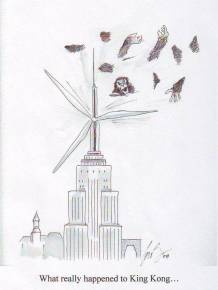 Thanks to Jon Boone.

 Allegheny Treasures