UPDATE: WIND DEVELOPER’S POSTER – Wind Power Director on taxing wind power – “of course it generates power and in that way it’s similar to a coal plant, but it’s fundamentally different from a coal plant. Because it’s intermittent …”

UPDATE:  WIND DEVELOPER’S POSTER – ORIGINAL POST TEXT FOLLOWS POSTER – From our friends in Ohio!

$400 million – much of it from taxpayers – for 130 MW Wind Plant

Cost of Wind Plant Poster

You heard it right:  “Wind Power Director on taxing wind power – “of course it generates power and in that way it’s similar to a coal plant, but it’s fundamentally different from a coal plant. Because it’s intermittent …

Interesting admission, don’t you think?  I heard similar commentary in Jon Boone’s excellent documentary, “Life Under a Windplant,” featured here a few days ago.  If you haven’t seen the documentary, you should take the time to do so.  Well worth a half hour of your time!

That comment in the documentary had to do with the portability of wind turbines which actually provided wind installation owners an additional tax advantage.  You might recall the lady in the documentary suggesting, by the same logic, perhaps her mobile home should be taxed at a much lower rate than other homes since it could be called temporary.  Sure, that’s gonna happen!

These are real life, after installation facts, folks – WAKE-UP!!!

The wind power folks want it both ways!!!  When they’re selling “we’ll be here forever” – when it comes to taxes “we’re a temporary structure.”  When they’re selling “we’re a reliable source of renewable energy” – when it comes to taxes “but we only produce intermittently.”  COME ON!  We’re not buying a second hand washing machine here, folks!  This is serious business.

Straight out of the Credence Clearwater Revival song:

Some folks are born silver spoon in hand,
Lord, don’t they help themselves, oh.
But when the taxman comes to the door,
Lord, the house looks like a rummage sale, yes

You tell me … should the fact that wind turbines are portable and wind installations produce power intermittently give them tax breaks even beyond what they will already receive simply by being a commercial energy source?  They think so.  Unfortunately, our Politicians also roll under the same bus in the dream of “taxes and jobs.”  But as jobs don’t materialize for our citizens and the tax base erodes, what is left?  As one commenter questioned, “How can we elect such gullible lawmakers.  I am utterly embarrassed – and scared –  for America?”

The exchange which contained the quote at the title to this post was sent to us from a friend in Ohio.  What follows is the section of the article he felt important to our circumstance in Mineral County, WV.  The link to the full article follows the text.

Web Posted 10/16/2009 9:32:00 AM

Article :

Buckeye Wind representatives visited with the Champaign County Commission Thursday for an update on the proposal to site 70 turbines in the county and also spoke about revenue and other concerns.

Josh Hahn of the County Commissioners Association of Ohio spoke about tax implications of wind facilities based on current state law and proposed House Bill218, which would lower the tangible personal property tax rate from 24 percent to 12 percent for utilities generated by renewable resources such as wind and solar.

Hahn presented information from the Education Tax Policy Institute, noting that for a 100 megawatt (MW) wind generation facility, the total property value would be about $200 million with an average annual tangible personal property tax of $1.3 million based on a rate of 60 mills. The Buckeye Wind project, under development by New York-based Everpower Renewables, could be between 126 and 175 MW depending on the size of turbines installed.

“We don’t necessarily disagree with Josh,” said Michael Speerschneider, Everpower director of development. “It’s a difference of approach and perception. When we look at the tax structures in Ohio, we don’t really know how Ohio tax codes will treat wind.”

Commissioner Bob Corbett asked how much Champaign County could expect to receive in total tax revenue, based on current laws. Speerschneider said the socio-economic study presented as part of the Buckeye Wind application gives a range of $800,000 to $1.5 million annually.

“There’s direct benefits, what we’ll be paying to the county, the townships and the school districts,” he said.

“So if (HB) 218 would go through it would, in theory, cut it in half,” Corbett said of the revenue prediction.

Speerschneider said that the current law doesn’t allow Everpower to be competitive in the state of Ohio.

“The utility rate would apply to our equipment,” he said. “When you start doing that math, that number is higher than what is experienced in other states.”

He also explained that the electricity would not stay in Champaign County for local use.

“We’re selling our power,” he said. “It could very well be to Ohio power purchasers, (but) it’s more of a regional market. We are in competition with plants in Indiana, Illinois and Michigan. The bigger picture of benefits is to keep that stuff in Ohio with supporting industry and jobs.”

“So you assumed in the beginning when you came in you would not be classified as a utility?” asked Commissioner Steve Hess.

“We did not assume anything,” Speerschneider replied. “We just did not know. The personal property tax for utilities would make them uncompetitive. That’s a big drop, a big reduction in tax revenue maybe because it’s a different type of industry. There are reasons why wind power – of course it generates power and in that way it’s similar to a coal plant, but it’s fundamentally different from a coal plant. Because it’s intermittent, that’s not to say it’s inefficient but it changes some of those dynamics.”

“Would the wind projects be viable if they weren’t receiving tax credits from the federal government?” asked Commissioner Max Coates.

“Straight off probably not,..

Full article here, for your convenience.

Posted in Jon Boone, Mineral County WV, Wind Power subsidies | Tagged , , , , | Leave a comment

Agencies sworn to protect must not permit the kill.

This very important letter by Ajax Eastman, which we are honored to present, has been submitted to the Baltimore Sun in response to their report on a Federal Court suit regarding a proposed industrial wind facility in Greenbrier County, West Virginia.

Ms. Eastman is an environmental activist and consultant of long – standing.  She has been instrumental with passage of Wildland designation of forests in Western Maryland.  She holds leadership positions on the Maryland Conservation Council, Inc., the Maryland Environmental Trust, and the Maryland Wildland Committee.  She travels extensively throughout the world.

Ms. Eastman is highly regarded in Maryland and the surrounding region as an honest spokesperson for the environmental community.

Sirs:

This morning’s article “Clean energy vs. nature” pits the tiny Indian bat against 122 wind turbines, 389 feet tall on an Appalachian ridge in West Virginia.  Bats are not the only species endangered by the rush to build so-called clean or green energy.

With thousands of industrial wind turbines envisioned all along the mountain ridges of the Eastern United States, mostly along the corridors of migrating bats, song birds, and raptors, the death knell would be more like a massacre.  Additionally, there would be enormous loss of terrestrial wildlife and habitats.  Unfragmented forests along the ridges that are vital to interior species would have giant holes punched into them for not only the turbines, but for roads and power line towers.

At another proposed facility in West Virginia, the Pinnacle Wind Farm in Mineral County, the U.S. Fish and Wildlife Service has discredited the wildlife studies submitted by the applicant.  It specifically finds fault with the applicant’s risk assessment for golden eagles pointing out that there is a high risk of mortality to eagles.

The Migratory Bird Treaty Act prohibits the taking, killing, injuring, or capture of listed migratory birds.  Bald and Golden Eagles are further protected under a separate U.S. Protection Act.  You would think that between these two Acts that the Eagles would be protected.  However, the USF&W just published new regulations that allow for applications for the kind of “take” (meaning killing) anticipated at wind power facilities.

The service will work with the applicant to avoid and minimize the killing, but most of their recommendations are for studies after the turbines are built and in operation.

How can an agency given authority to protect endangered species turn around and allow the killing of bats and eagles to happen?

Sincerely,

Ajax Eastman

Posted in Bat/Bird Kills, Eagles, US Fish &Wildlife | Tagged , , , , | Leave a comment

West Virginia’s Pinnacle Knob Wind Project – So many questions, so little time!

Allegheny Treasures is starting to receive, what appears to be open questions from readers regarding the Pinnacle Knob project, proposed for Mineral County, WV.  At least they’re still open to the submitters!  Maybe these have been answered, maybe not.

So, how about this thought.  I’ll just put up the raw questions as they come in, without edit, and let anyone who wishes, toss in an answer or a comment, or, heck, add another question.

You can use any alias you wish on the comments, if you don’t want your name “out there.”  Just make sure comments are on point and respectful of others.  I don’t know how we’ll sort our way through, but we’ll learn as we go.

Most of all, help us find out all we can, before the questions no longer matter.

Let the games begin:

  1. The eastern small-footed bat (Myotis leibii) is extremely rare and critically imperiled in West Virgina and endangered in nearby Maryland.  As this bat is found inhabiting rock outcrops on Appalachian ridgelines and is known from the Allegheny Front, how can this project be built without imperiling this bat and its roosting and foraging habitat?
  2. The same applies to the Allegheny woodrat (Neotoma magister), which is either very rare and local throughout its range or found locally in a restricted range.
  3. Rock outcrops are also habitat to the Timber Rattlesnake (Crotalus horridus).  This reptile is rare in many parts of its range.
  4. Appalachian ridgelines, due to their elevation, provide habitat to a suite of animals and plants not found at lower elevations.  These high elevation habitats are limited in extent compared to lower elevation sites.  Why should we detrimentally alter these “sky islands” for a low amount of electricity and small number of permanent jobs?
  5. The Allegheny Front and many other ridgelines form at certain times an important migratory pathway for numerous birds and bats during spring and fall migrations.  Studies have shown that Golden Eagles (Aquila chrysaetos) in particular are more than likely susceptible to being killed by rotating turbine blades during spring migration along the Allegheny Front.  They migrate along the front when winds are from the SE at an altitude within the blade sweep of proposed wind turbines. Within the United States, the Golden Eagle is legally protected by the Bald and Golden Eagle Protection Act.  How can the project be built without increasing the mortality on the Golden Eagle and other birds migrating along the Front?
  6. Since the first wind-power plant was built on Appalachian ridgelines, bat mortality has been a major conservation issue.  Literally, thousands of bats, primarily tree bats, are killed over a few short weeks each year during migration at Appalachian wind-power plants.  These bats are killed by being hit by rotating blades as well as by internal hemorrhaging consistent with trauma from the sudden drop in air pressure (a condition known as barotrauma) at turbine blades.  Cumulative impacts from a multitude of wind projects in the Appalachians could well contribute to the deaths of tens or hundreds of thousands of bats annually.  Curtailing the operation of turbines so that the blades do not turn during migration can prevent this mortality.  Will the developer curtail wind turbines during bat migration in spring and fall to minimize this mortality?
  7. Other environmental issues include loss of existing habitat, habitat fragmentation, increases in detrimental edge effects, increases in invasive species pathways, increased runoff into streams, indirect effects of blade movement, noise, light flicker on use of the area by wildlife.  How can the developer justify these environmental insults for such little gain in societal benefits?
  8. Separate from any “grid” requirements, is there evidence that an immediate need exists for WV, and by default this community?
  9. Does a need exist within the foreseeable future?
  10. Is there evidence the grid, for which the Pinnacle electricity is destined, has an immediate need.
  11. Does the need exist within the foreseeable future?
  12. If yes, what is the estimated percentage of electricity the Pinnacle project is expected to generate to the grid that cannot be made available by other existing sources?
  13. Assuming this to be true, wouldn’t it seem that US WindForce would prefer installation at Pinnacle occur nearer to the time of need, so that the Community served, would receive the maximum benefit of the latest technological advances in safety and efficiency?
  14. Moving energy production closer to the source and perhaps eliminate miles and miles of power lines and energy lost in the transmission over long distances seems to make sense.  What benefits are provided by installing turbines in remote areas away from consumption, such as the proposed Pinnacle installation?
  15. Is there evidence that the Pinnacle project will, within the next 10 years, replace any existing fossil fuel power plants currently supplying the grid to be supplied?
  16. Is the Mitsubishi Turbine specified for the Pinnacle Project proposal available to meet schedule, should construction take place during 2010?
  17. Will the recent action by General Electric, requesting that imports of the specified Mitsubishi Turbine due to “patent” infringement issues, impact schedule?
  18. Is the Mitsubishi Turbine Model specified firm in the design, or is consideration given to other modes/suppliers?
  19. If alternate sources are utilized, will that impact output requiring additional towers?
  20. Other than, perhaps increased tax revenue to the Community, what specific negative impact to the grid would occur should the Pinnacle project be delayed for 2, 5 or even 10 years?
  21. Is it possible that in 2, 5 or even 10 years design improvements to wind generators will become available that could provide:
  22. More efficient turbines operating at greater than current industry standards?
  23. Improved turbine and control designs to better accommodation to Environment concerns such as bat and bird kills?
  24. Improved turbine blade designs to further reduce noise, flicker and other issues common in communities with existing units?
  25. Is it possible that in 2, 5 or even 10 years improved sources of electricity could become available through new technologies and improvements to existing power sources?
  26. It has been suggested recently that forecasts for additional energy sources will actually occur for this region in the window of 10-15 years in the future.
  27. It was suggested that the local area would not be the beneficiaries of the energy generated by Pinnacle and that, in fact a majority of the energy would be consumed by major cities, many of which are located near coastlines.
  28. If so, is it not in the interest of the industry and citizens to push for offshore installations, as many in Europe now suggest is the better choice?
    1. Some members of the Community believe that, lacking heavy taxpayer subsidies and ultimately higher utility rates, wind energy cannot stand, and, in effect the taxpayers, when receiving rebates are simply getting back some of their own money.   Would USWF care to offer concrete evidence to the contrary, including sources?
      1. Is the contribution projected based on property taxes to be paid by the land owners holding the property leases, or does it include business taxes paid by the Pinnacle owners?
      2. Will contributions to the Community chest come as a result of increased electricity rates as a result of the addition of Pinnacle to the grid?
      3. What historical evidence suggests the increased revenue estimates are reliable?
      4. Has USWF been able to confirm actual versus projections from any of the active sites in the immediate area?
        1. It has been implied by local elected officials supporting formally endorsing the installation that New Page, a vital partner in our Community, will benefit from the installation.  Implied also in their statement is, and as a result of the Pinnacle installation, will be able to sustain or even add jobs and product market share.  We have not seen this confirmed by New Page, or conversely that, lacking the existence of the Pinnacle Wind Farm, they will need to reduce personnel or lose market share.
          1. Has New Page stated either position to USWF?
          2. Does USWF accept this premise?
        2. Some have suggested that, lacking subsidies, the installations will not continue to operate.  They express concern that installations will be abandoned and that the local community will be left to “clean up the mess.”  What specific financial guarantee is provided by US Wind Force, or required in ownership transfer to any future owner who acquires the facility, to dismantle and remove from the site, inoperable units?  (Inoperable by failure or choice)

        As always, please notify the writer of broken links, errors or commissions so we can take immediate corrective action.

        Posted in Open Questions, US WindForce | Tagged , , | Leave a comment

        The Allegheny Highlands – Where eagles dare!

        Tracking eagles:  “The National Aviary, in collaboration with the Powdermill Avian Research Center and the Ministère des Ressources naturelles et de la Faune in Quebec and with State Wildlife Grant funding from the Pennsylvania Game Commission, has embarked on a program to study the migration patterns of golden eagles in the Appalachian region of eastern North America, and the risk that these migrating birds may encounter from development of wind power sites in the Appalachian region.

        Here are a few interesting GIFs from the National Aviary Conservation and Field Research Site.  Be sure to visit for even more!

        The captions are mine, not theirs.  You can click on the map for the direct link to each map.

        Darn, Ralph! Pretty heavy traffic here in Eastern Panhandle!

        And this …

        Heading north to see the relatives!

        Finally.

        Going to the WV Football Game?

        Going to the WV Football Game?

        Visit the National Aviary in Pittsburgh, PA and drop by their web page – linked here for your convenience –  for lots more good stuff, and above all .. support their fine work with a donation at this link.

        At the same time, make sure, whatever you do, protect these magnificent creatures!

        Posted in Allegheny Highlands Eagles, Bat/Bird Kills, Eagles | Tagged , , | 1 Comment

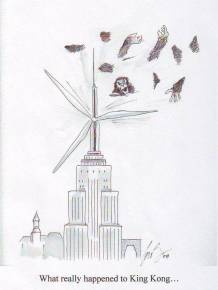
        “Hey, Pop! Are those big fans on the mountain dangerous to animals?” “Nah! No history of that, Son!”

        king kong windThanks to Jon Boone.

        Posted in Bat/Bird Kills, Eagles, Hey Pop!, Jon Boone | Tagged | Leave a comment

        Environmental groups say turbines will kill bats. Wind power developer says yes, but not “that” bat.

        Here we go …  (article supplied text in bold)

        A proposed West Virginia wind power project will harm a tiny, endangered bat and its developers should be [sic] should be required to obtain permits under the Endangered Species Act, attorneys for two environmental groups argued Wednesday in federal court.

        Can’t kill endangered species, that’s illegal!

        The developers admit bats will be killed by the turbines, but refuse to acknowledge the endangered Indiana bat will be among them, plaintiffs attorney Eric Glitzenstein argued in his opening statements.

        Refuse to acknowledge?  Is that anything like – they know for sure?

        Is there some reason to think Indiana bats will escape the fate” of the other bats expected to be killed, Glitzenstein asked District Judge Roger Titus, who is hearing the bench trial.

        Good question, your Honor!

        Defense attorney Clifford Zatz said the $300 million, environmentally responsible, renewable energy project is in “limbo” because of an untested hypothesis “over a rare bat that no one has ever seen at the site.”

        “Never seen?”  You mean like there’s proof the rare and endangered little critters never have, aren’t now and never will be – no reason for them to ever show up here – not even remotely possible they’re here kind of “never seen”, Attorney Zatz?

        Penn State University bat researcher Michael Gannon said surveys using nets at the site have not captured an Indiana bat, but recordings indicate the endangered bat is at the site.

        He sounds like he knows what he’s talking about, but is that all you’ve got Mr. Gannon?

        Gannon told the judge that of the 160 recordings that he reviewed, he was able to make an identification of 42, including three he thought were the endangered Indiana bat, although he could not say whether the recordings were of three separate bats or the same bat on three occasions.

        Under questioning by Glitzenstein, Gannon said he thought bats were at the site based on the location, habitat and recordings and he felt it was likely they would be harmed by the project.

        OK Counselor what have you got to say about that?

        Under cross-examination by (Attorney for the developer) Zatz, who questioned the accuracy of audio recordings, Gannon acknowledged Indiana bats had not been captured during netting survey, but added that the netting efforts were not intense enough.

        Gee, could it possibly be that none landed in the net during the tests because they’re rare?

        Zatz said the burden of proof rested with the plaintiffs and a better solution was what he called “adaptive management” of the project if it is found to affect the Indiana bat.

        Adaptive management?  You mean like you would put up the wind turbines, chop up some bats and, just in case they aren’t carted off by night foragers, tossed off-site by the impact or lost in the tall grass you would check out the ones you find to make sure none in the mess are Indiana bats, and if you find one, you’ll report it.  Then, if there is no other way to, “without a doubt,” solve the kill issue, you will tear down the turbines, yank down the transmission lines, haul all the scrap away, pay everyone back, plant some grass seed and leave?

        Darn, I think I’d be getting a permit.  I mean, if there are no Indiana bats there and you can prove it, how hard can it be?

        Full article here for your convenience.

        Posted in Bat/Bird Kills, Beech Ridge, Mountain Communities for Responsible Energy | Tagged , , , , | 1 Comment

        And another thing, Pop … what exactly do they grow over at the wind farm?

        A knowledgeable commenter took exception to my use of the term “wind farm” suggesting that “A wind plant farms nothing, except perhaps income sheltering tax avoidance schemes.”  “Farm” is a funny term for a  line of metal poles with a sometimes spinning propeller.  So, henceforth and hereafter, if you see the term “wind farm” here it will be to quote someone else.  (or I screwed up)

        I was not alone, however.  The Windtoons kids seem as confused as I once was (until today, that is!):

        Posted in Hey Pop!, Wind Installation, Windtoons | Tagged , , | 1 Comment

        Hey, Pop! Was that a UFO that just landed on the roof?

        Thanks to Windtoons.com for the great lead to this sobering tale:

        From National Wind Watch – “Wind turbine concerns lead to road closure, home evacuations

        McBAIN – A road in Missaukee County was closed for several hours Sunday afternoon and three homes were evacuated as a safety precaution after construction workers became concerned about the stability of a newly-installed 400-foot wind turbine.

        Rick Wilson, project manager for Heritage Renewable Energy, said the concerns regarded the fourth wind turbine the company has installed as part of the Stoney Corners Wind Farm. Installation had just been finished on Friday.

        Wilson said some movement at the top of the tower had come to the attention of crane operators.

        “There was nothing out of the norm as to what happened. It was moving in a normal fashion,” Wilson said.

        “The construction workers were being a little overly cautious, but that’s OK. Everything is secure, and there’s not reason whatsoever for concern,” he added.

        The turbine was located on leased land belonging to a local farmer.

        Three more wind turbines are still scheduled to be installed this fall.

        According to Missaukee County Sheriff Jim Bosscher, part of Seeley Road was closed from about 10 a.m. Sunday to around 5:30 p.m.

        The three houses that were evacuated were not so close to the wind turbine that the turbine would have fallen on them, but they were still evacuated out of an abundance of caution in terms of possible flying debris, Bosscher said.

        So, exactly how far away is a good far away?

        Posted in Hey Pop!, Wind Tower Safety, Windtoons | Tagged , , | Leave a comment

        “Life Under a Windplant” – a documentary. Will you hear the wake-up call Mineral County?

        “Life Under a Windplant”, Jon Boone’s documentary about the Meyersdale, PA wind facility, which he produced and directed with David Beaudoin, is provided here for your viewing, thanks to the courtesy of Mr. Boone.

        The documentary features how the wind plant affects the lives of the people in the community and shows the sights and sounds that emanate from 375-foot tall wind turbines sited atop surrounding ridgetops.  Mr. Boone’s very informative web site is linked here for your convenience –  Stop Ill Wind

        This documentary is recommended for viewing by every resident of Mineral County, West Virginia, as well as citizens of any community considering the installation of industrial wind turbines.

        Part 1

        Part 2

        Part 3

        Posted in Jon Boone, Mineral County WV, Wind energy | Tagged , , | 2 Comments

        “What goes up, must come down” … “nothing lasts forever” … “all things must pass”

        Maybe it’s just me, but when one of the major considerations of a multi-million dollar project is the plan to tear it down and sell it for scrap, I get a little queasy.  It strikes me as similar to putting the disposal instructions on the wrapper of a pack of AA batteries.

        Believe me, I understand the need for planning ahead.  Some of the projects I’ve worked on in my past were 5 to 15 years from concept to completion.  While decommissioning was certainly a factor, it seemed more an internal, contractual issue to be resolved by some predetermined industry standard.

        If the general public had a fight about the nuclear or hydro or coal-fired plant planned for next door, the major topic of conversation was not centered on who was going to pay to take it away.  The fight typically focused on whether it should be built next to “me,” or could you put it in some other “neighbor’s” yard.

        So why all the bluster about wind turbines?  Why are the folks seeing them placed in their midst so nervous about who’s going to pay to take them down and the owners seem so reluctant to a straight-forward agreement to put the cash up front.  Could be that they both realize, with the relatively short life span, they’ll probably both be around to see it happen?

        But then, maybe it’s an image problem.  Power plants are massive and speak to a certain permanence – a real commitment.  Wind farms seem so … well… portable – temporary.  And yes, I know they cost a lot of money.  But its kinda like camping.  Some folks like to pitch a tent and some folks buy land and build a cabin at the river.  Yes, it might be a really expensive tent and both groups will catch fish and have a great time, but you’re more likely to bump into the cabin owners when you come back next year.

        Unfair?  Perhaps!  But then there is that little commitment issue still remaining.  Take a look at the Pinnacle Knob wind farm proposed by US WindForce.  The facility is awaiting an evidentiary hearing by the WV PSC as the next step toward construction on a ridge near Keyser, Mineral County, WV.  After all the back and forth, some in the community are still very concerned by the unclear position US WindForce is taking to insure funds will be available for removal of the turbines at the end of their life, some 20 years from now.  The bounce around between the company, citizen’s groups and the state and local agencies responsible to protect the public is causing nothing but confusion and adding to the mistrust surrounding the project.

        Take for example, the comments made recently by Ms. Judy O’Hara, representing the citizen’s group, Allegheny Front Alliance, at a Mineral County Commission meeting concerning the proposed Pinnacle Knob wind farm.  The Mineral Daily News-Tribune noted that Ms. O’Hara centered most of her comments around the issue of decommissioning or removal of the turbines once they have reached the end of their useful life.

        Questioning whether U.S. Wind Force would make good on their promise to set aside enough money to allow for the removal of the old turbines, she expressed her displeasure that, while Wind Force representatives had said “decommissioning is typically addressed as part of the leasing process,” the leases are considered private documents and are not released to the public.

        The article stated that David Friend and Jim Cookman, representing U.S. Wind Force, were present at the commission meeting for the Allegheny Front Alliance presentation, but made no comment.

        So, why didn’t Mr. Friend or Mr. Cookman hop up out of their seats and set the record straight.  They said nothing.  Why is it like pulling teeth to have wind farm developers simply say, “Yep, as part of our good neighbor policy and to show you good folks how much we appreciate you allowing us to use your community to make a ton of money, we’re going to set aside the full amount of money required to get rid of these things when they no longer workIt’s the least we can do!

        How hard is that?  ZAP!, to use an electrical term, and one of the major bones of contention evaporates and the parties can get down to the serious business of determining if the project serves any real value to the community in which it’s placed and the consumers it will serve.

        Some might think this issue is settled, or perhaps it’s not a big deal and in the end it will just all work out.  But, until the ink is dry on a commitment that will demonstrate to our children 20 years from now that we did all we could to protect them, this issue is not settled.

        In my opinion, Mineral County Commissioners voting to endorse this project without these assurances being iced are not acting responsibly.  The specific Commissioner who voted to endorse by offering this reasoning “I’ve read all there is to read about this. We’ve studied and studied and studied it.  “No matter what we do, we’re not going to make everybody happy. I don’t know what the answer is, but I do know that we need jobs and we need the taxes” might want to reconsider that incredible statement.

        I don’t know, but it seems to me that until wind farm constructors and operators step up to the level of commitment necessary to insure no financial harm will come to this community, the public is right to see them as them as the AA batteries of the industry, and not the first class providers of a committed energy source consumers should rely upon.

        These turbines are going to come down!  Someone will pay!  If you’re around when they do you’ll probably hear your offspring say one of two things: “hey, thanks!” or “what a dope!”  You choose!

        And if, as David Friend, vice president of sales and marketing for WindForce, says, “We’re trying to show the commissioners and the public that we’re trying to be good neighbors,” now would be the time to step up and prove it.  Their silence on this topic is deafening.

        Please notify the writer of broken links, errors or omissions in the comment section.  Your comments are welcome.

        Posted in Allegheny Front Alliance, Archives, Decommission, Pinnacle Wind Farm, US WindForce | Tagged , , , | 2 Comments